
 Risk Capacity
 Wealth Management
 Outsourced CIO
 Retirement Plans
 Institutional
 Financial
  Open an Account
 IFA App

 Articles
 Charts
 Investor Education ▾
 Fund
Fund
 Store
Store

 Taxes
Taxes Back-testing Disclosures
 Glossary
 Form CRS
Will last month's good news about a company boost your returns? Most investors say yes. Most academics surveyed say it's already priced in. A major new study explains why, and gives you a simple test to use if you're tempted to buy.
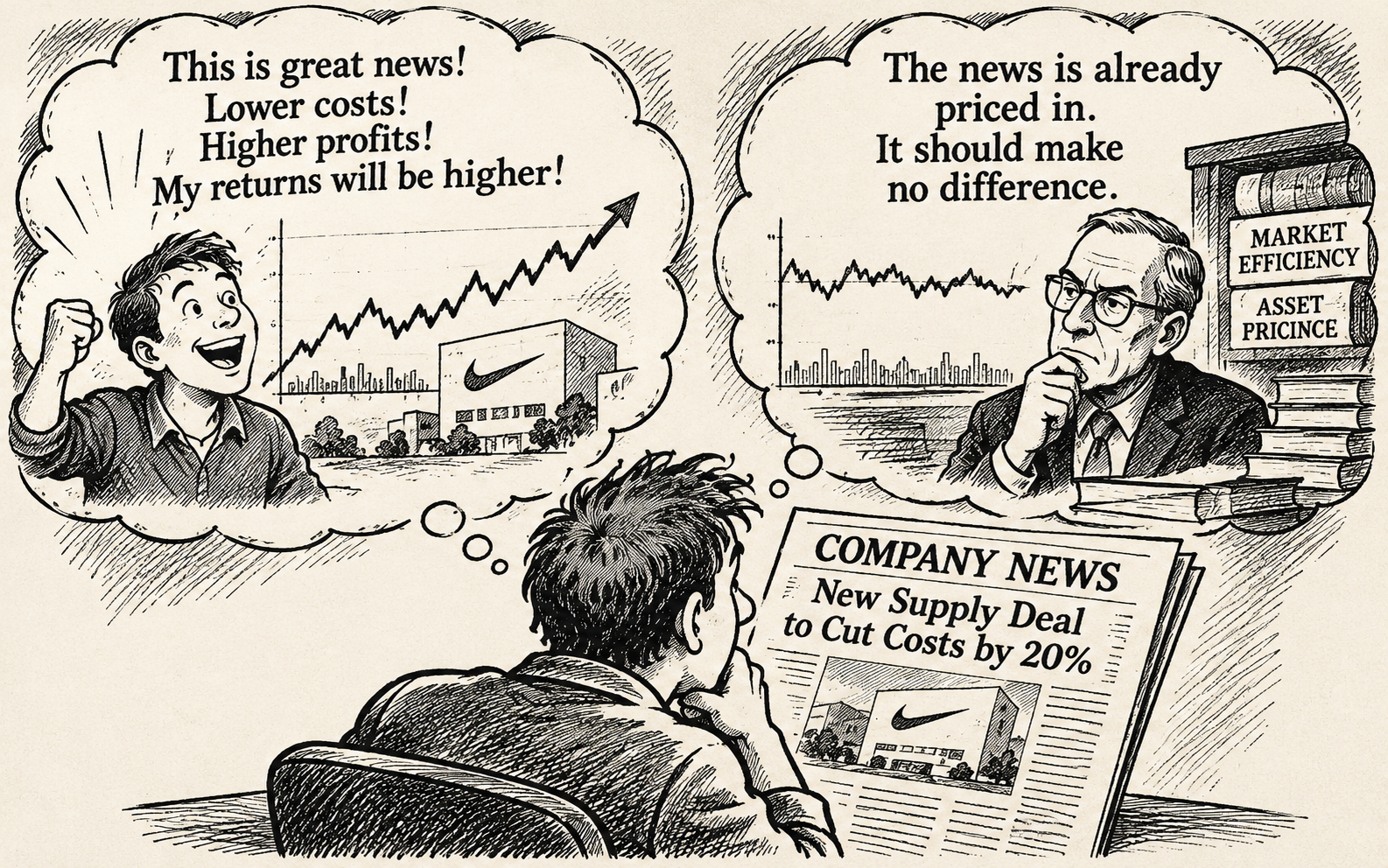
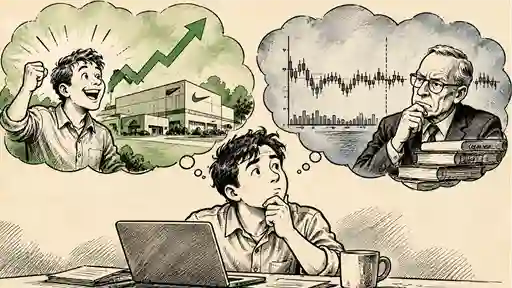
Imagine this. Four weeks ago, a large sportswear company announced a new supply deal, one expected to cut its raw material costs by a fifth. The news was widely covered.
Today you're deciding whether to put $1,000 into the stock. Over the next 12 months, will your return be higher than if the company had simply renewed its existing contract?
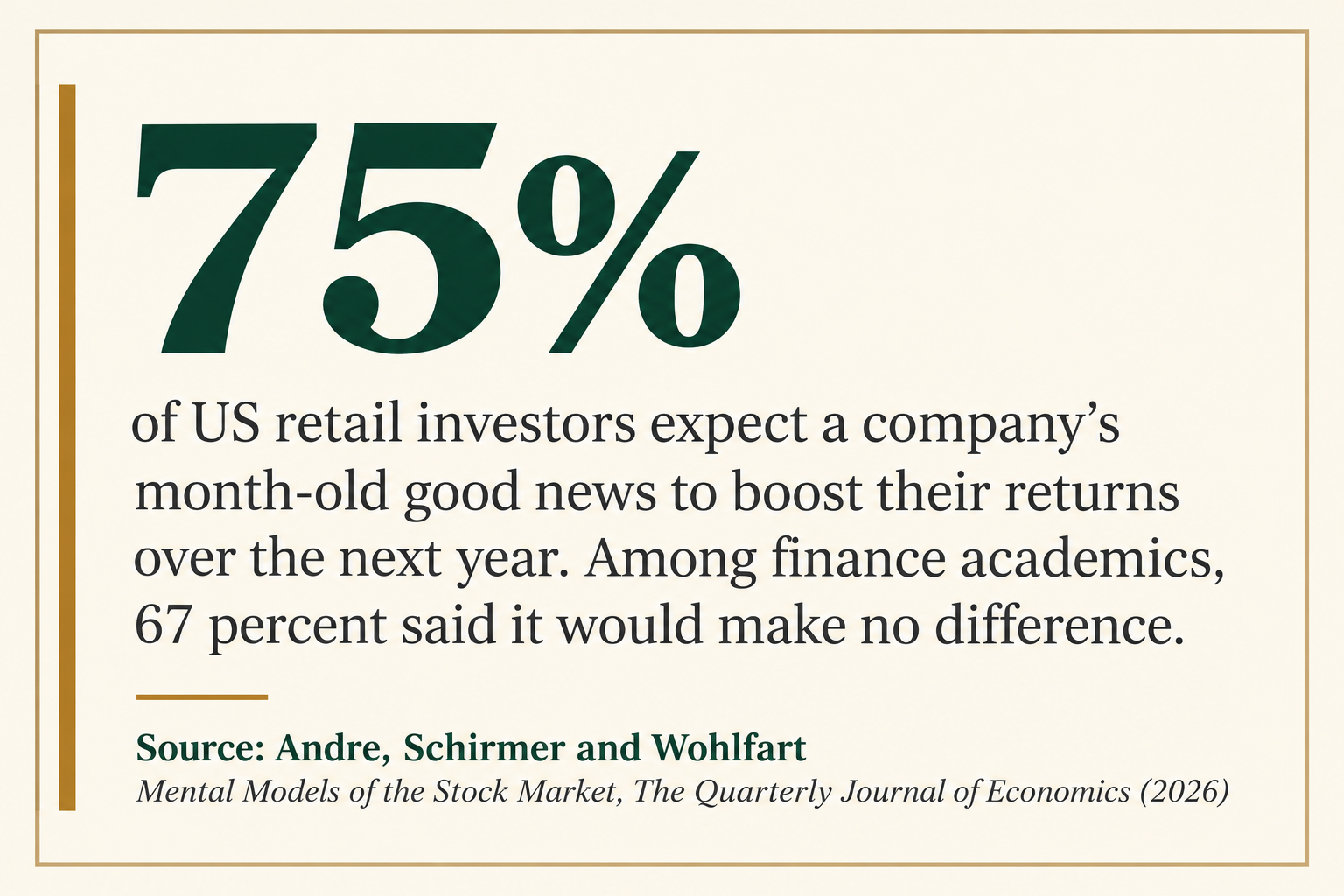
In a new study, 75 percent of U.S. retail investors asked that question said yes. Of the academic finance experts given the same scenario, 67 percent said it would make no difference, on the reasoning that a deal announced a month ago is already priced in.
If you've read IFA for any length of time, you probably sided with the academics. Don't relax just yet. The same research found that knowing the theory protects people far less than you'd expect, and the reason why is more useful than the headline result.
Why This Survey Could Do What Others Couldn't
The study is big enough, and built carefully enough, to offer insight into not just what investors expect but why. Writing in the Quarterly Journal of Economics, Peter Andre, Philipp Schirmer, and Johannes Wohlfart surveyed 29,180 households and investors, from the general public to published finance academics. The company in their scenario was Nike. Everyone gave a forecast, then explained it in their own words, with nothing prompted.
The authors don't say which reasoning is correct. They do point, in a footnote, to separate research finding that earnings news of this kind doesn't predict returns over these horizons, and that the prices of large, liquid stocks no longer keep drifting for weeks after an earnings surprise.
Asked About the Stock, Answering About the Company
The two groups may not have been disagreeing about the answer. They appear to have been answering different questions.
Most people treated "when can the stock investment be expected to succeed?" as the same question as "when can the company be expected to succeed?" The experts were pricing a share. Many others appeared to be appraising a business.
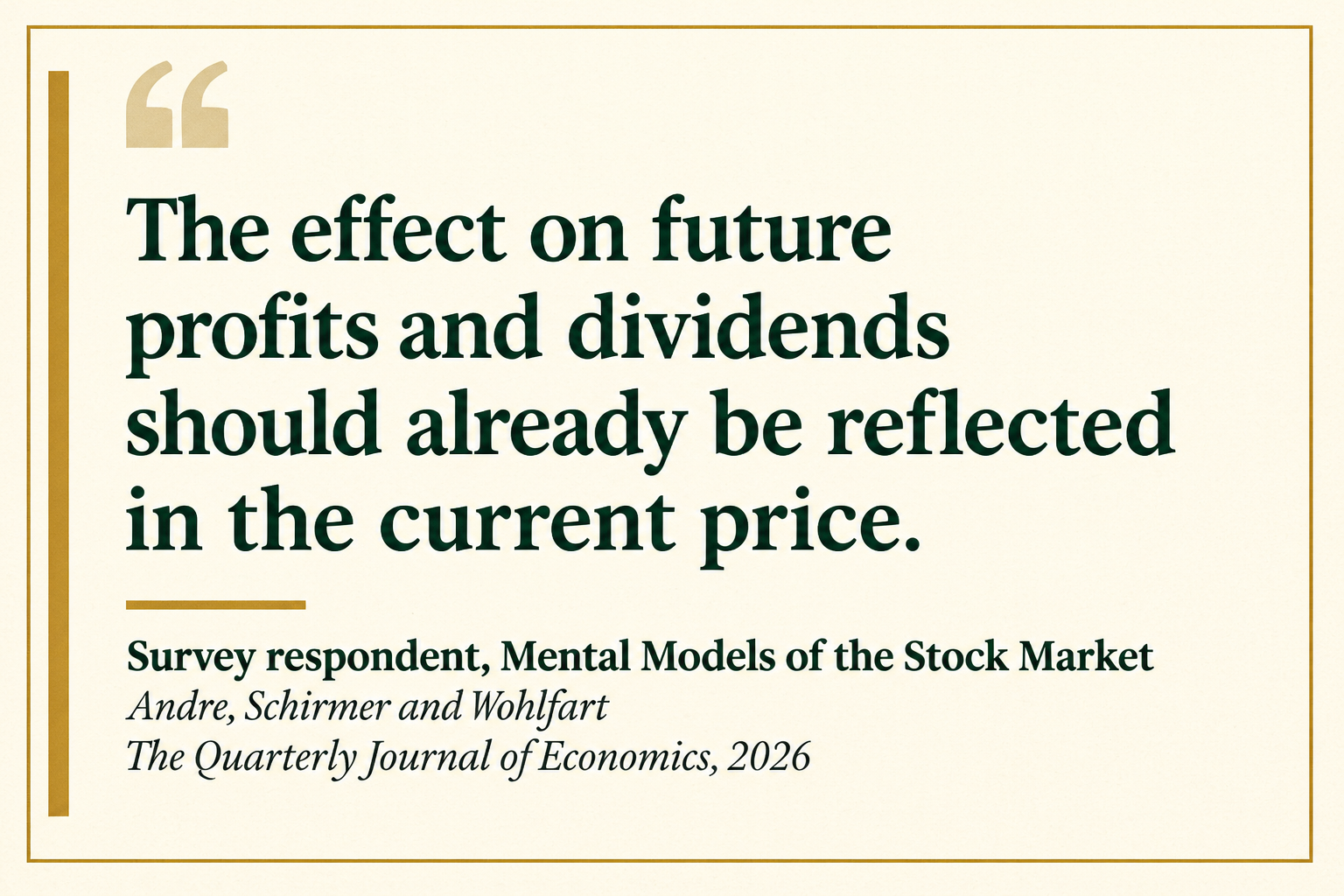
You can hear it in the explanations. One academic wrote: "The effect on future profits and dividends should already be reflected in the current price." One retail investor wrote: "Because Nike will continue a positive relationship with its partner and therefore the company can continue to grow profits, increasing the value of the stock." Both are coherent. Only one of these two quoted responses mentions the price.
The authors call the second pattern expected earnings reasoning: better profits ahead mean better returns ahead, with no allowance for the price having already moved. Only 9 percent of the academics reasoned that way. Among U.S. retail investors it was 69 percent, and among U.S. financial professionals 64 percent.
Even professional money managers were split. Of the fund managers surveyed, 35 percent reasoned from expected earnings, against 33 percent who argued from market efficiency.
Trying Harder Does Not Help
In this study, greater financial literacy did not appear to protect respondents from this reasoning pattern. Respondents who scored better on the standard "Big 3" financial literacy questions were, if anything, more likely to expect the old news to lift their returns.
Effort didn't help either. Making people spend at least two minutes on the question made no significant difference. Neither did offering a cash bonus for matching the academics' majority answer. Neither did the instruction that should have settled it: assume the current price already fully and correctly reflects the company's prospects.
Nor does the belief fade with time. Asked about returns four years ahead, between 29 and 40 percent of non-experts still expected the month-old news to be working in their favor. People expect a supply deal signed last month to still be lifting their returns a full presidential term later.
The Price Is Right There, and Nobody Sees It
Many respondents did not appear to treat the share price as a cost they pay. The authors identify this as a point where the reasoning may break down.
People aren't blind to the price. Asked directly, 88 percent of U.S. households said other traders would have been keener to buy at the old price, and almost all said the price had risen since the news. Knowing that made no difference to their forecasts.
So the authors spelled it out. A group of U.K. households (the later experiments used a British sample, and the control group's answers matched the U.S. results) was told the share price had risen 14 percent since the announcement. Even then, 70 percent still expected the higher return. Many of them now talked about the price, but they read it the wrong way round. The idea that a higher price signals a better stock gained far more ground than the idea that it's a higher cost. Told the shares cost more, most respondents concluded the shares were better.
Then the authors added one more line: what $1,000 would buy. It was 16 shares if the company had renewed its contract, and 14 after the good news. Forecasts that followed the news fell to 49 percent, the lowest share recorded among households in the study.
The authors locate the problem precisely: "For many households, the bottleneck does not seem to lie in noticing price changes but in attending to them as investor costs."
What This Habit Costs You
If this were only a quirk of survey answers, it wouldn't matter much. The paper's last section suggests this reasoning may influence people at the point of trade.
In an incentivized exercise, us households put more money into a stock after reading company news that was several months old. Retail investors explaining their own planned trades kept coming back to expected earnings, often naming a handful of dominant technology companies. And in German household survey data, those who reasoned this way were significantly more inclined to expect higher returns after a run of high ones.
Then there's the time. Households said that investing well means spending "a lot of time" following business news. The authors draw the connection to how people choose to invest: "if successful investment hinges on tracking earnings news, this could make people reluctant to invest in passive funds, while expertise in analyzing and interpreting earnings information is perceived to pay off."
A belief about how stocks work may be contributing to demand for an industry built around seeking to beat the market.
What Mark Hebner Has Been Saying for 20 Years
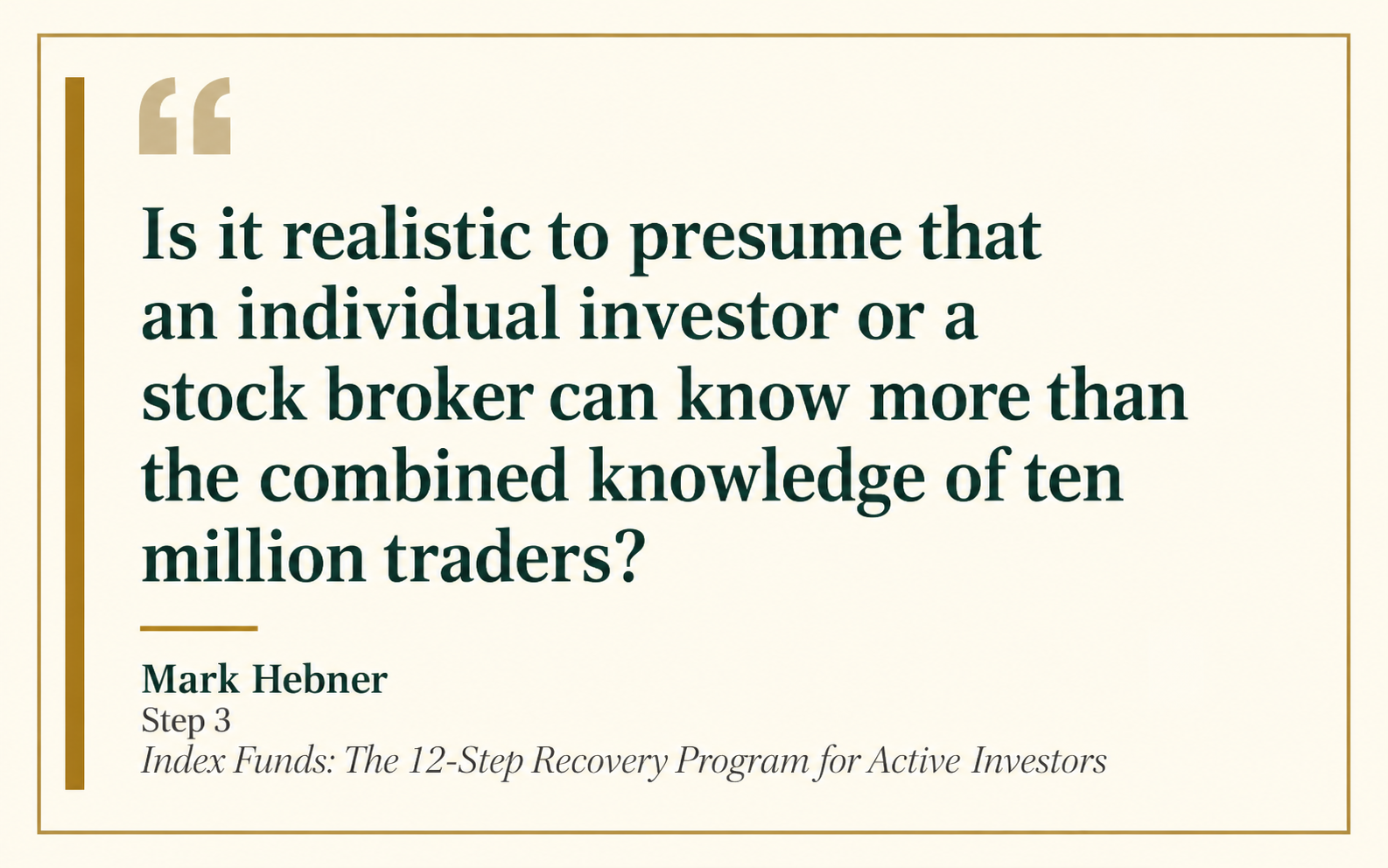
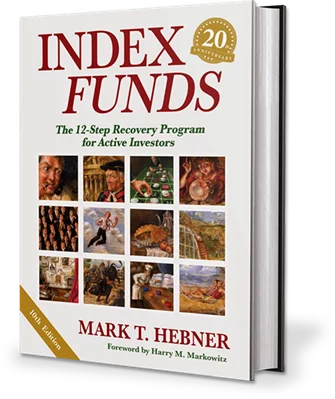
None of this would surprise anyone who has read Mark Hebner's Index Funds: The 12-Step Recovery Program for Active Investors. In Step 3 he argues that information about a company is digested by the market and embedded in its price, so what's publicly known may already be reflected in the price or, in his phrase, 'baked in the cake.' He also makes a point about language that goes straight to this research. The only prices any of us know are current and past ones, so we should say a market has gone up, never that it is going up.

That argument has been available to IFA's readers for two decades. What it never explained is why it keeps bouncing off people. The new research supplies the missing half. Investors may not consciously reject the argument. Many appear not to focus on the other side of the trade, the buyers who bid the price up, from where they're standing. And nobody can be expected to weigh a cost they were never shown.
Count the Shares
Go back to the $1,000 and the supply deal. The question you answered was whether the company would do better. The question in front of you was what a share of it costs today.
The research suggests effort won't close that gap. In these experiments, knowledge, time, money, and explicit instruction all failed to eliminate the effect. What worked was a change in what people were shown, and you can make that change yourself. Before you act on good news about a company, ask how many shares your money buys today compared with before the news. If the answer is fewer, the price may already reflect some or all of that news.
And if asking that every time sounds exhausting, there's a simpler approach, the one at the heart of IFA's philosophy: broad market exposure through diversified, low-cost index funds can reduce the need to evaluate individual-company news.
Source
Andre, P., Schirmer, P., & Wohlfart, J. (2026). Mental models of the stock market. The Quarterly Journal of Economics, 141(4), 2925–2978.
DISCLOSURES:
This article is for informational purposes only and does not constitute investment advice, an offer, or a solicitation to buy or sell any security. This material includes general educational information and should not be interpreted as individualized investment advice or a recommendation to take any specific action. Past performance is not indicative of future results. All examples and data cited are based on historical analysis and may not reflect future market conditions. Investing involves risks, including the possiblity of loss and principal. The mathematical principles and academic research discussed illustrate theoretical and historical concepts and should not be interpreted as guarantees of investment outcomes. Diversivication does not ensure profit or protect against loss.
Any discussion of regulatory actions is based on publicly available information and should not be interpreted as representative of industry-wide practices. There is no guarantee that reducing turnover or fees will result in improved investment outcomes.
The information discussed is general in nature and may not be suitable for all investors. Examples and studies cited reflect specific time periods and may not be representative of all market conditions or investor experiences. Individual circumstances vary, and readers should consult a qualified professional regarding their personal situation. Index Fund Advisors, Inc. (IFA) believes the information to be accurate but does not guarantee its completeness or accuracy. This article was sourced and prepared with the assistance of artificial intelligence (AI) technology.For more information about Index Fund Advisors, Inc, please review our brochure at https://www.adviserinfo.sec.gov/ or visit www.ifa.com.
Past performance doesn't guarantee future results. IFA's methods are research-based, but outcomes aren't guaranteed. This article is for educational purposes only and isn't personalized investment advice. Market-implied probabilities and expected returns are estimates derived from models and assumptions, may change, and are not forecasts or guarantees of actual market outcomes.

















 Home
Home 888-643-3133
 Contact Us
 Newsletter Subscribe
 eMoney
 IFA Apps
 Index Funds Book on Kindle
 Index Funds Audiobook
 Careers
 Facebook
 X
X LinkedIn
 Instagram
 Youtube
 Terms
Terms Index Descriptions