One of the world's most popular podcasts just broadcast the case for evidence-based investing to an audience of millions. The host of Diary of a CEO sat down with portfolio manager and educator Ben Felix — and what Felix told him is exactly what IFA and Mark Hebner have been saying for more than 25 years.
Steven Bartlett doesn't usually book guests to talk about index funds. The host of Diary of a CEO has built one of the world's biggest podcasts — north of 13 million YouTube subscribers and more than a billion total views — by interviewing celebrities, founders, and the occasional self-help author.
Then Bartlett sat down with Ben Felix — Chief Investment Officer at PWL Capital and CFA charterholder — and produced two hours of plain-English evidence-based investing for an audience that typically lands between one and five million views per episode.
His message? Buy low-cost index funds. Don't try to beat the market. Diversify globally. Control your behavior. And be skeptical of the products the financial industry wants to sell you. As Felix put it on the show: "Investing the way that I would say is sensible for most people, which is just using low-cost index funds capturing market returns — the market returns have been there and they're going to continue to be there."
For most viewers, this may have been the first time they'd heard those ideas stated cleanly by a credentialed professional. For IFA clients, none of it was news
Felix may be new to Bartlett's audience, but he's been required listening for financial nerds like Mark Hebner and me for years. His Rational Reminder podcast is essential stuff if you're the kind of person who reads factor-premium research for fun. I appeared on Rational Reminder show #27 and Mark appeared on show #116. Seeing Ben Felix on Diary of a CEO felt a bit like watching your favorite indie band sell out Wembley.
Felix even let slip the strategy that millions of viewers probably weren't expecting from a portfolio manager: one of the best things you can do for your investments is forget your password. We'll come back to that.
His appearance is a signal. The case for evidence-based investing — the one Mark Hebner founded IFA to make a quarter-century ago — has gone mainstream. What follows is a closer look at the points Felix made, the research behind each one, and how they line up with what IFA clients have understood for years.
The Market Already Knows What You Know
Bartlett, to his credit, set the audience up with a story about his older brother, who told him years ago that when you invest in something, you should "assume that the price you're paying for that investment is the total accumulation of everything everybody on the planet knows about that company."
Felix gave it a name. "He is describing the concept of an efficient market," he said. "An efficient market is a market where prices always — and this is a sort of a theoretical concept — fully reflect all available information, including your thoughts about what the price might do, really, if you trade on those thoughts."
He drove the implication home with Tesla. Everyone agrees Tesla is a popular company making popular cars. "That information is already included in the price," Felix said. Liking the product tells you nothing about whether the stock is undervalued.
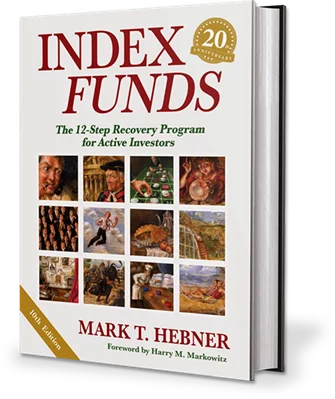
This is exactly the point Mark Hebner makes in Step 9 of Index Funds: The 12-Step Recovery Program for Active Investors. Markets are generally efficient, and new information is absorbed into prices in seconds. If the price already knows what you know, you can't beat it by knowing more.
The Data Active Managers Don't Want You to See
Felix didn't just argue that beating the market is hard in theory. He showed Bartlett that in practice it happens infrequently over long periods — and that the few who do beat it rarely repeat the trick.
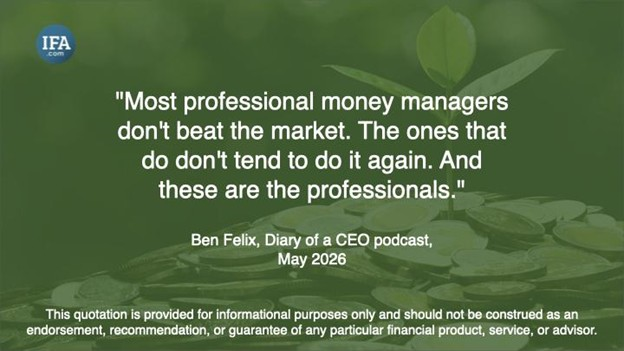
"If you look at the data on professional money managers who are trying to beat the market, most of them don't," Felix said. "And the ones that do — this is a crazy part — the managers who do beat the market over a period of time don't tend to go on to beat the market in the future."
The data backs him up. The S&P Dow Jones Indices SPIVA Scorecard for year-end 2024 found that, over the 15-year period to December 2024, not a single US equity category saw a majority of active managers beat their benchmark. In 2024 alone, 65 percent of actively managed large-cap US equity funds underperformed the S&P 500.
The companion S&P Persistence Scorecard tells the rest of the story. Among funds that ranked in the top quartile of US domestic equity funds at year-end 2020, not one stayed in the top quartile for the next four consecutive years. The headlines about past winners almost never carry into the future.
Felix told Bartlett about Warren Buffett's famous demonstration. In 2007, Buffett bet $1 million that an S&P 500 index fund would outperform any portfolio of hedge funds over the following decade. Ted Seides of Protégé Partners took the other side, choosing five funds-of-funds representing more than 100 individual hedge funds.
The S&P 500 index fund returned 125.8 percent over the decade. The five funds-of-funds returned 21.7 percent, 42.3 percent, 87.7 percent, 2.8 percent, and 27.0 percent respectively. Seides conceded early, writing: "For all intents and purposes, the game is over. I lost."
Past performance never guarantees future results, but the weight of the evidence cited favors passive strategies over long periods, though outcomes can differ in the future.
Your Worst Enemy Has Your Own Brokerage Password
Felix illustrated this with an anecdote about his fiancée. She is, he said, an excellent investor — because she keeps forgetting her brokerage account password. She doesn't log in. She doesn't tinker. She doesn't react to whatever the markets did this morning. Years later, they reset the password to take a look. As Felix told it: "We open it, we go, 'Baby, you're rich.'"
There's an academic backbone to this. In 2001, Brad Barber and Terrance Odean published Boys Will Be Boys: Gender, Overconfidence, and Common Stock Investment in The Quarterly Journal of Economics. Looking at more than 35,000 households at a large discount broker, they found that men traded 45 percent more than women, driven by overconfidence. The cost was real: men's risk-adjusted net returns were 1.4 percentage points per year lower than women's. Among single investors, the gap widened — single men traded 67 percent more than single women and underperformed them by 2.3 percentage points a year.
Felix told Bartlett what he thought it added up to: "I think women are probably better investors." His prescription was the same one he gave for almost everything in the interview — focus on what you can control. "You can't control markets, you can't control your performance relative to the market, and trying to outperform tends to make you worse off rather than better. But the things that you can control are a lot of the things we talked about — having an appropriate financial plan, having the right goals set, having an asset allocation that makes sense for you even if markets do decline."
That's the behavior gap that Mark Hebner and IFA have been pointing at for over two decades. For most people, the real value of a good evidence-based advisor isn't fund selection — it's the discipline to keep investors from sabotaging themselves between log-ins.
The Products Designed to Separate You From Your Returns
If there's a behavior gap, the financial industry's specialty is engineering products that widen it.
Felix singled out two categories that have boomed in recent years: covered call ETFs and thematic ETFs. Both look smart on the surface. Both can involve higher costs that may benefit managers more than investors over time.
Covered call ETFs sell upside in exchange for income. They appeal to investors who fall for what behavioral economists call mental accounting — treating the distribution they see as free money, while not noticing the capital growth they're sacrificing. "You're giving up so much upside that I don't think most investors realize," Felix said. "The implied cost of these products is enormous."
Thematic ETFs work on a different psychological lever: the fear of missing the next big thing. The cycle, Felix told Bartlett, is depressingly familiar. "Something becomes really hot. So maybe it's AI, maybe it's cannabis ... asset prices go up. An index provider creates an index for that hot theme, and then an ETF gets launched, but it gets launched when the asset prices are up here. And what tends to happen is the asset prices come down."
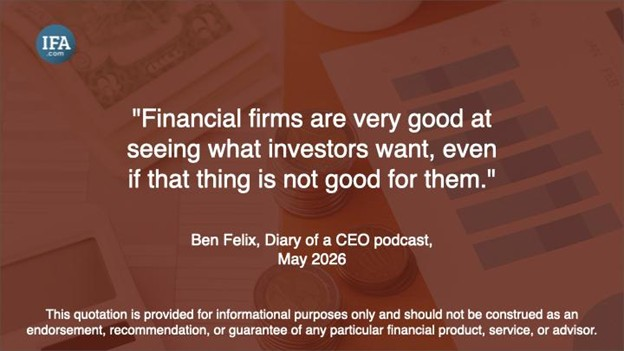
His broader point cuts deeper than either example. "Financial firms are very good at seeing what investors want, even if that thing is not good for them, and then creating a product to fulfill that desire."
Mark Hebner has long called these "silent partners" — the layers of intermediaries who skim a slice of investor returns. Most add little value relative to what they cost.
If the best strategy is to forget the password, this kind of product is the industry's way of convincing you that you need a more complicated one.
Think Globally, Stay the Course
Felix didn't only diagnose what doesn't work. He also told Bartlett's audience what the academic evidence supports.
The headline reference was what Felix called "the most controversial paper in finance" — Anarkulova, Cederburg, and O'Doherty's 2023 working paper Beyond the Status Quo: A Critical Assessment of Lifecycle Investment Advice. Using returns data from nearly 40 developed countries going back to 1890 and one million simulated lifetimes, the authors find that a portfolio of 100 percent equities — roughly one-third domestic, two-thirds international —produced the strongest simulated retirement outcomes in the authors' analysis across consumption, bequest wealth, and the probability of running out of money.
Felix put the implication plainly. "Stocks are a little bit safer for long-term investors than we probably thought, and bonds, which are typically considered safe, are actually a little bit riskier than we may have thought for long-term investors. The reason being that during periods of high inflation, bonds get absolutely decimated."
This isn't a license to bet the lot. The paper's findings depend on long horizons and the discipline to hold through the volatility that comes with all-equity portfolios — exactly the volatility that Felix's password-forgetting fiancée tolerates so well. Past simulation doesn't guarantee future returns; markets can fall, and stay fallen, longer than most investors expect.
But the international piece matters. A heavy domestic tilt leaves a portfolio exposed to the inflation and growth conditions of one country. Diversifying internationally may help manage or reduce that risk.
Felix's own portfolio? "I have a globally diversified stock portfolio with a Canadian home country bias, kind of like what that paper, the controversial paper, found." That's the approach IFA has been building portfolios on for decades — global diversification grounded in peer-reviewed, time-tested evidence.
The World Is Catching Up
Felix's two hours with Steven Bartlett demonstrated how far the consensus has shifted. The same arguments that, 25 years ago, were heard mainly inside academic journals and a handful of independent advisory firms have now been laid out in front of an audience the size of a small country.
Mark Hebner founded IFA after living the alternative. When he sold his nuclear pharmacy business in 1985, he hired a broker who recommended trades almost weekly. Twelve years later, he ran the numbers. Had he bought and held low-cost index funds instead, he calculated, he'd have been around $30 million better off. That discovery became the foundation of IFA.
The argument hasn't changed since. Consider low‑cost index funds, global diversification, and disciplined long‑term behavior while ignoring short‑term noise. If you can manage to forget the password for a while, even better.
Felix told millions of people exactly that. IFA has been telling its clients the same thing for a quarter of a century. The world is catching up to where evidence-based investors have been all along.
Resources
Anarkulova, A., Cederburg, S., & O'Doherty, M.S. (2023). Beyond the Status Quo: A Critical Assessment of Lifecycle Investment Advice. Working paper, available at SSRN.
Barber, B.M. & Odean, T. (2001). Boys Will Be Boys: Gender, Overconfidence, and Common Stock Investment. The Quarterly Journal of Economics, 116(1), 261–292.
S&P Dow Jones Indices. (2025). SPIVA U.S. Scorecard Year-End 2024. S&P Global.
S&P Dow Jones Indices. (2025). U.S. Persistence Scorecard Year-End 2024. S&P Global.
ROBIN POWELL is the Creative Director at Index Fund Advisors (IFA). He is also a financial journalist and the Editor of The Evidence-Based Investor. This article reflects IFA's investment philosophy and is intended for informational purposes only.
DISCLOSURES:
This article is for informational purposes only and does not constitute investment advice, an offer, or a solicitation to buy or sell any security. Past performance is not indicative of future results. All examples and data cited are based on historical analysis and may not reflect future market conditions. Investing involves risks, including the possible loss of principal. The mathematical principles discussed illustrate theoretical concepts and should not be interpreted as guarantees of investment outcomes. Diversification does not ensure a profit or protect against loss.
The information discussed is general in nature and may not be suitable for all investors. Individual circumstances vary, and readers should consult a qualified professional regarding their personal situation.
Index Fund Advisors, Inc. (IFA) believes the information to be accurate but does not guarantee its completeness or accuracy. This article was sourced and prepared with the assistance of artificial intelligence (AI) technology.
For more information about Index Fund Advisors, Inc, please review our brochure at https://www.adviserinfo.sec.gov/ or visit www.ifa.com.