
 Risk Capacity
 Wealth Management
 Outsourced CIO
 Retirement Plans
 Institutional
 Financial
  Open an Account
 IFA App

 Articles
 Charts
 Investor Education ▾
 Fund
Fund
 Store
Store

 Taxes
Taxes Back-testing Disclosures
 Glossary
 Form CRS
 Risk & Return
 Matching People With Portfolios
Risk and Return
Figure 1(permalink)
The most common risk measure is standard deviation — a statistic measurement of volatility that tells you how tightly the various annual returns are clustered around the average. When the annual returns are tightly bunched together the standard deviation is small and the bell-shaped curve is narrow. When the annual returns are spread apart and the bell curve is relatively flat, it tells you that you have a relatively large standard deviation.
The combination of the average and the standard deviation characterize various bell curve shapes, and those shapes represent the risk and return of the Index Portfolio. Figure 2 shows you graphically what a standard deviation represents.
Figure 2(permalink)
One standard deviation away from the average in both directions on the horizontal axis (the yellow area on the graph) accounts for somewhere around 68 percent of the annual returns in the time period. Two standard deviations away from the mean (the yellow and green areas) account for roughly 95 percent of the annual returns. And three standard deviations (the yellow, green and orange areas) account for about 99 percent of the annual returns.
Standard Error
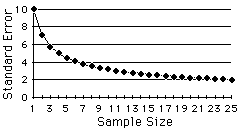
The standard error of the mean indicates the degree of uncertainty in calculating an estimate from a sample, like a series of returns data. A standard error can be calculated from the standard deviation by dividing the standard deviation by a square root of the sample size. So with only 3 years of returns data on the S&P 500, the error in the average return is 2.6 times larger than having 20 years of data.
Risk and Return Tables
Figure 3(permalink)
Figure 4(permalink)
Figure 5(permalink)
Figure 6(permalink)
Figure 7(permalink)
More About Our Portfolios
To achieve optimal results, investors need to match their Risk Capacity with a specific risk exposure aligned to one of our 100 Portfolios.
What's your Risk Capacity?
Calculating risk capacity is the first step to deciding which portfolio will generate optimal returns for each investor.
Each investor has a unique risk capacity and can be identified by a risk capacity score — a measure of
how much risk one can manage.
 Home
Home 888-643-3133
 Contact Us
 Newsletter Subscribe
 eMoney
 IFA Apps
 Index Funds Book on Kindle
 Index Funds Audiobook
 Careers
 Facebook
 X
X LinkedIn
 Instagram
 Youtube
 Terms
Terms Index Descriptions