
 Risk Capacity
 Wealth Management
 Outsourced CIO
 Retirement Plans
 Institutional
 Financial
  Open an Account
 IFA App

 Articles
 Charts
 Investor Education ▾
 Fund
Fund
 Store
Store

 Taxes
Taxes Back-testing Disclosures
 Glossary
 Form CRS
Many individual stocks fail to beat cash. The few that do are concentrated in a shrinking minority — and the evidence shows it's getting smaller over time. One rational response may be to stop picking and instead own the entire market.
Every year, roughly 21 million Californians buy a lottery ticket. That's about 70% of the state's adult population, lining up at gas stations and convenience stores for a shot at a jackpot they almost certainly won't win. The odds of hitting Powerball? One in 292,201,338.
Most people know the odds are stacked against them. But they buy anyway, because an $800 million jackpot does something to the brain that a statistics textbook can't undo.
The stock market works in a similar way, but almost nobody talks about it in those terms. Many individual stocks are, in fact, losing tickets. A tiny fraction are jackpot winners. And the overall return of the market, like the lottery's headline prize, creates an illusion that everyone has a reasonable shot.
The financial industry has spent decades selling the idea that smart people can pick the winning tickets. The evidence says otherwise.
Many Stocks Are Losing Tickets
Hendrik Bessembinder, a professor of finance at Arizona State University, has spent years studying what actually happens to individual stocks over their lifetimes.
Since 1926, a total of 28,114 stocks have been publicly listed in the US. Of those, 58.6% didn't just underperform — they destroyed shareholder wealth. The median cumulative compound return across all those stocks was −7.41%. The typical stock, held over its full lifetime, lost money.
So how does the overall market still go up? Because a tiny number of massive winners pull the whole average higher. All of the net wealth created by US stocks over nearly a century is attributable to roughly 4% of them. The other 96% collectively matched the return of one-month Treasury bills. Cash.
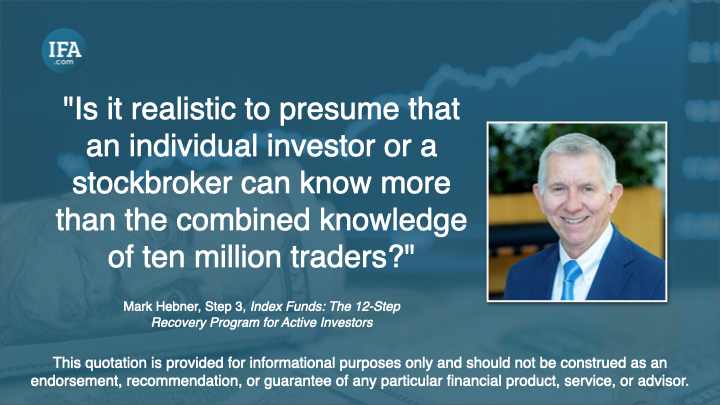
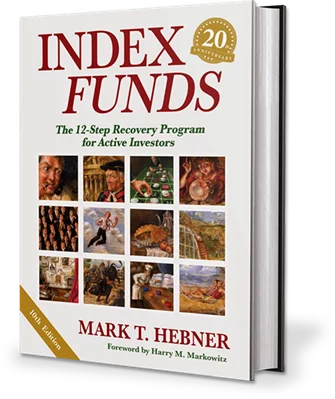
Identifying that 4% in advance would require consistently outsmarting a large majority of other market participants. As Mark Hebner puts it in Step 3 of his book Index Funds: The 12-Step Recovery Program for Active Investors: "Is it realistic to presume that an individual investor or a stockbroker can know more than the combined knowledge of ten million traders?"
Bessembinder wasn't finished. In a December 2025 paper, he argues that the standard measures academics and the industry use to report returns — arithmetic means, Sharpe ratios, alphas — don't actually describe what real investors experience, and — and give a misleadingly optimistic picture of picking stocks.
The profession, Bessembinder suggests, has been measuring what's mathematically convenient rather than what's economically relevant.
As he puts it: "It might be argued that we have studied arithmetic means because that is where the econometric street light shines, not because that is necessarily where the answers to relevant questions lie."
The lottery parallel is hard to miss. California Scratchers tickets advertise "any prize" odds of 1 in 3 to 1 in 5, which sounds decent — until you realize most of those prizes just cover the cost of the ticket. The feeling of winning is real. The economic gain isn't.
Stocks work the same way. Plenty go up. Your brokerage statement shows green numbers, and it feels like you're ahead. But "went up" isn't the right benchmark. The question is whether your stock beat what you'd have earned in risk-averse Treasury bills — doing nothing, taking almost no risk.
For many stocks, over many time periods, the answer is no. The reality is that buying individual stocks is riskier than most people think.
The Needle Is Shrinking and the Haystack Is Growing
So the odds are already bad, and they may be getting worse.
Bessembinder's latest data shows that concentration is increasing. In 2016, it took 90 top-performing stocks to explain half of all net US wealth creation since 1926. By 2019, that number had fallen to 83. By 2022, just 72. Meanwhile, the total number of stocks that have ever listed in the US exceeds 28,000. The needle is shrinking inside a growing haystack — and the probability math has tended to become less favorable to stock pickers over time.
This isn't just an American phenomenon.
Jonathan Fletcher and Michael O'Connell, in a January 2026 study published in the Journal of Asset Management, examined every stock listed on UK exchanges from January 1975 to December 2024 — 7,518 companies in total. Only 3.1% generated all of the market's aggregate net real wealth creation. The rest either broke even or lost money after inflation.
The UK data also reveals a dramatic shift over time. Before the so-called Big Bang deregulation of October 1986, 28% of UK companies contributed to the market's net wealth. After that, just 1.5%. And AIM — the market segment most associated with exciting small-cap stock picks — generated negative aggregate wealth of minus £2.6 billion. An entire market where, collectively, investors would have been better off holding cash.
The pattern holds globally. Fang, Marshall, Nguyen, and Visaltanachoti studied 71,697 stocks across 57 countries between 1996 and 2017, in research published in Finance Research Letters in 2021. In 55 of those 57 markets, fewer than half of individual stocks beat their local Treasury bill rate. The cross-country average: just 42.4% of stocks outperformed cash.
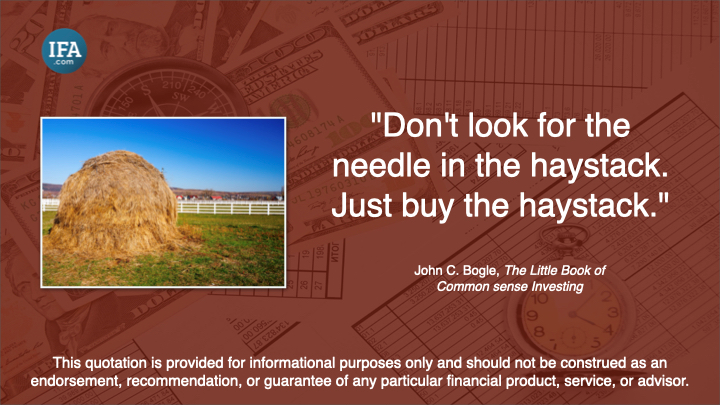
In 2007, John C. Bogle offered a piece of advice that has aged extraordinarily well: "Don't look for the needle in the haystack. Just buy the haystack."
Nearly two decades of subsequent research has made that counsel close to unanswerable.
Why Winner-Takes-Most Is the New Normal
This concentration isn't random. There may be a deeper reason why it's happening.
In 2020, economists David Autor, David Dorn, Lawrence Katz, Christina Patterson, and John Van Reenen published research in the Quarterly Journal of Economics documenting the rise of what they called "superstar firms."
Their thesis was that technology and globalization are pushing sales toward the most productive firms in each industry. Once a company achieves scale, its advantages compound. Network effects lock in customers. Data advantages widen the moat.
This isn't a story about a few tech giants. It's a story about how the economy itself has changed. The forces driving concentration — automation, digital infrastructure, global supply chains — are structural ones. They don't reverse easily.
So if everyone can see which companies are winning, why not just buy those? Because the market can see them too. As Mark Hebner writes in his book: "Great companies don't make great investments. You may love Elon Musk, but this doesn't mean Tesla is a great stock to buy."
The dominance of today's superstar firms is already reflected in their stock prices. Knowing that Apple or Nvidia is a great company gives you no advantage — millions of other participants have priced that information in already.
And yes, some stock pickers do beat the market. Bessembinder himself acknowledges that concentrated portfolios offer the possibility of outsized returns. But he also notes they will most likely underperform. The track records that look like skill rarely clear the statistical bar once luck and survivorship bias are properly accounted for.
Some people win the Powerball, too. That doesn't make buying lottery tickets a retirement strategy.
Buy the Haystack
Mark Hebner puts it plainly: "Picking stocks or bonds can be an ill-fated strategy that wastes time, energy, and money. The better solution is to trust the collective brain, buy the haystack, and maintain risk-appropriate exposures in low-cost globally diversified index portfolios."
If roughly 4% of stocks are responsible for all the net wealth the market creates, then the only question that matters is whether those stocks are in your portfolio.f
A total market index fund owns all tickets in the draw. The future Apple, the future Amazon, a company that will generate outsized returns over the next 30 years — already in there, waiting. You don't need to identify them in advance. You don't need to pay someone to try. You just need to not exclude them.
In the real lottery, buying every possible ticket combination would cost hundreds of millions of dollars. In the stock market, you can do exactly this — for a fraction of a percent in annual fees. The key is building true diversification — not just spreading money across a few funds, but owning broad exposure across asset classes, geographies, and risk factors.
The common objection: you'll also own the losers. Of course. But what does that actually cost? The roughly 96% of stocks that don't contribute to net wealth creation collectively match the return on cash. They have tended to offset each other. Not a drag the portfolio.
Miss the 4% that matter, and you miss everything. Owning the losers is the price of admission.
What To Do Next
- Audit your concentration risk. How many individual stocks do you hold? What percentage of your total wealth depends on them? If a handful of positions account for most of your portfolio, you're making a very specific bet — whether you intended to or not.
- Understand your actual odds. If roughly 4% of stocks create all the wealth, a portfolio of 20 individual stocks has approximately a 44% chance of containing none of them. (The math: 0.96 raised to the power of 20 is approximately 0.44.)
- Talk to a fiduciary advisor. Ask about building a globally diversified, low-cost index portfolio. Make sure the person you're talking to has a legal obligation to act in your interest — not just a sales quota to fill.
- Turn off the stock-picking shows. The talking heads recommending individual stocks are producing entertainment, not investment advice. The evidence on this is overwhelming. Choose evidence over opinions — and treat it accordingly.
You Can Buy Every Ticket
21 million Californians buy lottery tickets every year, knowing the odds are stacked against them. The jackpot is just too big, too vivid, too easy to dream about.
Stock picking runs on the same fuel. Most individual stocks lose. A tiny handful win big. And the dream of finding the next winner keeps people playing a game the evidence says they'll almost certainly lose.
But there's one difference between the lottery and the stock market — and it changes everything.
In the lottery, you're stuck with the tickets you buy. You can't buy every combination. You take your one-in-292-million shot and hope.
In the stock market, you can buy every ticket. You can own the whole haystack. Historically the small percentage of stocks responsible for all the wealth creation are sitting in your portfolio, without ever needing to know which ones they are.
Resources
Bessembinder, H. (2018). Do stocks outperform Treasury bills? Journal of Financial Economics, 129(3), 440–457.
Bessembinder, H. (2023). Shareholder wealth enhancement, 1926 to 2022. SSRN.
Bessembinder, H. (2026). Measuring investor outcomes. The Financial Review, 61(1), 5–13.
Bogle, J. C. (2007). The Little Book of Common Sense Investing. John Wiley & Sons.
Hebner, M. T. (2025). Index Funds: The 12-Step Recovery Program for Active Investors. IFA Publishing.
Autor, D., Dorn, D., Katz, L. F., Patterson, C., & Van Reenen, J. (2020). The fall of the labor share and the rise of superstar firms. The Quarterly Journal of Economics, 135(2), 645–709.
Fletcher, J., & O'Connell, M. (2026). Exploring the real wealth creation in U.K. stocks. Journal of Asset Management, 27(3).
Fang, J., Marshall, B. R., Nguyen, N. H., & Visaltanachoti, N. (2021). Do stocks outperform Treasury bills in international markets? Finance Research Letters, 40, 101710.
ROBIN POWELL is the Creative Director at Index Fund Advisors (IFA). He is also a financial journalist and the Editor of The Evidence-Based Investor. This article reflects IFA's investment philosophy and is intended for informational purposes only.
DISCLOSURES:
This article is for informational purposes only and does not constitute investment advice, an offer, or a solicitation to buy or sell any security. Past performance is not indicative of future results. All examples and data cited are based on historical analysis and may not reflect future market conditions. Investing involves risks, including the possible loss of principal. The mathematical principles discussed illustrate theoretical concepts and should not be interpreted as guarantees of investment outcomes. Diversification does not ensure a profit or protect against loss.
The information discussed is general in nature and may not be suitable for all investors. Individual circumstances vary, and readers should consult a qualified professional regarding their personal situation.
Index Fund Advisors, Inc. (IFA) believes the information to be accurate but does not guarantee its completeness or accuracy. This article was sourced and prepared with the assistance of artificial intelligence (AI) technology.
For more information about Index Fund Advisors, Inc, please review our brochure at https://www.adviserinfo.sec.gov/ or visit www.ifa.com.













 Home
Home 888-643-3133
 Contact Us
 Newsletter Subscribe
 eMoney
 IFA Apps
 Index Funds Book on Kindle
 Index Funds Audiobook
 Careers
 Facebook
 X
X LinkedIn
 Instagram
 Youtube
 Terms
Terms Index Descriptions