
 Risk Capacity
 Wealth Management
 Outsourced CIO
 Retirement Plans
 Institutional
 Financial
  Open an Account
 IFA App

 Articles
 Charts
 Investor Education ▾
 Fund
Fund
 Store
Store

 Taxes
Taxes Back-testing Disclosures
 Glossary
 Form CRS
At 4 a.m., David Jones's wife came downstairs to ask: "Are you ever coming to bed?" The book he couldn't put down that night transformed his approach to evidence-based investing — not by teaching him something new, but by giving voice to doubts he'd carried for years.
The package arrived from America — a thick parcel, the kind that felt like an event back then. David Jones's wife saw him eyeing it. "Don't start reading that now," she said. "Let's have dinner first."
They had dinner.
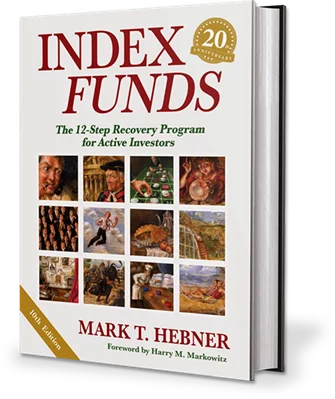
By 4 a.m., she came back downstairs to find him at the kitchen table, deep in Mark Hebner's Index Funds: The 12-Step Recovery Program for Active Investors. "Are you ever coming to bed?"
David had been a financial advisor in the UK for years. He knew the weight of managing money for people who trusted him — clients whose retirements, children's educations, and peace of mind depended on his decisions. And he knew, with an unease he couldn't quite name, how often that trust felt betrayed. Not by him. By the fund managers he'd been taught to rely on.
If you've ever watched a fund you believed in underperform year after year — while your advisor explained it away and counseled patience — you know what David felt. That creeping suspicion the whole exercise might be theater. That doubt you've learned to suppress because everyone around you seems to accept the rules of the game.
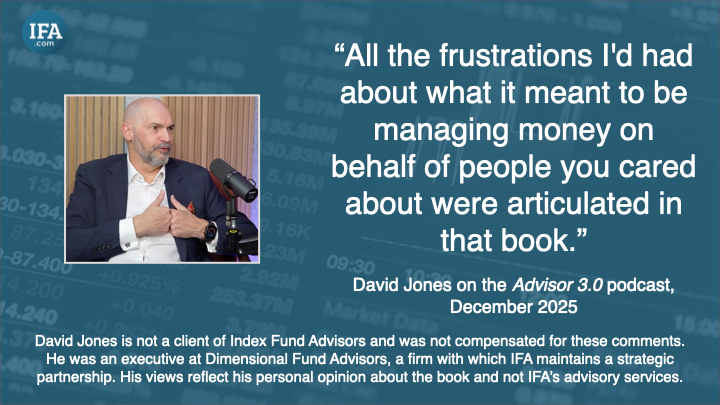
"All the frustrations I'd had about what it meant to be managing money on behalf of people you cared about," David recalled on the Advisor 3.0 podcast, "and how often we were let down by different fund managers — that was all articulated in that book."
That's the word that matters: articulated. David didn't learn something new that night. He heard someone say what he'd been thinking for years.
Why Articulation Beats Information
Most investment epiphanies follow a predictable script: someone encounters new data, reconsiders their assumptions, changes their mind. That's not what happened to David Jones.
He already knew something was wrong. The pattern was too consistent to ignore — recommending funds that looked promising, watching them disappoint, explaining the disappointment to clients who deserved better. The problem wasn't ignorance. It was isolation. He'd been carrying doubts he assumed were his alone.
Mark Hebner's book broke that isolation. Here was an American advisor who'd wrestled with the same questions, laying out the case that active management's failures weren't bad luck or poor timing. They were structural. Predictable. Mathematically inevitable.
For David, this wasn't conversion through argument. It was recognition. The book held up a mirror, and he saw his own thinking reflected back with clarity and rigor.
Information changes what you know. Validation changes what you're willing to do about it.
What Happened Next
David Jones spent the next 17 years at Dimensional Fund Advisors, becoming Vice President and Head of UK & Ireland Advisor Group. He spoke at conferences, wrote articles that shaped how a generation of advisors thought about their craft, and became one of the most recognized advocates for evidence-based investing in the UK.
He recently stepped down. On the Advisor 3.0 podcast, he offered a direct tribute to the man whose book he'd devoured that night:
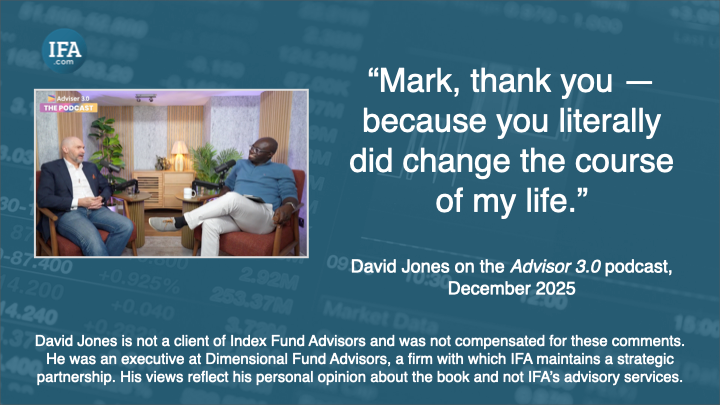
"Mark, thank you — because you literally did change the course of my life."
David's story unfolded in the UK, but the pattern he recognized crosses borders. American investors face the same dynamics — often magnified by the complexity of 401(k) lineups and the pressure to "do something" with retirement accounts.
Your Doubts Might Be Data
Here's what makes David's story more than a personal anecdote: his instincts were right.
The frustrations he felt in the early 2000s have since been validated by two decades of evidence. The most recent data — S&P Global's mid-year 2025 SPIVA scorecard, which tracks active fund performance against benchmarks — tells the same story. In the first half of 2025, a relatively good stretch for active managers, 54% of large-cap US equity funds still underperformed the S&P 500. Fixed income was worse: 90% of investment-grade bond funds and 86% of high-yield funds lagged their benchmarks.
SPIVA's conclusion is blunt: short-term snapshots may show roughly half of managers beating their benchmarks in volatile periods, but "the long-term pattern of majority underperformance remains intact over multi-year windows."
David's gut feeling, that the managers kept letting him down, wasn't cynicism. It was pattern recognition.
If you've felt that same nagging dissatisfaction — watching actively managed funds stumble while your advisor counsels patience — your frustration isn't a knowledge gap. It might be the beginning of clarity.
What You Can Do
Three steps if David's story resonates:
- Name your frustration. Write down the specific moments when your investment experience hasn't matched the promises. Not vague dissatisfaction — concrete instances. Articulating doubt is the first step toward resolving it.
- Check the evidence. Pull up your 401(k) or IRA holdings and compare each fund's performance against its benchmark over five, ten, and fifteen years. Not one year, and not the cherry-picked period in the marketing materials — the long-term record. Your plan's website has this data buried somewhere. Find it.
- Ask what you're paying for. If your actively managed funds have consistently lagged a simple index, what exactly is the fee buying? The answer may be "hope" — and hope isn't an investment strategy.
David's wife asked if he was ever coming to bed. In a sense, the answer was no.
He'd already woken up.
Have you read Mark's book?
You can now read or listen to Mark Hebner's book, Index Funds: the 12-Step Program for Active Investors, free of charge via the IFA website. If you'd prefer to own a hard copy, you can buy one on Amazon.
ROBIN POWELL is the Creative Director at Index Fund Advisors (IFA). He is also a financial journalist and the Editor of The Evidence-Based Investor. This article reflects IFA's investment philosophy and is intended for informational purposes only.
DISCLOSURES:
This article is for informational purposes only and does not constitute investment advice, an offer, or a solicitation to buy or sell any security. Past performance is not indicative of future results. All examples and data cited are based on historical analysis and may not reflect future market conditions. Investing involves risks, including the possible loss of principal. The mathematical principles discussed illustrate theoretical concepts and should not be interpreted as guarantees of investment outcomes. Index Fund Advisors, Inc. (IFA) believes the information to be accurate but does not guarantee its completeness or accuracy. This article was sourced and prepared with the assistance of artificial intelligence (AI) technology.
For more information about Index Fund Advisors, Inc, please review our brochure at https://www.adviserinfo.sec.gov/ or visit www.ifa.com.













 Home
Home 888-643-3133
 Contact Us
 Newsletter Subscribe
 eMoney
 IFA Apps
 Index Funds Book on Kindle
 Index Funds Audiobook
 Careers
 Facebook
 X
X LinkedIn
 Instagram
 Youtube
 Terms
Terms Index Descriptions