
IFA founder Mark Hebner describes asset allocation as the most important decision an investor can make. Yet a study of more than 36,000 retirees suggests that retirement asset allocation often depends on the advisor you happen to have.
Imagine two retired couples. They're the same age, they've saved the same amount, and they have the same guaranteed income. Asked how much risk they're comfortable with, they give the same answer.
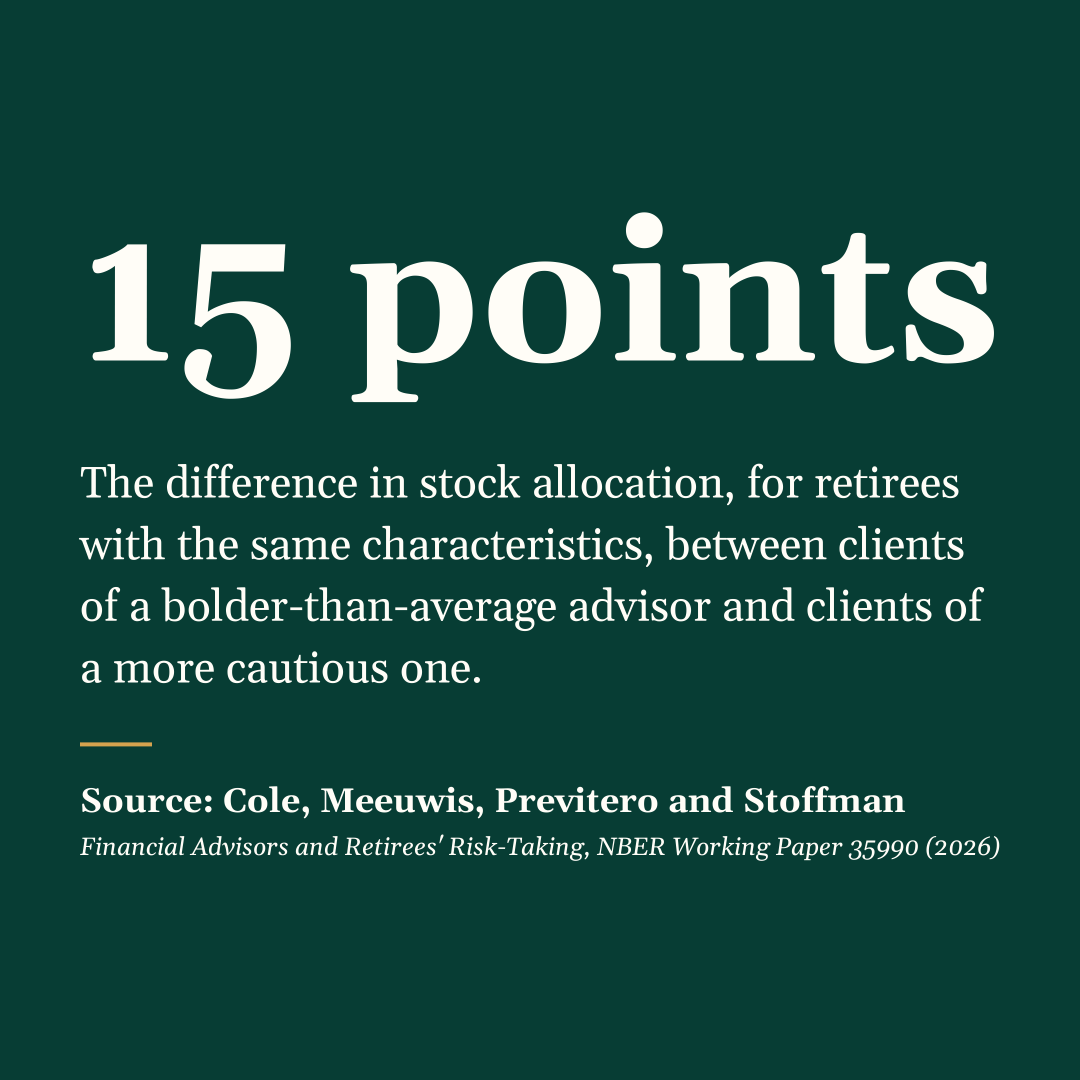 Each couple then walks into a different advisor's office. Neither advisor is unusual. One is a little more cautious than most, the other a little bolder. But a major new study suggests the second couple would typically end up with about 15 percentage points more of their portfolio in stocks. On a hypothetical $1 million portfolio, that's roughly $150,000 more in stocks, based on the study's findings rather than differences in the couples' measured characteristics.
Few decisions matter more. As IFA founder Mark Hebner puts it in Step 11 of his book Index Funds: The 12-Step Recovery Program for Active Investors, asset allocation "is the most important determinant of a portfolio's expected return."
So who really makes that decision? Four researchers, Cole, Meeuwis, Previtero and Stoffman, set out to answer that using the accounts of 36,034 Canadian retirees. Their paper has just been published as a working paper by the National Bureau of Economic Research.
The researchers measured each retiree's net worth, tolerance for risk, and financial knowledge, among other things. Those characteristics explained 16 percent of the differences in how much the retirees held in stocks. Adding just one fact, the identity of each retiree's advisor, raised that to 36 percent.
Switch Advisors, and Your Portfolio May Start to Follow
The clearest sign that advisors shape their clients' allocations comes from retirees who changed advisor. Suppose a retiree moved from an advisor whose clients held 60 percent in stocks on average to one whose clients averaged 80 percent. Two years later, the retiree's own stock allocation would typically be about six percentage points higher, closing 28 percent of the gap. If allocations were driven primarily by clients' own circumstances, a new advisor would not necessarily be expected to move them much. Yet they moved, and in the new advisor's direction.
Some of those moves were the client's choice, and a client who picks a bolder advisor may already want more stock. But when the switch was forced on investors, because their old advisor retired, died or left, they still drifted toward the new advisor's style. For retirees alone, there were too few such cases to rule out chance.
As a group, the advisors in the study favored stocks. They were commission-paid advisors at two Canadian mutual fund dealers, working between 1999 and 2013, with no fiduciary duty to their clients. Their retired clients held about 75 percent in stocks at 65, falling to about 55 percent by 85, an average of 64 percent. That's more than twice what retirees without an advisor held, and about 35 percentage points more than one widely used target-date fund holds at the same ages.
The Advisors Invest the Same Way Themselves
The advisors invested their own money the same way they invested their clients'. The researchers could see the advisors' personal portfolios, and found no reliable difference between their stock allocations and those of their clients. That stayed true after the advisors retired. If heavy stock allocations were a sales pitch, you'd expect advisors to drop them once there was nobody left to pitch to. They didn't.
Fees don't explain much either. A stock allocation ten percentage points higher came with annual fees only about 0.07 percentage points higher. That's about $70 a year for every $100,000 invested. And fees didn't rise the longer a client stayed.
What does seem to matter is trust. Economists Gennaioli, Shleifer and Vishny have described advisors as "money doctors": the more clients trust them, the more comfortable they feel taking risk. The study fits that idea. Retirees who had been with the same advisor for more than ten years held about seven percentage points more in stocks than those in their first year.
So the advisors appear to have been doing what they genuinely believed was best. But a belief about markets, however sincere, is still one person's view, and it travels with that person to every client they advise.
That matters even if your advisor is a fiduciary. A fiduciary duty requires an advisor to act in your best interest. It does not necessarily prevent an advisor from sincerely believing that a particular allocation is in your best interest.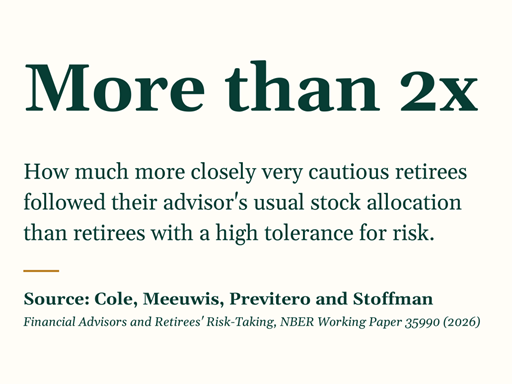
Back to the Canadian retirees, then. Did all that extra stock do them any good?
Is the Extra Stock Worth What It Costs?
The researchers say that case weakens as savings grow. A separate US model, by Duarte, Fonseca, Goodman and Parker, finds that the best share of stocks varies substantially with wealth.
US Advisors Disagree About the Same Client
So far, the evidence comes from Canada, and from commission-paid advisors working between 1999 and 2013. Does anything similar happen in the US? The evidence is thinner, but it points the same way.
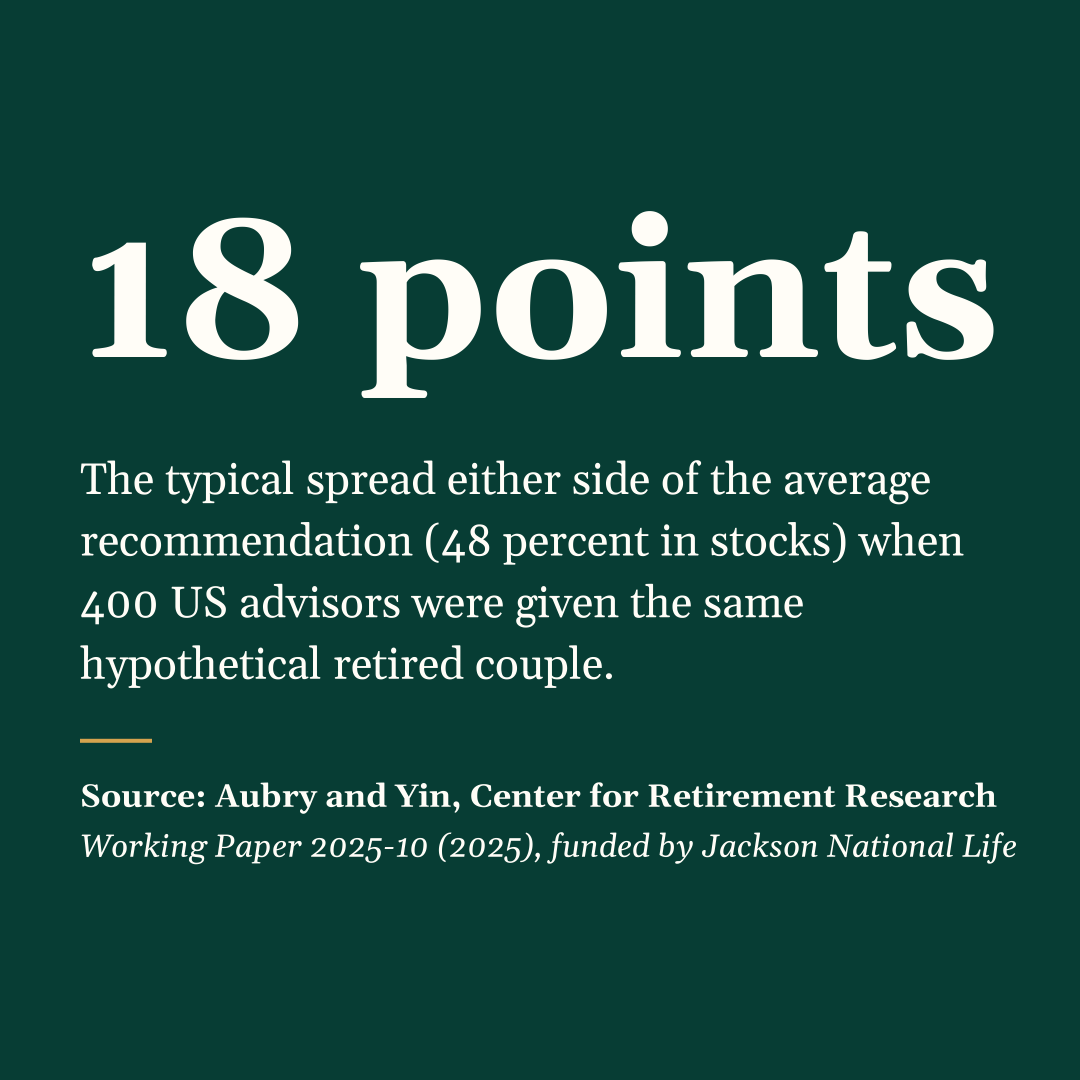 In a study funded by Jackson National Life Insurance Company, Aubry and Yin of the Center for Retirement Research at Boston College ran a version of this article's opening thought experiment. They gave 400 US advisors the same hypothetical client: a retired couple, both 65, with $350,000 to invest, $2,000 a month from Social Security, and a moderate appetite for risk. On average, the advisors recommended 48 percent in stocks. But their answers typically sat about 18 percentage points either side of that. One advisor suggesting 30 percent and another 66 percent for the same couple would have been nothing unusual.
The advisors also leaned toward more stock than investors of similar age and risk tolerance said they wanted. That doesn't make the investors right; the authors conclude the advice is probably beneficial. The couple was hypothetical, and less wealthy than most readers of this article. But if advisors given identical facts land this far apart, the number on your own statement may owe something to whose office you walked into.
A second US study found a similar pattern among cautious households. Jeong and Babiarz analyzed the Federal Reserve's Survey of Consumer Finances. Households who said they were "not willing to take any financial risks" and used a financial planner held 7.9 percentage points more of their financial assets, cash included, in stocks than similar households without one. For households with average or high risk tolerance, the gap was roughly half that, at 3.6 and 4.0 percentage points. It's an association, not proof of cause and effect.
The levels are another matter. For a couple aged 65, US advisors recommended 48 percent in stocks on average. Canadian advised retirees of the same age held about 75 percent. A similar pattern appears in both studies; the levels differ substantially.
Three Questions to Ask Any Advisor
The test of any advisor is whether they can show how your allocation follows from your own circumstances. The first of those US studies suggests that's not something to take for granted. When its authors gave advisors a version of the couple with more guaranteed income, the average recommendation fell slightly, from 48 percent in stocks to 44 percent. Economic theory can point the other way: the more of your spending a safe income covers, the more stock risk an investor may have the capacity to bear, depending on their overall circumstances.
"How does this allocation follow from my capacity for risk?" Capacity covers more than comfort. It's about how big a loss your plans could absorb.
"How did my guaranteed income and my total wealth change the number?" Social Security, pensions and annuities may all be relevant, as may the size of your savings. An advisor should be able to show their work.
"What would have to change in my life for you to change it?" A good answer is about your circumstances, not about where the advisor thinks markets are heading.
In Step 12 of his book, Hebner lists what an advisor who specializes in passive investing does for clients. The first item is to help them "invest according to their risk capacity." Another is to "maintain a portfolio with appropriate risk exposure." That's a standard worth holding any advisor to, IFA included.
The questions won't tell either couple at the start of this article which number is right. They will tell them whether the number is theirs. An allocation you can't trace back to your own circumstances may be your advisor's allocation, not yours.
Sources
Aubry, J.-P., & Yin, Y. (2025). What stock allocations do advisors recommend and how does it impact their clients? (CRR Working Paper 2025-10). Center for Retirement Research at Boston College.
Cole, A. T., Meeuwis, M., Previtero, A., & Stoffman, N. (2026). Financial advisors and retirees' risk-taking (NBER Working Paper No. 35990). National Bureau of Economic Research.
Duarte, V., Fonseca, J., Goodman, A. S., & Parker, J. A. (2026). Simple allocation rules and optimal portfolio choice over the lifecycle (NBER Working Paper No. 29559). National Bureau of Economic Research.
Gennaioli, N., Shleifer, A., & Vishny, R. (2015). Money doctors. The Journal of Finance, 70(1), 91–114.
Jeong, D., & Babiarz, P. (2025). Willingness to take financial risks and portfolio choice: The moderating role of financial planners' advice. Financial Planning Review, 8(3), e70007.
DISCLOSURES:
This article is for informational purposes only and does not constitute investment advice, an offer, or a solicitation to buy or sell any security. This material includes general educational information and should not be interpreted as individualized investment advice or a recommendation to take any specific action. Past performance is not indicative of future results. All examples and data cited are based on historical analysis and may not reflect future market conditions. Investing involves risks, including the possiblity of loss and principal. The academic research discussed reflects theoretical and empirical findings and should not be interpreted as a guarantee of investment outcomes. Diversivication does not ensure profit or protect against loss.
The information discussed is general in nature and may not be suitable for all investors. Examples and studies cited reflect specific time periods and may not be representative of all market conditions or investor experiences. Individual circumstances vary, and readers should consult a qualified professional regarding their personal situation. Index Fund Advisors, Inc. (IFA) believes the information to be accurate but does not guarantee its completeness or accuracy. This article was sourced and prepared with the assistance of artificial intelligence (AI) technology.For more information about Index Fund Advisors, Inc, please review our brochure at https://www.adviserinfo.sec.gov/ or visit www.ifa.com.
Past performance doesn't guarantee future results. IFA's methods are research-based, but outcomes aren't guaranteed. This article is for educational purposes only and isn't personalized investment advice.