Pioneers of Probability · Episode 14
This video is for informational and educational purposes only and does not constitute a solicitation or recommendation to buy or sell any security. The historical and mathematical concepts discussed are intended to illustrate the development of probability theory and its relevance to investing. Past performance is not indicative of future results. All investing involves risk, including the possible loss of principal. The examples provided are hypothetical and based on historical index data, not an actual investment. Index returns do not reflect the performance of any actual portfolio or the deduction of advisory fees. Content is AI assisted.
◆ The Question
The story of Carl Friedrich Gauss and the integers from 1 to 100 is one of the most famous anecdotes in the history of mathematics. A schoolmaster in Brunswick, trying to occupy an unruly class, instructs the students to sum all the integers from 1 to 100. The students begin laboriously adding. One boy puts down his slate almost immediately with the answer 5,050. He has noticed that the numbers form fifty pairs, each summing to 101 — (1 100), (2 99), (3 98) — and the result follows immediately.
The boy was seven or eight years old. His name was Carl Friedrich Gauss.
The anecdote may be embellished. What is not embellished is what came after. At three, Gauss had reportedly corrected an arithmetic error in his father's wage calculations. At fifteen, the Duke of Brunswick recognized his talent and began paying for his education — the patronage of a minor German nobleman saving what would become one of the greatest mathematical minds in human history from a life of manual labor. At eighteen, Gauss proved that a regular seventeen-sided polygon could be constructed with compass and straightedge alone, resolving a problem that had been open since antiquity. At twenty-one, he submitted his doctoral dissertation containing a rigorous proof of the fundamental theorem of algebra. At twenty-four, he published the Disquisitiones Arithmeticae, a work so advanced and comprehensive that it essentially founded modern number theory as a discipline.
He was just getting started.
◆ The Insight
In January 1801, the Italian astronomer Giuseppe Piazzi discovered a small object in the solar system that appeared to be a new planet. He named it Ceres. He observed it for forty-one nights. Then it passed behind the sun, and when it was expected to reappear on the other side, no one could find it. The available observations were too few and too imprecise to predict its position with confidence. Astronomers across Europe attempted the calculation. None could locate Ceres.
Gauss could. In three months of calculation, using methods he had been developing for years, he predicted exactly where Ceres would be found. On the last night of 1801, the astronomer Franz Xaver von Zach pointed his telescope at the precise location Gauss had specified. Ceres was there. The twenty-four-year-old mathematician from Brunswick had done what the observatories of Europe could not.
The methods Gauss used — which he had not yet published, and would not publish in full until his 1809 Theoria Motus — included the method of least squares and, crucially, the mathematical justification for why it was optimal. That justification required him to derive, from first principles, the probability distribution of measurement errors. What shape do errors take when you measure the same quantity many times? What distribution makes the arithmetic mean the single most probable estimate of the true value?
The answer Gauss derived — working from a set of carefully chosen assumptions about the behavior of errors — was the normal distribution. The bell curve. The shape that de Moivre had glimpsed in 1733 as a limit of the binomial distribution, that Laplace had extended toward the Central Limit Theorem. Gauss arrived at it from a completely different direction: not from repeated trials, but from the theory of measurement error. He showed that if errors are symmetric, if small errors are more probable than large ones, and if the arithmetic mean of multiple measurements is the best estimate of the true value — then the only distribution consistent with all three assumptions is the normal distribution. And if errors are normally distributed, then least squares is provably the optimal method for combining observations.
◆ The Proof
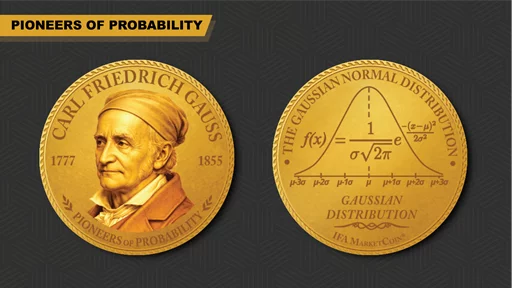
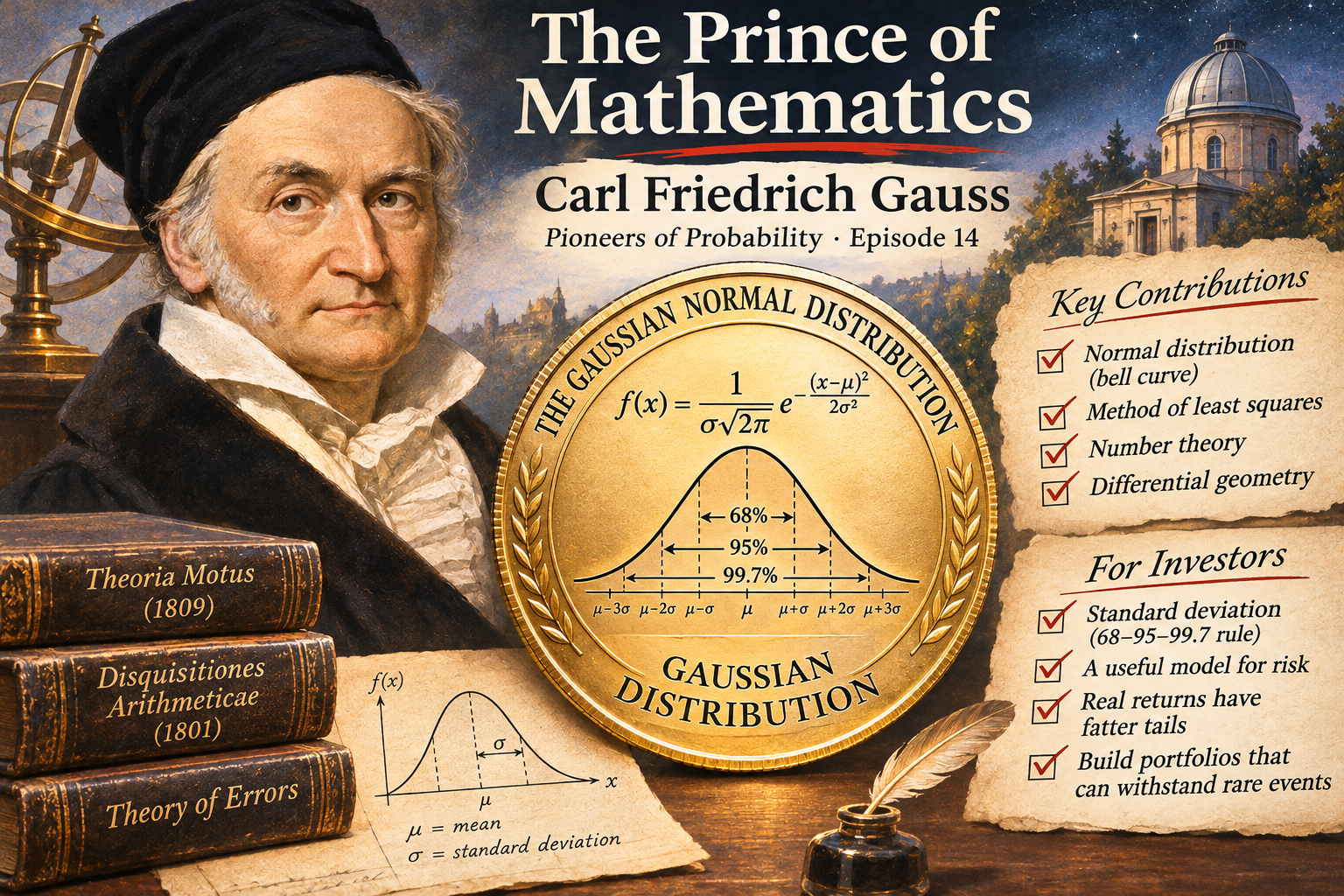
The formula appears on the reverse of the IFA MarketCoin® for Gauss in its full, exact form: f(x) = 1/(σ√2π) × e^(−(x−μ)² / 2σ²), beneath the inscriptions "The Gaussian Normal Distribution" and "Gaussian Distribution." The coin also shows the bell curve with its signature markers: 68 percent of observations falling within one standard deviation of the mean, 95 percent within two, 99.7 percent within three. These are not approximations. They are exact results, derivable from the formula, that have become the working vocabulary of every field that measures uncertain quantities.
Two parameters describe the distribution completely: μ, the mean — the center of the bell, the most probable value; and σ, the standard deviation — the spread of the bell, the typical size of an error. Every bell curve in every textbook, every risk model, every quality control chart, every scientific measurement report is described by exactly these two numbers.
Gauss was characteristically reluctant to publish what he had not perfected. His private mathematical diary — discovered after his death — revealed that he had anticipated multiple major mathematical discoveries years or even decades before others published them. He is credited with anticipating non-Euclidean geometry, the law of quadratic reciprocity, aspects of complex analysis, and much more — results he had kept to himself because they were not yet in the form he considered complete. He held his work to an impossibly high standard. His motto was pauca sed matura — few, but ripe.
The normal distribution bears his name rather than de Moivre's partly because de Moivre's derivation was from the binomial (a computational approximation) and Gauss's was from error theory (a theoretical justification). Gauss gave it a reason to be true. The curve he described was not merely an observation about what happens when you flip many coins. It was the shape that measurement errors must take, derived from first principles about what good measurement means.
◆ The Legacy
Gauss remained at Göttingen for the rest of his life as professor of astronomy and director of the observatory. He conducted the geodetic survey of the Kingdom of Hanover, literally walking across it for years taking measurements, applying his methods to produce maps of unprecedented precision. He and Wilhelm Weber invented the electromagnetic telegraph. He made fundamental contributions to differential geometry, magnetism, and optics. He won the Copley Medal — the Royal Society's highest honor — in 1838.
His portrait was, for most of the twentieth century, on the German ten-Deutsche-Mark note — the normal curve printed beside him, the formula inscribed in the background. His name is applied to at least a dozen major results across mathematics and physics. He is, by any reasonable accounting, one of the three or four greatest mathematicians in recorded history, and is sometimes called the greatest without qualification.
He died in 1855 at his desk in Göttingen. His notebooks, examined afterward, contained results that mathematicians spent the next several decades publishing as new discoveries, only to find that Gauss had been there first and had kept quiet about it.
◆ Your Money
For investors, the Gaussian normal distribution is simultaneously the most useful framework in quantitative finance and its most important limitation — and both facts need to be held simultaneously.
Standard deviation — the number that appears on every fund fact sheet as the primary measure of volatility — is a concept that makes full mathematical sense only within Gauss's framework. A portfolio with an annual standard deviation of 15 percent is, in Gaussian terms, one where roughly two-thirds of annual returns fall within 15 percentage points of the mean, and roughly 95 percent fall within 30 percentage points. These estimates, from the 68-95-99.7 rule on the coin's reverse, are standard tools for understanding portfolio risk.
But real market returns are not perfectly Gaussian. The tails of the actual distribution are fatter than the bell curve predicts. Extreme events — the crashes, the crises, the sudden dislocations that define career-altering moments in investment history — happen more often than a normal model suggests. The 2008 financial crisis produced daily losses that were astronomically unlikely under Gaussian assumptions, and produced them on consecutive days. Every serious risk manager knows this.
Gauss himself understood the limits of any model derived from assumptions. His derivation of the normal distribution from error theory was rigorous — but it rested on specific assumptions about the behavior of errors that may or may not hold in a given application. The discipline he modeled was one of always asking: are my assumptions justified here?
Use the bell curve. Understand the 68-95-99.7 rule. Know what standard deviation means. Then never forget that the tails are fatter than the formula says, and that the rare events are less rare than they appear. Build portfolios that can survive what the normal distribution says should almost never happen. The prince of mathematics proved the bell curve. He would have been the first to tell you it is a model, not a map.
Sources: Gauss, C. F. (1809). Theoria motus corporum coelestium. Perthes and Besser. Stigler, S. M. (1986). The history of statistics. Harvard University Press. MacTutor History of Mathematics, University of St Andrews.
Disclosure: This article is for informational and educational purposes only and does not constitute a solicitation or recommendation to buy or sell any security. Past performance is not indicative of future results. All investing involves risk, including the possible loss of principal. Any historical return examples, if referenced, are hypothetical illustrations based on published index data and are not reflective of actual investor experience. Statements regarding statistical concepts, market behavior, and portfolio construction reflect educational commentary and should not be construed as forecasts or guarantees of future market outcomes.
Content is AI-assisted. Index Fund Advisors, Inc. is a registered investment adviser. For additional information, please visit adviserinfo.sec.gov or www.ifa.com.
About the pen name: "Claude Hebner" represents a collaboration between Mark Hebner, founder and CEO of Index Fund Advisors, Inc., and Claude, Anthropic's AI. The research, historical narrative, and investment analysis in each article are the result of that partnership, combining human editorial oversight with AI-assisted research and drafting.