Pioneers of Probability: Andrey Markov

Disclosure:
This video is for informational and educational purposes only and does not constitute a solicitation or recommendation to buy or sell any security. The historical and mathematical concepts discussed are intended to illustrate the development of probability theory and its relevance to investing. Past performance is not indicative of future results. All investing involves risk, including the possible loss of principal. This video does not present IFA performance results. The IFA Markov Chain Calculator referenced uses hypothetical, back-tested data, which has inherent limitations and is not indicative of future results; see IFA's Back-testing Disclosures at ifabt.com. Content is AI-assisted. Index Fund Advisors, Inc. is a registered investment adviser; however, such registration does not imply a certain level of skill or training and no inference to the contrary should be made. For additional information, please visit adviserinfo.sec.gov or www.ifa.com.
The market went up today. Does that tell you anything about tomorrow?
Many investors behave as though it does. A strong week prompts optimism — surely the momentum will continue. A bad month prompts fear — surely more losses are coming. We instinctively treat recent market direction as information about future direction.
But what if it isn't? What if the market, like a flipped coin, has no memory? What if everything that happened yesterday is genuinely irrelevant to what happens today?
That question — whether a sequence of events carries information about what comes next, or whether each event is independent of the last — is the question Andrey Markov spent his career answering. And the mathematical framework he built to answer it is a tool that can be used to test whether market-return direction shows evidence of dependence.
Welcome to Pioneers of Probability. This is the final episode.
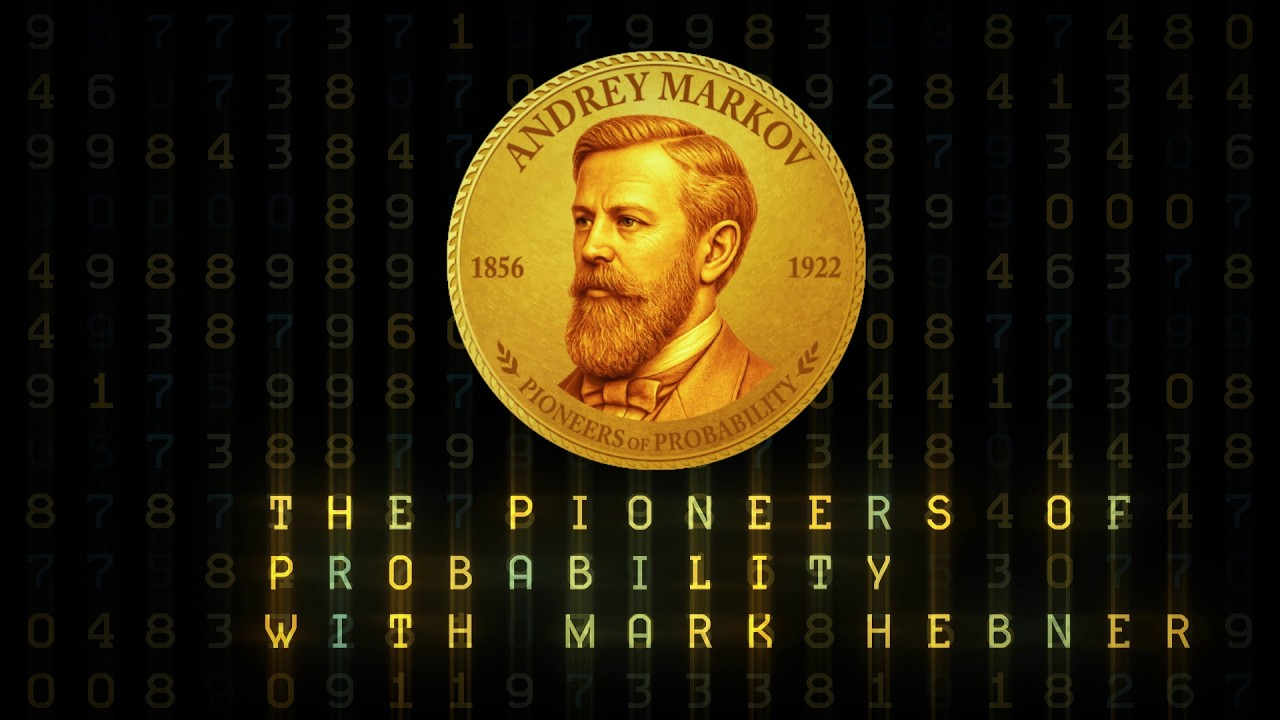
Andrey Markov was born in 1856 in Ryazan, Russia, and spent his career at St. Petersburg University — the same city where Daniel Bernoulli had published his solution to the St. Petersburg Paradox 118 years earlier. He was a brilliant and combative mathematician, famous for his feuds with colleagues and his fierce independence of mind.
His most celebrated contribution began with an unlikely subject: the sequence of vowels and consonants in Alexander Pushkin's novel in verse, Eugene Onegin. Markov counted the transitions — how often a vowel was followed by another vowel, how often by a consonant, and vice versa. He found that the probability of the next letter being a vowel or consonant depended on the current letter — but not on any letter before it.
This was a Markov chain: a sequence of events where the probability of each state depends only on the immediately preceding state, not on the full history of the sequence. The probabilities for the next state depend on the present state. The past — beyond the single most recent observation — does not affect those probabilities.
The coin reverse shows his vowel-consonant transition probabilities. A vowel is followed by another vowel 87 percent of the time and by a consonant 13 percent of the time. A consonant is followed by a vowel 67 percent of the time and by another consonant 33 percent of the time. Simple. Precise. And the foundation of an important mathematical framework in modern science.
A Markov chain has one defining property: memorylessness. The transition probabilities are fixed. They do not depend on how long you have been in the current state, or what states you visited before. Only now matters.
The simplest possible Markov chain has two states and equal transition probabilities — fifty percent chance of staying, fifty percent chance of switching. That is a fair coin flip. Each outcome is independent of the last. The chain has no memory at all.
Flip a fair coin thousands of times and the sequence will look like it contains patterns: streaks of heads, sudden reversals, stretches that feel due for a change. There are none. Each flip is a fresh start. The streaks are simply what randomness looks like, and the human mind is very good at finding stories in them.
Statisticians have a tool for telling a streak from a signal. The Runs Test — the Wald-Wolfowitz test — counts how often a sequence switches direction and compares that count with what pure chance would produce. If a sequence of ups and downs switches far more or far less often than chance predicts, something may be ordering it. If it does not, the sequence is consistent with a random ordering of direction.
For an investor, the question is whether the daily direction of an investment has memory in this sense: does an up day make another up day more or less likely? You do not have to take anyone's word for it. IFA's Markov Chain Calculator at IFAmarkov.com lets you pick an investment and a period and see the transition probabilities and the randomness tests for yourself.
Academic research on market efficiency, beginning in the 1960s, has found that past price changes are of limited use in predicting future ones, though researchers continue to debate how far this holds.
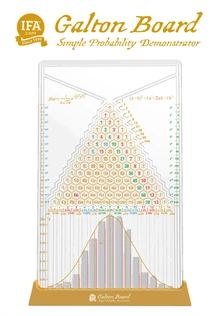
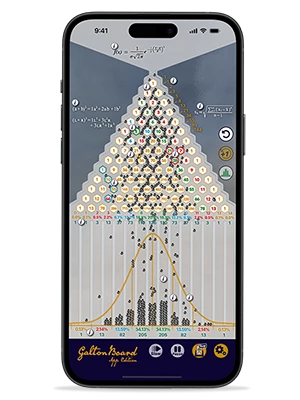
The Galton Board is a useful physical analogy for randomness in direction, even though the size of market movements involves more complex dynamics that a simple coin model does not capture.
Markov chains have become a widely applied mathematical tool in the history of science. They are used to model the folding of proteins, the spread of disease, the behavior of search engine algorithms, the training of language models, and the pricing of financial derivatives. When a system's future-state probabilities depend only on its current state — and not on its full history — a Markov chain may provide an appropriate framework.
Markov himself did not live to see most of these applications. He died in 1922, having spent his final years in an increasingly difficult political environment as Russia transformed around him. His mathematical work, characteristically, continued until the end.
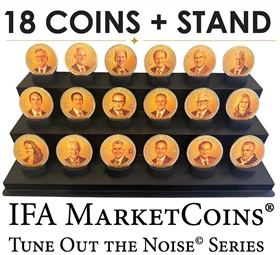
He is the last of eighteen pioneers in this series. The chain — from Fibonacci's numerals to Markov's transitions, from Cardano's gambling table to today's market data — is now complete.
Markov's idea carries a direct implication for investors, because it separates two things people constantly confuse: a streak and a signal.
If the direction of returns behaves as though it has no memory, then a run of up days does not make an up day more likely tomorrow, and a run of losses does not make a recovery more or less probable. A Markov chain gives you a way to check that for yourself, instead of relying on instinct.
This is consistent with the intuition behind what Eugene Fama would later formalize as the Efficient Market Hypothesis: if prices already reflect available information, yesterday's direction would already be reflected in today's price.
The investor who chases momentum — buying after up days, selling after down days — may be treating a process that behaves as though it has no memory as though it had one. The investor who tries to call turning points — buying after losses, expecting recovery — may be making the same error in the opposite direction. Both are at risk of reading patterns into a sequence where a streak is just a streak.
These are ideas to test, not guarantees. Markets can behave differently in different periods, and no statistical test can tell you what happens next.
Try it yourself at IFAmarkov.com. The Markov Chain Calculator compares the pattern of up and down periods in an investment's returns with fair coin flips, using standard randomness tests. What you find will depend on the investment and the period you choose.
This logic is consistent with a diversified, low-cost approach designed to capture broad market returns over time.
Eighteen pioneers. Eight hundred years. One chain of ideas, each link forged by a person solving the problem directly in front of them — a merchant's arithmetic, a gambler's puzzle, a duke's question about dice, a letter about an interrupted game, a theological argument, a book on reasoning, a legal dispute about evidence, a theorem about repetition, a coffee house calculation, a paradox about infinite expected value, a manuscript found after death, a definition of classical probability, a four-page appendix about orbits, an astronomical error model, a distribution of rare events, a dataset of Scottish soldiers, a board of falling beads, and a sequence of vowels and consonants in a Russian poem.
None of them were building modern finance. All of them were.
The mathematics of chance is now complete — not because the subject is exhausted, but because the core tools for thinking clearly about uncertainty, probability, risk, and return have now been introduced. The rest is application.
Fibonacci gave us the numbers. Markov showed us how to test for memory.
In between, sixteen thinkers gave us everything else.
We are eighteen steps into an 800-year story. The chain is complete.
Sources: Markov, A. A. (1906). Rasprostranenie zakona bol'shikh chisel na velichiny, zavisyashchie drug ot druga [Extension of the law of large numbers to dependent quantities]. Izvestiya Fiziko-Matematicheskogo Obshchestva pri Kazanskom Universitete, 15, 135–156. Basharin, G. P., Langville, A. N., & Naumov, V. A. (2004). The life and work of A.A. Markov. Linear Algebra and its Applications, 386, 3–26. Fama, E. F. (1965). The behavior of stock-market prices. Journal of Business, 38(1), 34–105. Samuelson, P. A. (1965). Proof that properly anticipated prices fluctuate randomly. Industrial Management Review, 6(2), 41–49.