Pioneers of Probability · Episode 15
This video is for informational and educational purposes only and does not constitute a solicitation or recommendation to buy or sell any security. The historical and mathematical concepts discussed are intended to illustrate the development of probability theory and its relevance to investing. Past performance is not indicative of future results. All investing involves risk, including the possible loss of principal. The examples provided are hypothetical and based on historical index data, not an actual investment. Index returns do not reflect the performance of any actual portfolio or the deduction of advisory fees. Content is AI assisted.
◆ The Question
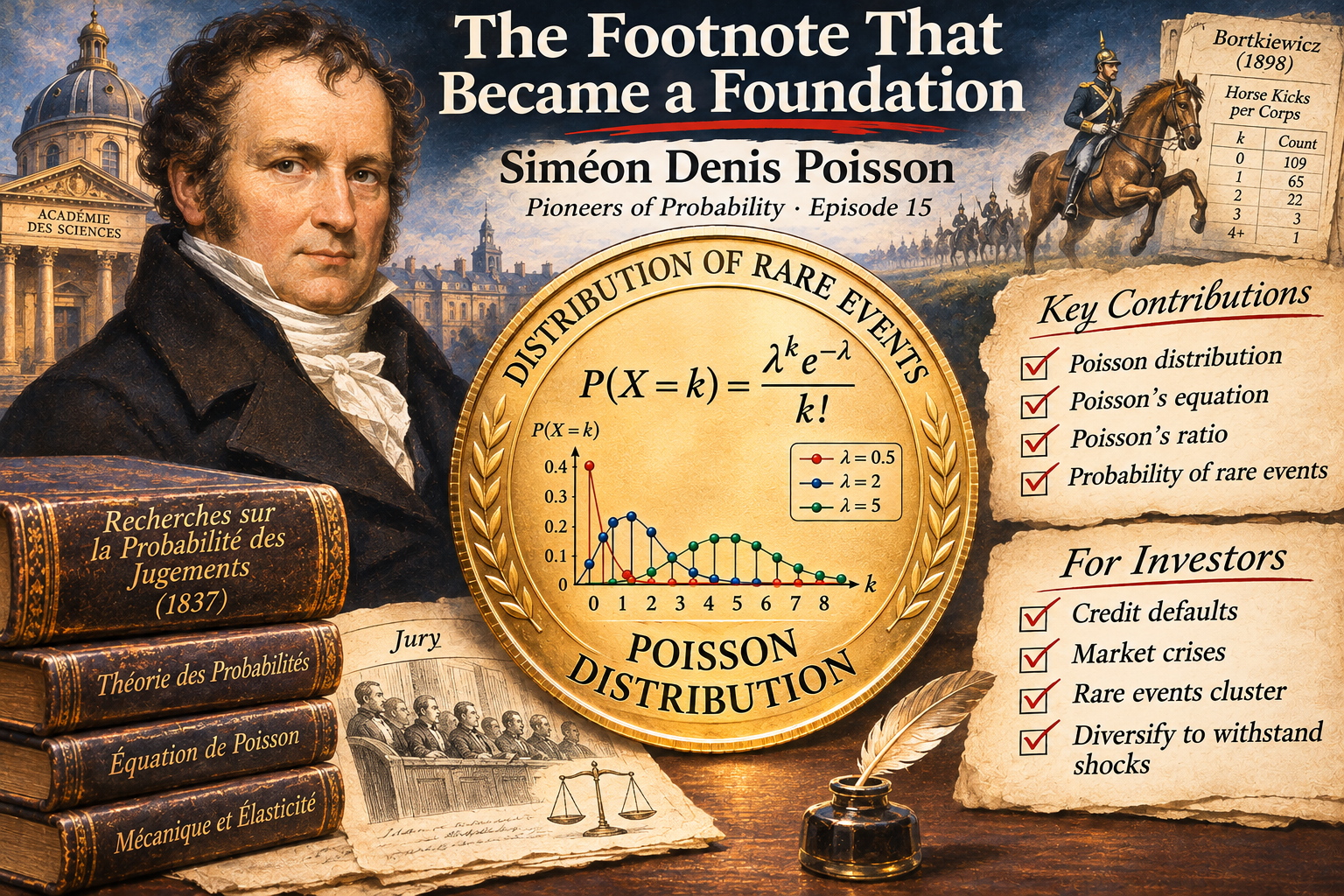
In the late 1890s, a statistician named Ladislaus Bortkiewicz sat down with a set of records from the Prussian army and began counting something that sounds almost comic: the number of soldiers killed by horse kicks in each cavalry corps in each year between 1875 and 1894.
He was not interested in horses. He was not particularly interested in the Prussian army. He was testing a mathematical model that had been published sixty years earlier, largely ignored, in a book about jury decisions by a French mathematician who had not lived to see whether anyone would find his footnote useful.
The model fit the data with striking precision. Bortkiewicz published his results in 1898 in a book entitled Das Gesetz der kleinen Zahlen — The Law of Small Numbers — a deliberate echo of Jacob Bernoulli's Law of Large Numbers. Where Bernoulli had described what happens as many independent trials accumulate, Poisson had described what happens when the probability of any individual event is very small but the opportunities for events are very large. Together, the two laws covered the full spectrum of probabilistic behavior, from the common to the rare.
The model Bortkiewicz was testing had been developed by Siméon Denis Poisson. The distribution that now bears his name had been sitting in a legal treatise since 1837, waiting for the right dataset to demonstrate its power.
◆ The Insight
Siméon Denis Poisson was born in 1781 in Pithiviers, France, the son of a former soldier who had been reduced to administrative work after the old regime ended. His father had hoped Poisson would become a surgeon, and arranged an apprenticeship for him. Poisson was, by all accounts, spectacularly unsuited for surgery — clumsy with instruments, temperamentally unsuited for clinical practice. He left and taught himself mathematics. His gifts were so obvious that at seventeen he passed the entrance examination for the école Polytechnique in Paris with the highest possible score.
At the école Polytechnique, he encountered Lagrange and Laplace — two of the dominant figures in French mathematics — and impressed both immediately. After a single year as a student, he was appointed répétiteur — teaching assistant — a position typically reserved for graduates. He never left academic life again. Over the next four decades, he published more than three hundred papers and books on mechanics, physics, mathematics, elasticity, magnetism, heat, and probability. He is credited with independently deriving the Navier-Stokes equations for fluid dynamics, introducing what is now called Poisson's ratio in mechanics, solving Poisson's equation in electrostatics, and developing major results in what would become potential theory. He reportedly said: "Life is good for only two things: discovering mathematics and teaching mathematics."
By 1837, Poisson was one of the most eminent scientists in France — a member of the Académie des Sciences, a professor at the Sorbonne, and that year elevated to the peerage as a Baron. In that same year he published the book that contained, almost as an aside, the probability distribution that would eventually carry his name.
◆ The Proof
The book was Recherches sur la Probabilité des Jugements en Matière Criminelle et en Matière Civile — Research on the Probability of Judgments in Criminal and Civil Matters. Its central subject was the reliability of jury verdicts: given the probability that a juror votes correctly, what is the probability that a majority verdict is just? Poisson analyzed French court records to estimate these probabilities and concluded, among other things, that a simple 7-5 majority was the appropriate standard for a twelve-person jury.
Buried within this analysis was a mathematical observation that would prove far more consequential than any of his jury conclusions. When the number of trials is very large and the probability of any individual event is very small, the binomial distribution — the exact formula for such situations — becomes computationally unwieldy. Poisson derived the elegant limiting form that approximates it: the distribution that now bears his name.
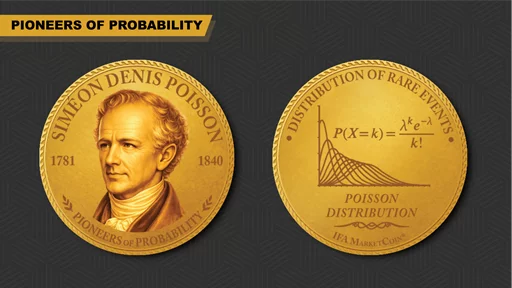
The formula on the reverse of the IFA MarketCoin® for Poisson states it directly: P(X = k) = λᵏ × e⁻λ / k!, beneath the inscriptions "Distribution of Rare Events" and "Poisson Distribution." The coin shows multiple Poisson curves with different values of λ — the single parameter that describes everything. λ is the average number of events expected in a given interval. k is the specific count you want to calculate the probability for. From those two numbers, the formula gives you the exact probability of observing exactly k events when you expect an average of λ.
When λ is small, the distribution is highly skewed — zero events is overwhelmingly the most likely outcome. As λ grows, the distribution spreads and symmetrizes, approaching the normal distribution for large values. The multiple curves on the coin trace this evolution, from the sharply asymmetric case of very rare events to the more symmetric case when events become moderately frequent.
Bortkiewicz's horse-kick data fit beautifully. With an average of 0.61 deaths per corps per year, the Poisson formula predicted the observed frequencies of zero, one, two, and three deaths per corps-year with remarkable accuracy. The mathematics described reality. A distribution developed to model wrongful jury convictions turned out to describe accidental cavalry deaths. And radioactive decay. And the arrival of phone calls at a telephone exchange. And mutations in DNA. And the occurrence of market crashes.
◆ The Legacy
Poisson did not live to see any of this. He died in April 1840 at the age of fifty-eight, still working, having attended the weekly meetings of the Académie des Sciences as an invalid in his final months. His distribution was largely ignored for most of the six decades between its publication and Bortkiewicz's vindication. The exception, as the historian Stephen Stigler notes, was Russia, where the mathematician Chebyshev engaged seriously with Poisson's probabilistic ideas and developed them further.
Once the horse-kick study brought the distribution to scientific attention, its versatility became clear almost immediately. Any process with many independent opportunities and tiny per-opportunity probability conforms to Poisson statistics: the emission of particles from a radioactive source, the occurrence of mutations in a DNA strand, the defaults in a large credit portfolio in a given year, the arrival of insurance claims in a given month. These phenomena — too rare to model reliably with the normal distribution, too numerous to track individually — were precisely what Poisson's law was designed for.
The distribution filled a gap in the probability toolkit that had existed since the normal distribution was named. Gauss's bell curve handles continuous measurements. Jacob Bernoulli's binomial handles repeated trials with fixed probability. The Poisson distribution handles discrete counts of rare events where individual probabilities are too small and opportunities too numerous to track directly. Together, these three distributions cover an enormous range of the phenomena that science and finance need to quantify.
◆ Your Money
For investors, the Poisson distribution addresses a class of events that the normal distribution handles worst: rare but devastating occurrences that define long-term portfolio outcomes more than any ordinary year.
Consider credit defaults. In a large portfolio of bonds or loans, each individual borrower has a small probability of defaulting in any given year. The defaults occur roughly independently. The average rate is relatively stable over time. This is precisely the Poisson regime. Poisson-based models are standard tools in credit risk management for exactly this reason — they give risk managers a principled way to estimate the probability of experiencing zero, one, two, or many defaults in a given period.
Consider market crises. If severe dislocations occur at a historically estimated average rate — say, once every ten years — the Poisson distribution tells you the probability of experiencing two in a decade is roughly 18 percent, not negligible. The probability of experiencing none in fifteen years is roughly 22 percent, also not negligible. A long-term investor who expects market crises to arrive on a perfectly regular schedule, or who is surprised when two arrive in close succession, has not internalized Poisson's arithmetic.
For the index investor, the lesson is not to avoid risk but to understand its structure. Rare events are not as rare as they feel — and patient diversification is not a strategy for avoiding them. It is the rational response to a world where rare events follow Poisson statistics: uncertain in their timing, but predictable in their long-run frequency, and survivable if the portfolio is not concentrated in the specific assets most vulnerable to any single crisis.
Poisson published his distribution as a footnote to a book about jury decisions. It took sixty years and a dataset about horse kicks to demonstrate its power. That is how foundational tools often arrive — quietly, before the problem that needs them has fully presented itself.
Sources: Poisson, S. D. (1837). Recherches sur la probabilité des jugements en matière criminelle et en matière civile. Bachelier. Bortkiewicz, L. von (1898). Das Gesetz der kleinen Zahlen. Teubner. Stigler, S. M. (1986). The history of statistics. Harvard University Press.
Disclosure: This article is for informational and educational purposes only and does not constitute a solicitation or recommendation to buy or sell any security. Past performance is not indicative of future results. All investing involves risk, including the possible loss of principal. Any historical return examples, if referenced, are hypothetical illustrations based on published index data and are not reflective of actual investor experience. Statements regarding statistical concepts, market behavior, and portfolio construction reflect educational commentary and should not be construed as forecasts or guarantees of future market outcomes.
Content is AI-assisted. Index Fund Advisors, Inc. is a registered investment adviser. For additional information, please visit adviserinfo.sec.gov or www.ifa.com.
About the pen name: "Claude Hebner" represents a collaboration between Mark Hebner, founder and CEO of Index Fund Advisors, Inc., and Claude, Anthropic's AI. The research, historical narrative, and investment analysis in each article are the result of that partnership, combining human editorial oversight with AI-assisted research and drafting.