Pioneers of Probability · Episode 13
This video is for informational and educational purposes only and does not constitute a solicitation or recommendation to buy or sell any security. The historical and mathematical concepts discussed are intended to illustrate the development of probability theory and its relevance to investing. Past performance is not indicative of future results. All investing involves risk, including the possible loss of principal. The examples provided are hypothetical and based on historical index data, not an actual investment. Index returns do not reflect the performance of any actual portfolio or the deduction of advisory fees. Content is AI assisted.
◆ The Question
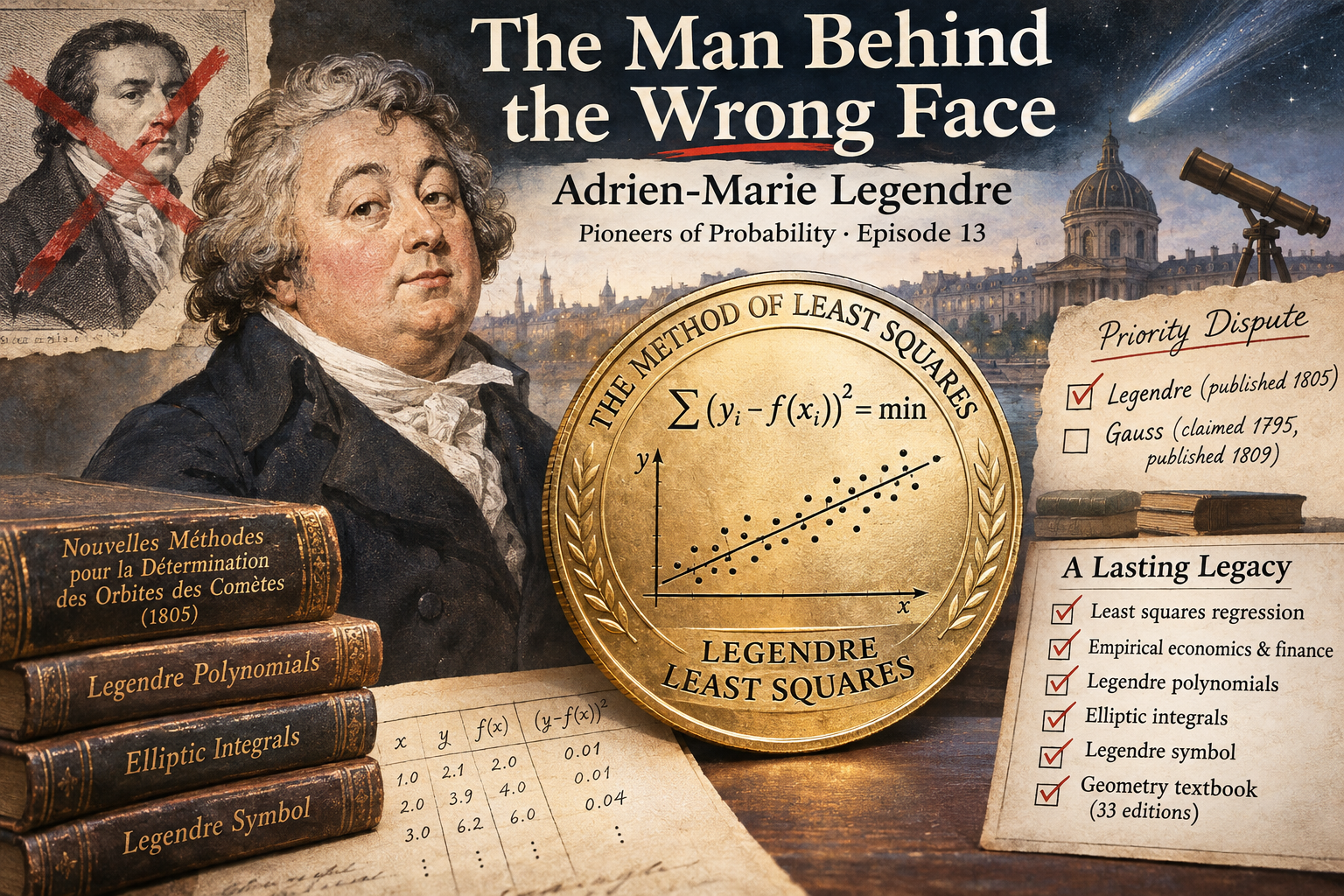
For more than a century, a confident-looking man in a dark coat stared out of the pages of history books, encyclopedias, and mathematics textbooks as the face of Adrien-Marie Legendre. He appeared in the authoritative histories, on websites, in university lecture slides. Generations of mathematicians and students learned to recognize him.
The portrait has nothing to do with Adrien-Marie Legendre. It depicts a different man entirely — Louis Legendre, a Revolutionary politician, a member of the Montagnards, a man who voted for the execution of Louis XVI and who shared only a surname with the mathematician. The error persisted for over a century because an 1874 edition of a collected works mislabeled an engraving, and no one checked closely enough to notice.
The real Adrien-Marie Legendre — the mathematician — was finally identified in 2007 when a researcher discovered an obscure 1820 album of watercolor caricatures held in the library of the Institut de France. There, on a single piece of paper with his contemporary Joseph Fourier, was a lightly satirical sketch of a rather round-faced man: the only authenticated image of Legendre known to exist. A caricature. The sole surviving likeness of the man who gave the world the method of least squares is a joke portrait, found in a private collection that had been auctioned at Christie's in 1999 before anyone knew what it contained.
The irony runs deeper than biography. Legendre spent much of his professional life fighting to have his priority recognized. He had published something first and watched someone else receive the credit. In the end, even his face had been replaced.
◆ The Insight
Adrien-Marie Legendre was born in Paris in 1752 to a wealthy family, educated at the prestigious Collège Mazarin, and had published significant work in number theory, geometry, and celestial mechanics before the French Revolution remade France and, incidentally, eliminated his private fortune. He lost everything in 1793. He married Marguerite-Claudine Couhin the same year — she is credited by historians with helping him restore order to his affairs — and continued working as a government mathematics examiner, a member of the reconstituted Académie des Sciences, and a contributor to the enormous project of standardizing the metric system.
In 1824, his government pension was stopped because he refused to vote for the official candidate at the Institut National. He was seventy-two years old. The pension was partially restored four years later when the political winds shifted. He died in Paris in 1833 after a long illness. His widow preserved his belongings with such dedication that she left their final home to the village of Auteuil where they are both buried. His name is among the 72 inscribed on the Eiffel Tower.
The problem Legendre was working on in 1805 was one of the central practical challenges of early nineteenth-century science: how to fit a mathematical model to a set of imperfect, inconsistent observations. Astronomers, geodesists, and physicists were drowning in data contaminated by measurement error. They had observations. They had models. They needed a principled, reproducible way to find the best fit between the two.
Different scientists had different methods, and no consensus existed. Some took averages. Some chose the observation that seemed most reliable. Some simply picked the result that best matched their preferred theory. None of these approaches had a mathematical justification for being optimal. The result was that two scientists analyzing the same data with different informal methods could arrive at different answers, both claiming confidence.
◆ The Proof
Legendre's answer appeared in 1805 as an appendix to a technical book on comet orbit determination — Nouvelles Méthodes pour la Détermination des Orbites des Comètes. The appendix ran to nine pages and introduced what he called the méthode des moindres carrés — the method of least squares.
The core idea, stated with characteristic directness, was this: among all possible methods for fitting a model to data, the one to use is the one that minimizes the sum of the squares of the errors. For each data point, calculate the difference between the observed value and the value your model predicts. Square each difference. Sum all the squared values. Find the model that makes that total as small as possible.
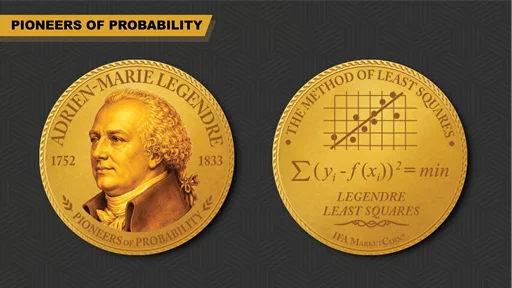
The IFA MarketCoin® for Legendre captures this precisely on its reverse, showing Σ(yᵢ − f(xᵢ))² = min alongside a scatter plot with a regression line fitted through data points, beneath the inscriptions "The Method of Least Squares" and "Legendre Least Squares." The scatter plot is not incidental. It is the entire story of what least squares does: it finds the line — or curve, or surface, or any mathematical function — that sits as close as possible, in the squared-error sense, to every data point simultaneously.
Legendre was confident in what he had. He wrote in the appendix: "Of all the principles that can be proposed for this purpose, I think there is none more general, more exact, or easier to apply." He was right. Within a decade, least squares had become standard in astronomy and geodesy across Europe. Within a generation, it was the foundational tool of empirical science.
Then Gauss published his Theoria Motus in 1809 and claimed he had been using the method since 1795. He acknowledged that Legendre had published it first. He claimed priority anyway. The two men exchanged increasingly sharp letters. Legendre fought to establish his precedence for the rest of his life, with only partial success. Modern historical consensus holds that Gauss almost certainly did develop the method independently and possibly earlier — but that he had kept it private, and that Legendre published it first. The credit went primarily to Gauss. The initial work had been Legendre's.
◆ The Legacy
The method of least squares became the backbone of regression analysis, which became the backbone of empirical economics, psychology, medicine, and finance. Every regression coefficient in every academic paper published since 1900 is a least squares result. Every factor model in finance, every earnings estimate, every election forecast built from polling data descends from the nine-page appendix Legendre tucked into the back of a book about comets.
His other contributions were substantial: Legendre polynomials, fundamental to physics and engineering; elliptic integrals, which occupied him for decades and provided the foundation on which Abel and Jacobi built their revolutions; the Legendre symbol in number theory; a geometry textbook that went through thirty-three editions and was used in schools for over a century. Niels Henrik Abel, one of the most gifted mathematicians of the nineteenth century, called him the founder of the theory of elliptic integrals. Galois theory has roots in Legendre's work on polynomials.
Most of it was completed or perfected by others. Most of it bears other names. That, too, is the Legendre story: first in the door, second in the history books.
◆ Your Money
Least squares regression is not a historical curiosity for investors. It is the analytical engine running beneath the most important empirical results in modern finance.
The Fama-French factor models — which identified market, size, value, profitability, and investment as systematic drivers of investment returns across decades and markets — were built with regression analysis. When a portfolio manager reports that a fund has a beta of 0.85, or a value tilt of 0.4, or a profitability exposure of 0.2, those numbers were estimated using least squares regression fitted to years of return data. Beta itself is a least squares regression coefficient: the slope of the line that best fits the fund's returns against the market's, minimizing the sum of squared residuals.
The practical implication is direct. Evidence about what drives investment returns — the case for capturing systematic risk factors broadly and cheaply — rests on this method. The line through the scatter plot on Legendre's coin points toward the same conclusion it has always pointed toward: own the factors, diversify broadly, minimize costs, and let the mathematics do the work.
Legendre gave science the tool. The tool has been used. The conclusion it keeps reaching is the same one every time.
Sources: Legendre, A.-M. (1805). Nouvelles méthodes pour la détermination des orbites des comètes. Courcier. Stigler, S. M. (1986). The history of statistics. Harvard University Press. Duren, P. (2009). Changing faces: The mistaken portrait of Legendre. Notices of the AMS, 56(11).
Disclosure: This article is for informational and educational purposes only and does not constitute a solicitation or recommendation to buy or sell any security. Past performance is not indicative of future results. All investing involves risk, including the possible loss of principal. Any historical return examples, if referenced, are hypothetical illustrations based on published index data and are not reflective of actual investor experience. Statements regarding statistical concepts, market behavior, and portfolio construction reflect educational commentary and should not be construed as forecasts or guarantees of future market outcomes.
Content is AI-assisted. Index Fund Advisors, Inc. is a registered investment adviser. For additional information, please visit adviserinfo.sec.gov or www.ifa.com.
About the pen name: "Claude Hebner" represents a collaboration between Mark Hebner, founder and CEO of Index Fund Advisors, Inc., and Claude, Anthropic's AI. The research, historical narrative, and investment analysis in each article are the result of that partnership, combining human editorial oversight with AI-assisted research and drafting.