Pioneers of Probability · Episode 16
This video is for informational and educational purposes only and does not constitute a solicitation or recommendation to buy or sell any security. The historical and mathematical concepts discussed are intended to illustrate the development of probability theory and its relevance to investing. Past performance is not indicative of future results. All investing involves risk, including the possible loss of principal. The examples provided are hypothetical and based on historical index data, not an actual investment. Index returns do not reflect the performance of any actual portfolio or the deduction of advisory fees. Content is AI assisted.
Adolphe Quetelet, the Average Man, and the double-edged power of human statistics
◆ The Question
Lambert Adolphe Jacques Quetelet was born in Ghent in 1796, the son of a French adventurer who had crossed the English Channel, become a British citizen, served as secretary to a Scottish nobleman, traveled Italy, eventually settled in Belgium, and died when Adolphe was seven years old. That biographical chain — French origin, British citizenship, Scottish employment, Italian travel, Belgian death — left a boy with remarkable cosmopolitan inheritance and no father. Quetelet's mother could not afford his continued education. He took a job teaching mathematics at a school in Audenaerde at seventeen, supporting his family on a schoolteacher's salary while quietly developing the mathematical gifts that would eventually make him one of the most influential scientists of the nineteenth century.
He earned his doctorate in mathematics from the University of Ghent at twenty-three. He went to Paris shortly afterward to study probability theory with Laplace, Fourier, and Poisson — the three most eminent probabilists alive. He returned to Brussels and founded the Royal Observatory there in 1828, directing it for decades. He organized the first international statistical congress. He accumulated over 2,500 correspondents, among them Goethe, Malthus, and US President James Garfield, who consulted him about improving the American census. He tutored Prince Albert, Queen Victoria's consort, and his ideas may have shaped Albert's thinking about the uses of science in governance. He essentially invented the discipline that Auguste Comte would later call sociology, describing it first as "social physics."
He was a cosmopolitan builder of institutions, a tireless correspondent, a man who believed that mathematics could illuminate the structure of human society the way it illuminated the structure of the solar system. He also, without intending to, handed future ideologues one of the most dangerous conceptual tools in the history of social thought.
◆ The Insight
The central insight of Quetelet's career was a reframing of the normal distribution so radical that it took the scientific community a generation to fully digest. Gauss had derived the normal distribution to describe measurement errors — the scatter of imprecise observations around a single true value. For Gauss, the distribution was noise. The signal was the true value at the center. Everything else was error.
Quetelet asked: what if the variation itself is real? What if the chest circumferences of 5,738 Scottish soldiers are not imperfect measurements of some single true chest circumference, but genuine, accurate measurements of 5,738 genuinely different chests — and the distribution of those differences follows the normal curve?
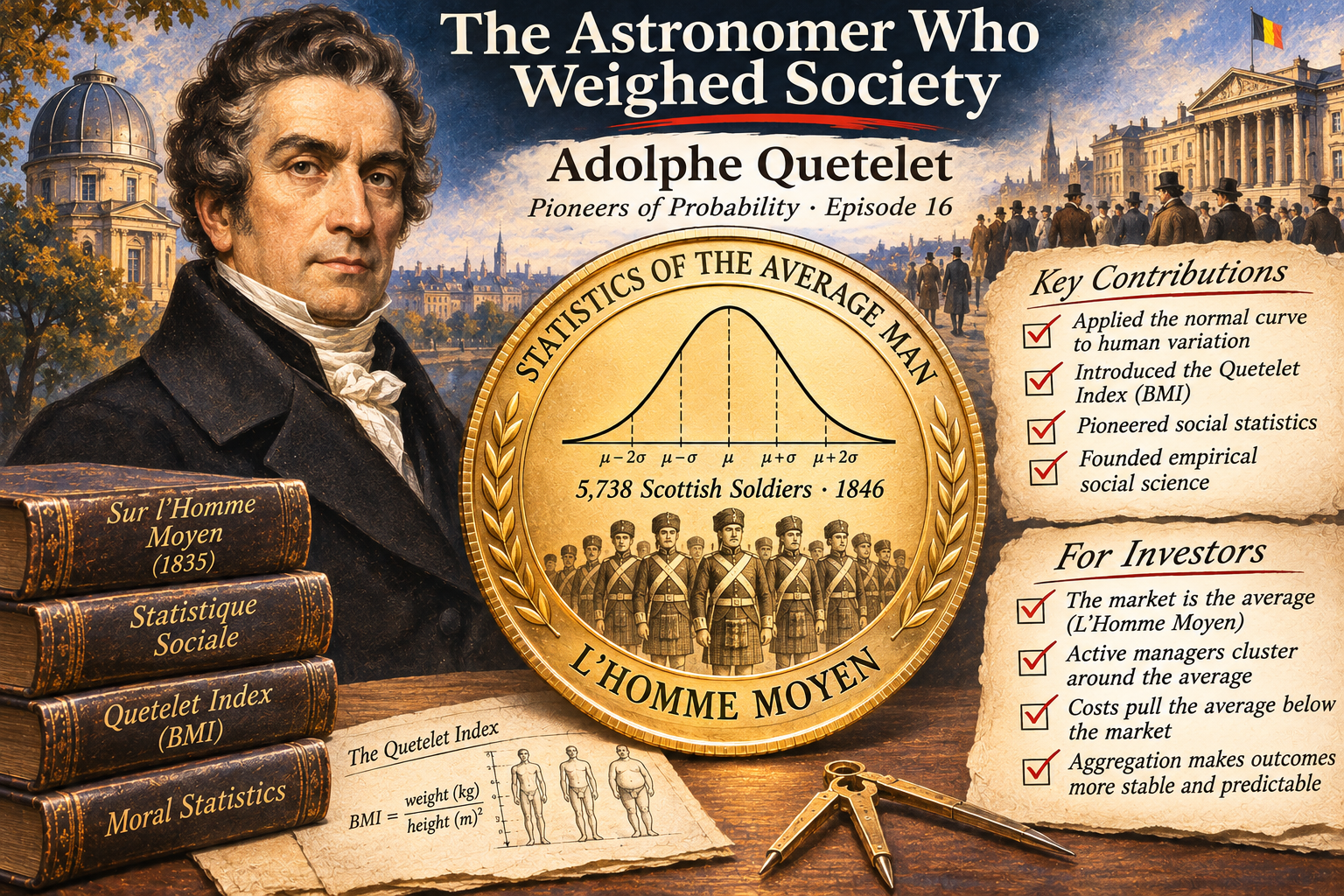
The dataset in question was published in 1846 in the Edinburgh Medical and Surgical Journal by a Scottish army surgeon who had measured the chest circumferences of 5,738 soldiers in inches. The measurements ranged from 33 to 48 inches. When Quetelet plotted their frequency distribution, the result was unmistakably a bell curve: smooth, symmetric, peaked at the average, declining toward the extremes. The IFA MarketCoin® for Quetelet honors this directly on its reverse, showing the normal distribution curve over the label "5,738 Scottish Soldiers • 1846" and "L'Homme Moyen," beneath the inscription "Statistics of the Average Man."
Quetelet concluded that the pattern he was observing in the soldiers' chests was not a statistical artifact but a law of nature. Just as astronomical instruments scatter their observations around the true position of a star, nature scatters the physical characteristics of a population around a central type — what he called L'Homme Moyen, the Average Man. This ideal type was not any specific person. It was the statistical center of the human distribution: the mean height, the mean weight, the mean chest measurement, the mean propensity toward crime or suicide or marriage. The Average Man was, in Quetelet's words, the center of gravity of the social system.
◆ The Proof
To operationalize his ideas, Quetelet developed what he called the Quetelet Index in 1832: a person's weight in kilograms divided by the square of their height in meters. It was a numerical tool for measuring how far an individual deviated from the average physical type. We know it today as the Body Mass Index — the BMI — used by physicians, health agencies, and insurers worldwide. It was not designed by a health researcher. It was designed by an astronomer trying to measure human beings the way he measured celestial objects.
Quetelet applied the same framework to what he called moral statistics: the frequency of crime, suicide, marriage, and other social phenomena across large populations. He found, to his considerable surprise, that these rates were remarkably stable from year to year — much more stable than any individual's choices would suggest. He concluded that social behavior, aggregated across millions of people, followed statistical laws as reliable as the laws of physics. Individual humans might feel free to act as they chose. Society as a whole obeyed equations.
He gathered data for decades, corresponding with governments across Europe to standardize the collection of vital statistics. He helped develop the Belgian census. He contributed to mortality tables that would eventually underpin modern insurance. He showed that birth rates, death rates, crime rates, and even suicide rates followed predictable distributions that could be modeled, compared between nations, and tracked over time. He was, in the fullest sense, the founder of empirical social science.
◆ The Legacy
Quetelet's legacy divides precisely along the line between his descriptive achievement and the uses to which it was put.
On the productive side, he established that human populations could be studied scientifically — that patterns in births, deaths, crime, and disease were not random but structured, and could be measured, modeled, and eventually influenced by policy. Every modern epidemiological study, every public health intervention, every demographic analysis builds on this framework. Florence Nightingale, who pioneered the use of statistics in medicine, was deeply influenced by Quetelet. So was Francis Galton, who appears in the next episode of this series. So was the entire tradition of quantitative social science.
On the problematic side, Quetelet's habit of treating the average as an ideal — and deviation from it as error, defect, or social pathology — proved dangerous in other hands. The eugenic movements of the late nineteenth and early twentieth centuries drew directly on the statistical frameworks he had established. The idea that human beings could be ranked by their deviation from an average, and that the distribution could in principle be improved by selective breeding or exclusion, required exactly the kind of normal-distribution thinking that Quetelet had made respectable. He did not advocate eugenics. But the conceptual infrastructure he built made it thinkable in a way it had not been before.
A stroke in 1855 left him significantly impaired for the last nineteen years of his life. He continued attending meetings and corresponding, but the productive work had essentially ended. He died in Brussels in 1874.
◆ Your Money
Quetelet's framework carries a direct and important implication for how investors should think about the population of investment outcomes.
If individual stock returns are approximately distributed around the market average, then active stock-pickers are sampling from that distribution. Some will land above average — in any given period, by luck alone, a predictable number will appear to be exceptional. Some will land below. Over short periods, luck determines most of where they land. Over long periods, the distribution reasserts itself: most active managers cluster near the average return, minus their costs.
This is the statistical case for indexing stated in Quetelet's language. The market return is the center — the L'Homme Moyen of the investment universe. Costs are a guaranteed negative deviation from it. The average active manager must, by definition, earn the average return before costs, because active managers collectively are the market. After costs, the average active manager earns less than the index.
There is a second lesson from Quetelet's life that applies equally well to investing: the power of aggregation. He showed that individual choices — whether to commit a crime, whether to marry in a given year, whether to die before fifty — appear random and unpredictable at the individual level. Aggregated across millions of people, they follow stable, predictable distributions. The market is similar. No individual stock's next year is predictable. The aggregate return of a diversified portfolio, over long periods, is far more stable than any of its components. Own the average. Let the distribution work for you.
Sources: Quetelet, A. (1842). A treatise on man and the development of his faculties (R. Knox, Trans.). William and Robert Chambers. Stigler, S. M. (1986). The history of statistics. Harvard University Press. Britannica: Adolphe Quetelet.
Disclosure: This article is for informational and educational purposes only and does not constitute a solicitation or recommendation to buy or sell any security. Past performance is not indicative of future results. All investing involves risk, including the possible loss of principal. Any historical return examples, if referenced, are hypothetical illustrations based on published index data and are not reflective of actual investor experience. Statements regarding statistical concepts, market behavior, and portfolio construction reflect educational commentary and should not be construed as forecasts or guarantees of future market outcomes.
Content is AI-assisted. Index Fund Advisors, Inc. is a registered investment adviser. For additional information, please visit adviserinfo.sec.gov or www.ifa.com.
About the pen name: "Claude Hebner" represents a collaboration between Mark Hebner, founder and CEO of Index Fund Advisors, Inc., and Claude, Anthropic's AI. The research, historical narrative, and investment analysis in each article are the result of that partnership, combining human editorial oversight with AI-assisted research and drafting.