About two basis points a year. That is what new research from Chicago and Wharton estimates access to private markets may be worth to a retail investor. Institutional pricing, with no fee penalty at all, would add next to nothing to it.
Set the fees aside for a moment. Forget the sales load, the platform charge, the advisory markup, and the fund expenses stacked underneath all of them. Imagine instead being offered private markets on precisely the terms a large pension plan gets — the same pricing, the same access, no penalty at all for being a household rather than an institution. What would that be worth?
The question matters now, because the offer is arriving. Executive Order 14330, "Democratizing Access to Alternative Assets for 401(k) Investors," was signed on August 7, 2025. The title tells you how the case is being made. Access is the product.
The vehicles carrying that access are multiplying too. Morningstar counted net assets approaching $600 billion in semi-liquid funds at the end of March 2026, more than double the end-2022 figure. That universe is broader than private equity, taking in non-traded credit and property funds as well.
None of what follows argues that private equity is a poor asset class. The academic surveys have generally found its historical record favorable, particularly in buyouts. This is a narrower question, and a prior one. Before anyone argues about the price of access, it is worth establishing what access is worth.
What The Access Is Actually Worth
According to the authors' model, opening private markets to retail investors would make them better off by roughly one to two basis points of wealth a year. That is the central finding of a working paper published in August 2026 by Ľuboš Pástor of Chicago Booth, with Robert Stambaugh and Lucian Taylor of Wharton.
The measure they use is a welfare gain: the extra certain return an investor would need to be handed to be exactly as well off as democratization makes them. Hold the capital private firms raise fixed, and it averages one basis point a year and never exceeds three. Let firms respond by raising more, and the average reaches two, the 95th percentile seven, and the highest figure anywhere in the results 24.
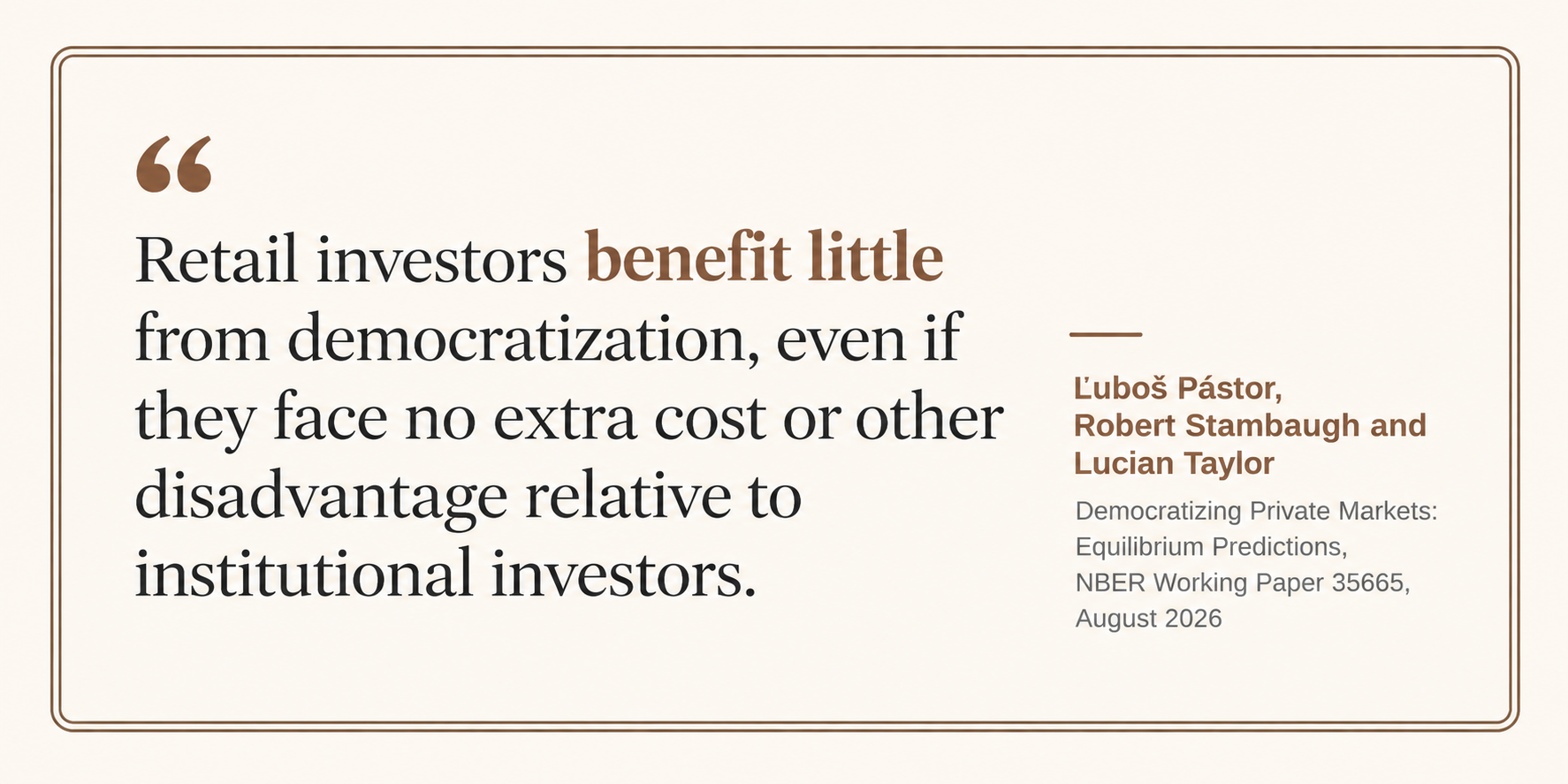
Then the authors removed the obstacle most of the public argument is about. They set the retail investor's cost disadvantage to zero, with no extra fee, no worse access, no informational handicap, and ran it again. The averages came out at one basis point and three. Retail investors, they write, "benefit little from democratization, even if they face no extra cost or other disadvantage relative to institutional investors."
This is a calibrated model rather than a record of what anyone earned, and it has not been peer reviewed. Nor is it one convenient scenario. The authors varied their parameters across a grid, kept every combination meeting their empirical restrictions, and were left with 16,870 of them. They also discarded the combinations in which retail investors would buy nothing at all, which would have dragged the averages lower still. These are the generous numbers.
*Pástor is an independent director and trustee of Vanguard.
Why The Gain Is So Small
The authors conclude the benefit is small largely because the private market is relatively small. Diversification pays only for risk you do not already own, and public and private companies rise and fall together far more than the marketing implies. An investor shut out of private markets already owns something that behaves a great deal like the companies inside it. Only the leftover part, the private-company risk that public markets miss, is genuinely on offer, and how much of it there is depends on the size of the private market.
In the authors' calibration, that size is $5.6 trillion of North American private equity and venture capital, reported by Preqin for December 2025, against $70.6 trillion of US public equity. Private equity funds come to about 7.4 percent of the two combined. Their share of total US equity has more than doubled since 2000, from below 3 percent to recent highs between 7 and 9. It has grown fast, and it is still small.
Nor does much hang on that figure. Double the private market's share to 16 percent and the gain rises to 4.0 basis points with capital fixed and 11.2 with capital adjusting. Push it to 30 percent, far beyond any current estimate, and it reaches 18.0 and 47.0. The conclusion holds under assumptions considerably kinder than the evidence supports.
The portfolios themselves show it most plainly. Across every calibration, the correlation between a retail investor's returns before democratization and after runs from 0.992 to 1.000, with a mean and median of 0.999. The private market, as the authors put it, "is simply too small for improved risk sharing to matter much."
Who The Change Is Actually For
The large effects in this research land on the companies raising the money, not the households supplying it. Before democratization, the private firm in the model earns about a percentage point a year more than its market risk alone would justify, a positive CAPM alpha in the jargon. Open it to retail buyers and that premium falls to roughly 0.4 points. The extra return was payment for bearing a risk only institutions could bear, and a risk shared across far more buyers commands less.
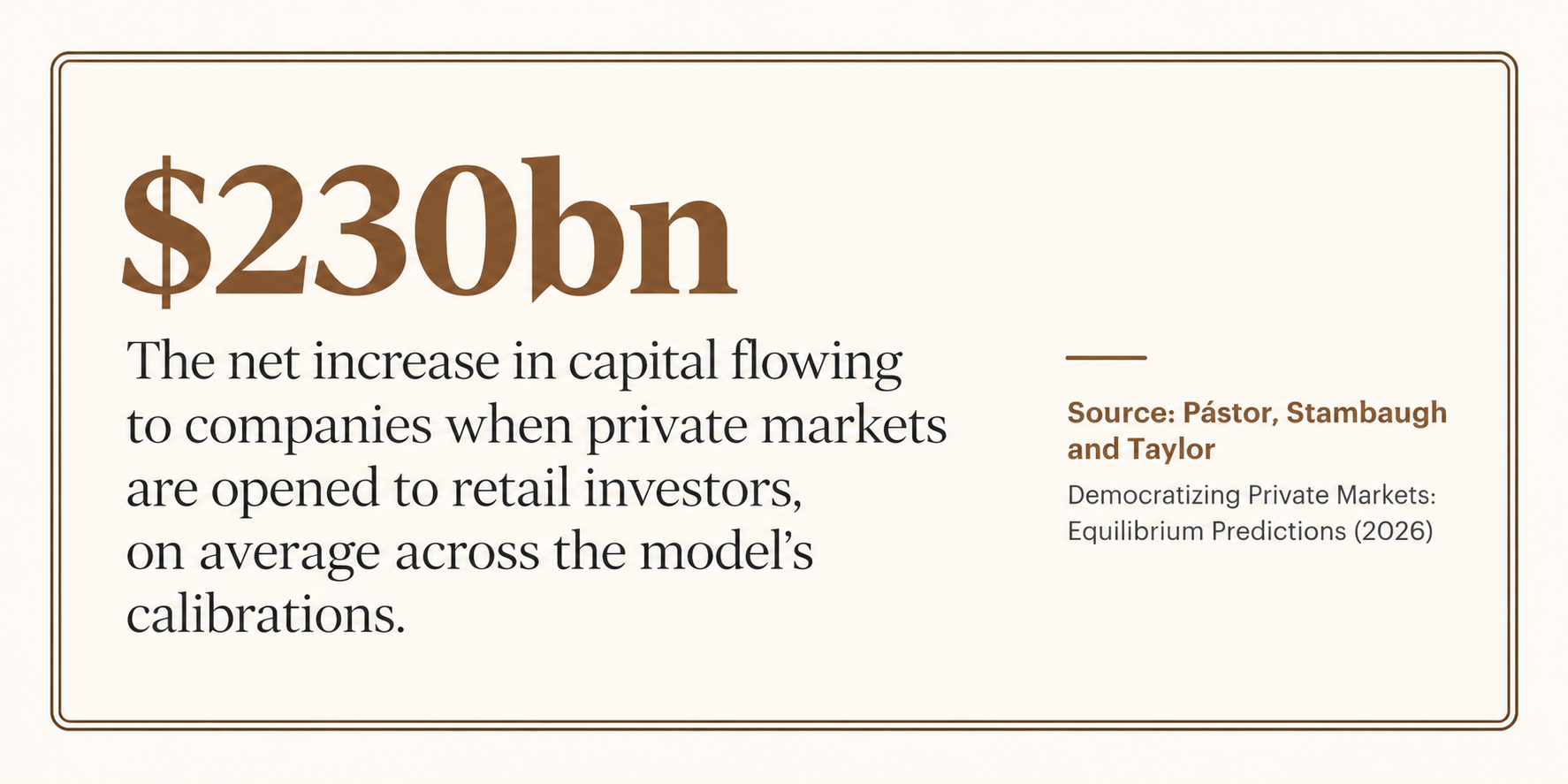
The firm's cost of capital drops by more than 60 basis points, and it does what any company does when capital gets cheaper. Private-firm capital expands by 4.8 percent on average, public-firm capital slips by five basis points, and the net effect is roughly $230 billion of additional capital in the economy.
Retail investors do end up owning a serious slice of that private firm, just over 40 percent on average, with a range across calibrations running from nothing to 78 percent. Strip out their cost disadvantage and the share reaches 72 percent, simply their share of total wealth. Institutions lose. Their loss averages 11 basis points and reaches 67 at its worst, more than the corresponding retail gain, so aggregate investor welfare generally falls.
The authors are careful about what that does and does not mean, and so should we be. Their measure covers investors only. It leaves out the original owners who sell, the intermediaries who take a cut, and the workers and consumers who might benefit from a larger capital stock. They write that they "do not read the aggregate certainty-equivalent decline as a verdict against democratization." Neither should anyone else.
A Second Route To The Same Answer
The obvious objection is that this is a model, not a record of what happened. Fair enough. But three things make it hard to dismiss on those grounds. The parameters were bounded by empirical restrictions rather than chosen for convenience. The result holds when the cost disadvantage is removed. And a separate body of work, using none of the same tools, arrives at the same place.
William Clayton of Brigham Young University and Elisabeth de Fontenay of Duke, in a paper forthcoming in the Duke Law Journal, come at it as institutional analysts rather than asset pricers. Private equity's supposed advantages, they argue, rest on concentrated ownership, long holding periods, bespoke contracting and sophisticated repeat-player investors, all of which depend on the asset class staying private. Push more capital in and attractive opportunities get competed away. Access to sought-after managers is rationed, so opening the asset class does not open its best funds. And retail wrappers create pressure toward more liquidity, more frequent valuation and broader diversification, making private equity steadily more like the public markets it claims to beat.
Read them together. Pástor, Stambaugh and Taylor assume conditions unusually kind to retail investors and still find almost nothing. Clayton and de Fontenay argue real conditions are considerably less kind. Two disciplines, opposite methods, and broadly similar conclusions.
One limit deserves stating. The model covers a single period and treats illiquidity as a holding cost, so it does not settle whether a long-horizon saver is well placed to bear lock-ups. But if the diversification gain is a basis point or two, whatever premium is on offer for bearing them may compensate investors for a risk that, according to the authors' framework, provides limited diversification benefit.
What Is Actually Being Sold
The vehicles being built to deliver private markets for retail investors cost more than 3 percent a year, and several do not hold what the pitch implies. Morningstar's June 2026 study put the average net expense ratio in annual reports, adjusted for borrowing costs, a little above 3 percent, and its warning matters as much as its number. Even that figure understates what investors pay, because incentive fees and underlying fund expenses are not disclosed consistently. Incentive fees alone can "rival, or even exceed, management fees."
Cliffwater's August 2024 study of 19 registered private equity interval and tender-offer funds found all-in expenses averaging 2.91 percent of net asset value, ranging from 0.96 to 5.49 percent, using each fund's cheapest institutional share class. Mark Hebner has written on IFA about the chain of intermediaries that produces numbers like these, in "The Silent Partner Problem."
The more interesting finding in the Morningstar work concerns contents rather than price. Many widely available private equity semi-liquid products buy minority stakes rather than taking the operating control traditionally associated with private equity, or invest through other private funds instead. Both approaches, Morningstar notes, dilute the very control said to drive private equity returns, and the fund-of-funds route adds another layer of fees. Registered vehicles also face co-investment restrictions, and a new semi-liquid fund can be too small to get a meaningful allocation to the deals its manager's established funds are doing.
Access to an asset class is not access to its returns. Even institutions are finding those returns harder to reach. Harris, Jenkinson, Kaplan and Stucke, using institutional cash-flow data through December 2020, found buyout persistence had weakened substantially, with little evidence of it after 2000 once investors are held to what they knew when a manager's next fund was raising. Venture capital held up better. Past performance is never a reliable guide to future returns, and on this evidence a particularly poor one in buyouts.
The Question Worth Asking
We began by granting the industry its best case. Institutional pricing, institutional access, no handicap for being a household. Measured honestly, that best case is worth single basis points a year, and everything the fee argument fights over sits downstream of it.
One of the largest effects identified in this research turns up somewhere else entirely, in the financing costs of the companies doing the raising. Worth knowing, before you are asked to supply the capital.
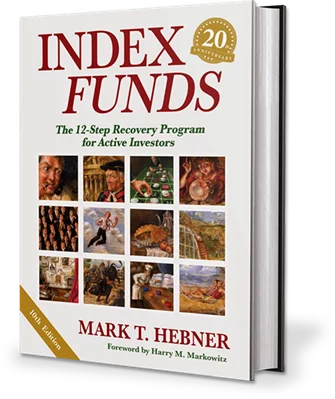
Hebner has spent ten editions of Index Funds: The 12-Step Recovery Program for Active Investors making a version of the same point, that long-term outcomes may be influenced by cost and by risks for which investors have historically been compensated.
So when private markets for retail investors appear on your menu, inside a 401(k) or alongside it, price is the second question. The first is what the diversification benefit is, before anything is charged for it. Investors may wish to ask that question and evaluate whether the answer is supported by quantitative evidence.
Resources
Clayton, W. W., & de Fontenay, E. (forthcoming). Private equity for all: The paradoxical push to democratize private markets. Duke Law Journal.
Harris, R. S., Jenkinson, T., Kaplan, S. N., & Stucke, R. (2023). Has persistence persisted in private equity? Evidence from buyout and venture capital funds. Journal of Corporate Finance, 81, 102361.
Pástor, Ľ., Stambaugh, R. F., & Taylor, L. A. (2026). Democratizing private markets: Equilibrium predictions (Working Paper No. 35665). National Bureau of Economic Research.
ROBIN POWELL is the Creative Director at Index Fund Advisors (IFA). He is also a financial journalist and the Editor of The Evidence-Based Investor. This article reflects IFA's investment philosophy and is intended for informational purposes only.
DISCLOSURES:
This article is for informational purposes only and does not constitute investment advice, an offer, or a solicitation to buy or sell any security. This material includes general educational information and should not be interpreted as individualized investment advice or a recommendation to take any specific action. Past performance is not indicative of future results. All examples and data cited are based on historical analysis and may not reflect future market conditions. Investing involves risks, including the possible loss of principal. The mathematical principles and academic research discussed illustrate theoretical and historical concepts and should not be interpreted as guarantees of investment outcomes. Diversification does not ensure profit or protect against loss.
Any discussion of regulatory actions is based on publicly available information and should not be interpreted as representative of industry-wide practices. There is no guarantee that reducing turnover or fees will result in improved investment outcomes.
The information discussed is general in nature and may not be suitable for all investors. Examples and studies cited reflect specific time periods and may not be representative of all market conditions or investor experiences. Individual circumstances vary, and readers should consult a qualified professional regarding their personal situation. Index Fund Advisors, Inc. (IFA) believes the information to be accurate but does not guarantee its completeness or accuracy. This article was sourced and prepared with the assistance of artificial intelligence (AI) technology.For more information about Index Fund Advisors, Inc, please review our brochure at https://www.adviserinfo.sec.gov/ or visit www.ifa.com.