David Booth's new book reinforces an investment philosophy that Index Fund Advisors has taught since 1999: accept uncertainty, trust market prices, diversify broadly, follow the evidence, and stop trying to predict what cannot be predicted.
David Booth chose two words for the title of his new book that may be among the most valuable instructions an investor can receive:
Stay Calm.
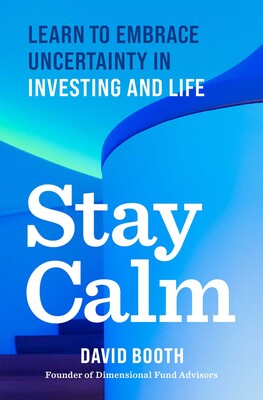 For more than five decades, Booth, founder of Dimensional Fund Advisors, has worked at the intersection of academic financial research and real-world investing. His new book, Stay Calm: Learn to Embrace Uncertainty in Investing and Life, distills many of the lessons from that remarkable career into an idea that sounds simple but has profound implications: a sound investment process need not rely on predicting an uncertain future. It requires learning how to make sensible decisions without knowing exactly what comes next.
Published September 1, 2026, the 240-page book describes an approach rooted not in predictions, market timing or investment "hacks," but in evidence, diversification, discipline and long-term thinking. The publisher describes Booth as having spent more than 50 years helping transform investing from speculation toward a discipline informed by financial science.
That philosophy should sound familiar to longtime readers and clients of Index Fund Advisors.
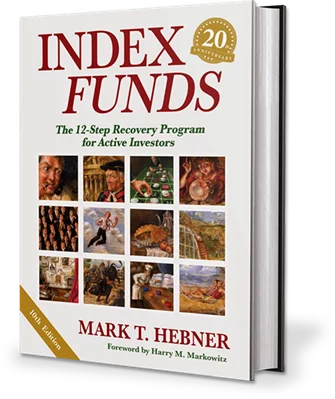
When I founded IFA in 1999, I had reached many of the same conclusions through my own experience with active investing and, importantly, through the academic research and education that subsequently changed the way I thought about markets. I eventually organized those lessons into Index Funds: The 12-Step Recovery Program for Active Investors.
The first eleven steps are intended to help investors understand why stock picking, market timing, manager picking, style drifting, excessive costs and other forms of speculation are so difficult to convert into reliable investment strategies. They then introduce investors to risk, market history, diversification, risk capacity and appropriate portfolio construction.
And then comes Step 12:
Invest and Relax
That has been IFA's destination for investors since 1999.
Booth calls it Stay Calm.
IFA calls it Invest and Relax.
Academy Award-winning director Errol Morris gave essentially the same idea another memorable name in his documentary about the revolution in financial science:
Tune Out the Noise.
Different words. Same fundamental lesson.
The Future Is Uncertain. That Is Not a Problem to Be Solved.
Much of the financial industry is built around the proposition that uncertainty is a problem someone can solve for you.
Turn on financial television and someone will tell you where stocks are going next. Read market commentary and someone will forecast interest rates, inflation, artificial intelligence, oil prices, recessions, elections or Federal Reserve policy.
Wall Street has spent generations selling investors the idea that someone, somewhere, can see around the corner.
The great contribution of financial science was to ask a different question:
What if investors don't need to see around the corner?
That is where Booth's Stay Calm connects directly with the philosophy IFA has taught for more than a quarter century.
Prices in highly competitive markets incorporate an enormous amount of information and the collective expectations of millions of participants. What changes prices tomorrow is largely new information. If information is genuinely new, we should not expect investors, analysts, algorithms or investment committees to consistently know it today.
Accepting that fact can initially be uncomfortable.
Eventually, it can become liberating.
You no longer need to know which company will become the next great market winner. You don't need to predict the next recession. You don't need to know when the Federal Reserve will change rates. You don't need to identify the next star fund manager. And you don't need to decide every morning whether the market is about to rise or fall.
You need a portfolio and financial plan that do not depend on knowing those things.
That idea is central to Stay Calm. Booth's book emphasizes trusting markets rather than gurus, diversification rather than concentrated bets, discipline rather than reaction, and treating uncertainty as something investors must intelligently accommodate rather than eliminate.
Investing Is Decision-Making Under Uncertainty
This is one reason I believe Stay Calm may be valuable to many investors.
Investing forces us to make important decisions today with incomplete knowledge of tomorrow.
That is true for a 30-year-old making a first 401(k) contribution.
It is true for a retired couple depending on a portfolio for income.
It is true for a family office.
And it is equally true for the investment committee responsible for a multibillion-dollar pension, endowment or foundation.
The appropriate portfolio may be radically different in each case. The underlying problem is not.
All of these investors must make decisions in the presence of uncertainty.
Financial science gives us a much better framework for making those decisions than prediction does.
Instead of asking, What is going to happen next?, an evidence-based investor can ask, How should I position my portfolio given the range of things that could happen?
That change in the question can substantially change an investor's decision-making framework.
From Financial Theory to an Investment Philosophy
Booth's career is particularly important because he helped bridge the enormous gap between academic discoveries and actual portfolios.
The intellectual foundation came from researchers including Eugene Fama and many of the economists associated with the University of Chicago. Their work helped transform finance from a field dominated by Wall Street anecdotes and conventional wisdom into one increasingly grounded in data, probability and empirical testing.
Booth helped take those ideas into the real world.
Dimensional Fund Advisors was built around the proposition that investors should not attempt to continually outguess market prices, but should instead use financial science to construct diversified portfolios designed around sensible sources of expected return.
IFA was founded on many of those same principles.
Since 1999, our mission has been Replacing Speculation with an Education and helping investors move toward disciplined, evidence-based investing. IFA's approach emphasizes risk-appropriate, globally diversified and tax-managed investment strategies combined with fiduciary advice, financial planning and investor education.
The destination of the 12-Step Recovery Program has always been surprisingly uncomplicated: once investors understand how markets work, determine an appropriate amount of risk, diversify broadly and implement their portfolios intelligently, they may be better positioned stop obsessing over what the market will do tomorrow.
They can Invest and Relax.
What I Learned From David Booth
There is also a personal reason I recommend this book.
I learned a significant amount of what I know about investing from David Booth and from the rigorous, academic-style educational programs Dimensional developed for investment advisors.
Those programs did far more than explain investment products.
They brought advisors into direct contact with the research, the data and many of the academics whose work transformed modern finance. They encouraged advisors to think about investing in terms of evidence, probability, risk, expected returns, diversification, market prices and the limitations of forecasting rather than Wall Street predictions and investment stories.
That education had a profound influence on the way I developed Index Fund Advisors.
I had already experienced the frustrations of active investing personally. As I became immersed in the academic evidence, however, I began to understand that my experience was part of a much larger story. There were fundamental reasons why stock picking and market timing were so difficult, why diversification mattered, why costs mattered and why the relationship between risk and expected return needed to be understood probabilistically rather than through forecasts.
Booth and Dimensional helped create an educational ecosystem in which investment advisors could learn this research deeply enough to explain it to clients and, perhaps more importantly, help clients rely on it when markets became frightening.
That last part matters.
It is one thing to understand market efficiency in a classroom.
It is another to believe in markets when your portfolio is down 30%.
The value of education is tested when uncertainty becomes uncomfortable.
My Long-Form Conversation With David Booth
In 2019, I had the opportunity to sit down with David for an extensive interview. Looking back at that conversation today, with the publication of Stay Calm, I am struck by how many of the ideas in the new book were already evident in the way he talked about markets, Dimensional and the development of financial science.
It was not a short promotional interview. We had a wide-ranging conversation about his early years, the beginnings of his career, his time at Wells Fargo, the development of Dimensional, market timing, expected returns, profitability, the expansion of Dimensional from primarily institutional investing toward individual investors working with financial advisors, and even his extraordinary connection to the original rules of basketball.
IFA later divided that discussion into 11 segments, but the complete interview is available as one long-form conversation. IFA's archive describes it simply as Mark Hebner sitting down with Dimensional Fund Advisors Chairman David Booth for an in-depth discussion ranging from the formation of Dimensional to the history of basketball.
For investors who finish Stay Calm and want to understand more about the person behind the book-and how these ideas developed over decades-I strongly recommend watching the interview.
Watch my full interview with David Booth on IFA.com
Watch the full interview on YouTube
The interview is particularly valuable because it allows you to hear Booth discuss these ideas conversationally. You can see how naturally his thinking about financial science, markets and investor behavior fits together. It also helps explain why his influence on financial advisors went well beyond building investment products.
For me, that conversation was not simply an interview with the founder of a large investment firm. It was a conversation with someone whose thinking and educational efforts had materially influenced my own career.
Tune Out the Noise: The Film Behind the Philosophy
Anyone who reads Stay Calm should also watch Tune Out the Noise.
Directed by Academy Award-winning filmmaker Errol Morris, the documentary tells the story of the academic and financial revolution that transformed investing during the second half of the twentieth century.
The film follows a group of academics centered around the University of Chicago whose research challenged traditional Wall Street practices and ultimately contributed to the development of index funds, Dimensional and evidence-based financial advice. Among those appearing in the film are David Booth, Eugene Fama, Kenneth French, Robert Merton, Myron Scholes, Rex Sinquefield, Mac McQuown, Roger Ibbotson-and I was honored to participate as well.
My portion of the film begins at approximately 1:10:57 and tells some of my own journey from active investing toward the evidence-based philosophy that ultimately became IFA's 12-Step Recovery Program.
I see Stay Calm as a natural companion to the documentary.
Tune Out the Noise tells the history.
Stay Calm explains the mindset.
Index Funds: The 12-Step Recovery Program for Active Investors provides a process for applying much of that philosophy.
And Step 12 tells investors what to do once they get there:
Invest and Relax.

Watch *Tune Out the Noise* on IFA.com
Why This Matters Even More During Market Turmoil
It is easy to embrace evidence-based investing when markets are calm.
The philosophy is tested when they are not.
Imagine a severe bear market. Financial television becomes increasingly dramatic. Predictions of further losses multiply. Investors watch years of accumulated wealth disappear from account statements.
Everything in human nature says:
Do something.
But activity should not be confused with good decision-making.
A diversified portfolio may need rebalancing. Tax-loss harvesting opportunities may appear. A change in an investor's circumstances may require an adjustment to the financial plan. These are purposeful actions based upon predetermined principles.
Selling stocks because the news is frightening is something entirely different.
The danger is that investors abandon a long-term strategy during periods when maintaining discipline may be particularly valuable.
This is why IFA's Step 12 is not merely a slogan.
In the 12-Step framework, Invest and Relax comes last.
First, investors have to do the work. They have to understand the evidence. They have to understand risk. They have to determine their capacity to bear it. They have to select an appropriate risk exposure. They have to diversify. They have to develop a financial plan.
Then they can relax-not because nothing bad will happen, but because the investment strategy was designed from the beginning with the understanding that unpredictable things will happen.
IFA's Step 12 encompasses the ongoing work required to support that discipline, including asset allocation and location, rebalancing, glide paths, tax-loss harvesting, tax planning and financial planning.
That is a very different definition of relaxing from simply ignoring a portfolio.
Risk Is the Price of an Uncertain Future
Uncertainty also helps explain why expected investment returns exist.
Investors naturally would prefer high expected returns without uncertainty. But competitive markets do not generally offer something attractive without requiring investors to bear some kind of risk.
If a future investment payoff were completely certain and unusually attractive, investors would bid up its current price. The unusually high expected return would begin to disappear.
The uncertainty investors find uncomfortable is therefore not necessarily an unfortunate flaw in markets.
It is often associated with the opportunity for investors to seek higher expected returns.
This doesn't mean every risk is worth taking.
It means investors should carefully decide which risks make sense, how much risk they have the capacity to accept, and how efficiently those risks can be diversified.
That is very different from attempting to avoid every period of uncertainty.
Institutions Are Not Immune to Human Nature
One of the reasons I believe Stay Calm deserves an unusually broad audience is that its message applies just as strongly to institutions as it does to individual investors.
It is tempting to believe that an investment committee overseeing billions of dollars has escaped the behavioral problems confronting a family managing a retirement account.
It hasn't.
The pension plan may have consultants. The endowment has analysts. The foundation has an investment committee. The family office may employ an entire investment team.
But none of them knows tomorrow's news.
Institutions can chase performance just as individuals do. They can hire managers following unusually strong returns and terminate them following periods of underperformance. They can become attracted to fashionable asset classes. They can alter long-term strategies based upon short-term economic forecasts. Investment committees can feel compelled to "do something" during periods of uncertainty simply because doing nothing appears irresponsible.
The numbers get larger.
Human behavior remains remarkably similar.
This is why an institutional investment policy statement can be so important. Asset allocation, diversification, risk limits, liquidity requirements, spending policies, manager oversight and rebalancing rules establish a framework for decisions before markets become stressful.
The institutional version of "Stay Calm" does not mean complacency.
It means governance over guesswork.
A $10 Billion Portfolio Has No Crystal Ball
Scale provides real advantages.
An institution may have access to different markets, lower trading costs, sophisticated technology, specialized investment professionals and greater negotiating power.
But $10 billion does not purchase tomorrow's newspaper.
Neither does $100 billion.
The fundamental problem remains the same whether someone is responsible for a $1 million retirement portfolio or a multibillion-dollar endowment:
Decisions must be made today even though tomorrow is uncertain.
A disciplined investment philosophy acknowledges that limitation rather than pretending it can be engineered away.
That is why Stay Calm is not merely a book for individual investors. I think trustees, investment committee members, pension executives, nonprofit leaders, family offices and institutional fiduciaries can benefit just as much from Booth's message.
Investing Is Applied Probability
This is also why I have spent so much time at IFA teaching investors about statistics, probability and randomness.
Investing is not a physics problem with a single predetermined answer.
It is a probability problem involving a range of possible outcomes.
Historical returns are samples. Expected returns are estimates. Risk premiums are uncertain. Future returns come from a population we cannot observe in advance.
A scientific investor therefore should not ask:
What will happen?
A better question is:
Given what we know, what is a sensible way to position ourselves across the range of things that could happen?
Diversification follows naturally from that question.
So does humility.
So does patience.
And ultimately, so does Booth's instruction to Stay Calm.
The Advisor's Role Changes Too
This philosophy also changes the definition of investment advice.
If an advisor's value proposition is primarily based on forecasting markets and selecting tomorrow's winning securities or managers, that advisor has accepted an extraordinarily difficult burden of proof.
IFA approaches the job differently.
An advisor can help an investor determine an appropriate amount of risk, construct and maintain a diversified portfolio, integrate investing with financial and tax planning, rebalance when appropriate, harvest eligible tax losses, manage asset location, adjust risk as circumstances change and help clients avoid emotionally driven departures from their investment plan.
There is another responsibility that may be even more important:
Education.
An investor who understands why a portfolio is constructed in a particular way may be better equipped to stay with the strategy when it is tested by changing market conditions.
That is why IFA's longstanding mission has been Replacing Speculation with an Education.
The objective is not merely to tell clients not to panic.
It is to educate them so thoroughly about markets, risk and probability that staying disciplined becomes the logical response to uncertainty.
In that sense, investor education may be one of the most important forms of behavioral risk management an advisor can provide.
Stay Calm Does Not Mean Ignore Your Portfolio
There is an important distinction here.
"Stay Calm," "Tune Out the Noise" and "Invest and Relax" do not mean "do nothing."
An intelligent investment strategy involves plenty of activity behind the scenes.
Portfolios require monitoring. Allocations drift. Financial circumstances change. Taxes create planning opportunities. Retirement approaches. Spending needs evolve. Estate plans change. Required distributions arise. Charitable goals develop.
Institutions face their own ongoing responsibilities involving governance, spending, liabilities, liquidity, fiduciary oversight and risk management.
The distinction is between planned action and predictive action.
Rebalancing because a portfolio has moved away from its appropriate allocation is planned action.
Selling stocks because somebody predicts a recession is predictive action.
Tax-loss harvesting when appropriate is planned action.
Moving to cash because an election makes someone nervous is predictive action.
Adjusting risk because an investor's circumstances have materially changed is planned action.
Changing a portfolio because the stock market reached an all-time high is predictive action.
A sound investment process seeks to emphasize the first category and limit reliance on the second.
Three Phrases, One Philosophy
There is a remarkable symmetry among these three expressions of essentially the same investment philosophy.
Stay Calm means accepting that uncertainty is inherent in investing and concentrating on the things we can control.
Tune Out the Noise means understanding the financial science that overturned much of traditional Wall Street thinking and resisting the endless stream of forecasts, opinions and distractions competing for our attention.
Invest and Relax means building a risk-appropriate, globally diversified portfolio based on evidence, coordinating it with a comprehensive financial plan, maintaining discipline and allowing markets to work.
Booth arrived at these principles through a career spent turning financial science into practical investment solutions. The academics featured in Tune Out the Noise arrived there through decades of research.
My own journey was deeply influenced by both.
I learned a significant amount of what I know about investing from David Booth and from the academic-style education Dimensional provided to investment advisors. Those programs did far more than explain investment products. They taught advisors how to engage seriously with the evidence.
That education influenced how I built IFA, how I wrote the 12-Step Recovery Program, how I think about portfolio construction, and how I believe advisors should educate investors.
That is why I do not view Stay Calm simply as a new book whose conclusions happen to resemble IFA's philosophy.
I recognize in it many of the ideas that helped shape my own thinking decades ago.
And after sitting across from David for our long-form interview, appearing with him and many of the academics who influenced us both in Tune Out the Noise, and spending more than 25 years teaching investors to reach Step 12, the connection now seems especially clear.
Different journeys have led to a remarkably similar destination:
Stay Calm. Tune Out the Noise. Invest and Relax.
Why I Recommend Stay Calm
I beleive Stay Calm may be worthwhile reading for many individuals and institutions responsible for capital.
That includes someone making a first contribution to a 401(k), a couple approaching retirement, a financial advisor, a trustee, an investment committee member, a corporate retirement plan, a foundation, an endowment, a family office or another institution responsible for billions of dollars.
Booth's central lesson applies to all of them because no level of wealth, sophistication or computing power eliminates uncertainty.
The goal should never have been to predict the future.
The goal is to develop an investment strategy robust enough that you don't have to.
After more than a quarter century of teaching investors to Invest and Relax, I find it gratifying to see David Booth expressing so much of that same philosophy in two words:
Stay Calm.
And if doing that becomes difficult, there is one more piece of advice worth remembering:
Tune Out the Noise.
Read, Listen and Watch
Stay Calm: Learn to Embrace Uncertainty in Investing and Life by David Booth was published September 1, 2026, by Authors Equity and distributed by Simon & Schuster. The hardcover is 240 pages with a list price of $32.
View or purchase the hardcover edition of *Stay Calm*
The unabridged audiobook is narrated by Matt Godfrey.
Listen to the *Stay Calm* audiobook
David Booth: Full Interview with Mark T. Hebner - recorded in 2019 and presented in full as well as in an 11-part series by IFA.
Watch the full David Booth-Mark Hebner interview on IFA.com
Watch the full interview on YouTube
Tune Out the Noise, directed by Errol Morris, traces the academic breakthroughs that helped transform modern investing. The film features Booth, Eugene Fama, Kenneth French, Robert Merton, Myron Scholes, Rex Sinquefield, Mac McQuown, Roger Ibbotson, Mark Hebner and others.
Watch *Tune Out the Noise* on IFA.com
Index Funds: The 12-Step Recovery Program for Active Investors
Explore IFA's complete 12-Step program, ending with Step 12: Invest and Relax
Disclosures:
IFA maintains a business relationship with Dimensional Fund Advisors and may recommend or use Dimensional investment products for certain clients. Neither Dimensional nor the publisher compensated IFA or the author for this article, and IFA does not receive compensation from the book links.
This material is for general informational and educational purposes only and is not intended as individualized investment, tax, or legal advice or as a recommendation of any particular investment strategy. The views expressed are those of the author as of the date of publication and may change without notice. Investing involves risk, including possible loss of principal. Diversification, asset allocation, and adherence to an investment plan do not ensure a profit or protect against loss. Individual circumstances vary, and investors should consult appropriate professionals before making financial decisions. Artificial intelligence tools were used for limited editorial assistance. The author reviewed and approved the final content.