
 Risk Capacity
 Wealth Management
 Outsourced CIO
 Retirement Plans
 Institutional
 Financial
  Open an Account
 IFA App

 Articles
 Charts
 Investor Education ▾
 Fund
Fund
 Store
Store

 Taxes
Taxes Back-testing Disclosures
 Glossary
 Form CRS
Pioneers of Probability · Episode 12
This video is for informational and educational purposes only and does not constitute a solicitation or recommendation to buy or sell any security. The historical and mathematical concepts discussed are intended to illustrate the development of probability theory and its relevance to investing. Past performance is not indicative of future results. All investing involves risk, including the possible loss of principal. The examples provided are hypothetical and based on historical index data, not an actual investment. Index returns do not reflect the performance of any actual portfolio or the deduction of advisory fees. Content is AI assisted.
◆ The Question
In 1766, a seventeen-year-old boy arrived in Paris from a village in Normandy carrying a letter of introduction to the mathematician Jean le Rond d'Alembert, one of the most powerful figures in French intellectual life. The boy was the son of a small farmer — some accounts say a farm laborer, others a cider merchant — and his education had been paid for partly by wealthy neighbors who had noticed his abilities. He had been intended for the Church, enrolled in theology at the University of Caen, and then abandoned the plan when he discovered mathematics.
D'Alembert was accustomed to receiving letters of introduction. He was less accustomed to what happened next. The young man — Pierre-Simon Laplace — sent him a paper on the principles of mechanics. D'Alembert was so impressed that he arranged a professorship for him at the école Militaire within weeks. Laplace was nineteen years old and had no degree.
The connection proved consequential in multiple directions. In his new role, Laplace was expected to examine military cadets in mathematics. In 1785, he examined and passed a sixteen-year-old student named Napoleon Bonaparte. Fourteen years later, three weeks after Napoleon seized power in the coup of 18 Brumaire, Laplace presented him with copies of his work on celestial mechanics. Napoleon invited Laplace and his wife to dinner and named him Minister of the Interior. The appointment lasted six weeks. Napoleon later remarked that Laplace "carried the spirit of the infinitesimal into administration" — meaning that he applied the same exhaustive precision to bureaucratic decisions that made his mathematics brilliant and his management impractical.
Laplace survived the French Revolution, Napoleon's rise, Napoleon's fall, and the Bourbon Restoration — shifting his political allegiances with a smoothness that impressed even his contemporaries, and that has made historians politely uncomfortable ever since. He was created a marquis in 1817 by the restored monarchy. He died in 1827, having outlasted nearly every political regime France had attempted in his lifetime.
◆ The Insight
By the end of the eighteenth century, probability theory had accumulated a remarkable set of results but lacked a unified foundation. Cardano had counted outcomes. Galileo had enumerated arrangements. Pascal and Fermat had solved the Problem of Points. Huygens had formalized expected value. Leibniz had argued for degrees of belief. Jacob Bernoulli had proved the Law of Large Numbers. De Moivre had discovered the normal curve. Bayes had provided a framework for updating beliefs with evidence.
Each breakthrough had been a solution to a specific problem. What the field lacked was a single coherent framework from which all these results could be derived, extended, and applied. One man spent fifty years building it. The question Laplace set himself was not how to solve any particular probability problem. It was: what is probability, precisely, rigorously, completely?
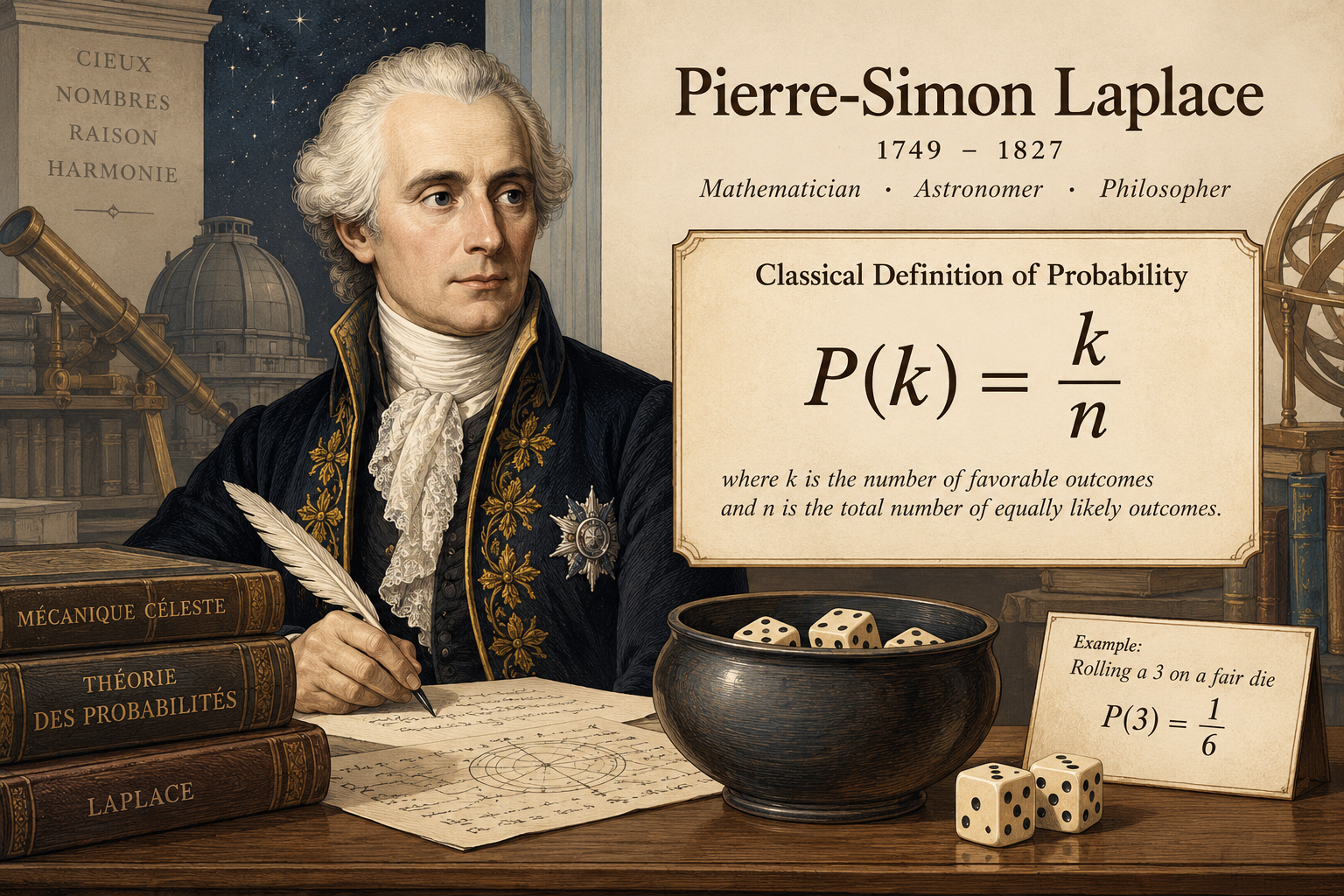
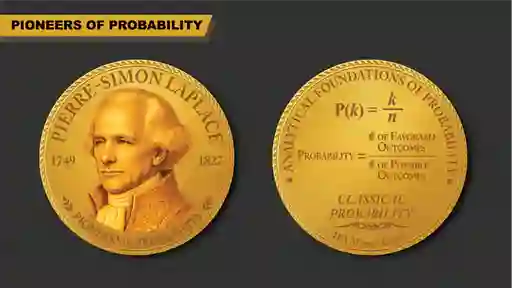
His answer began with what became known as the classical definition of probability: P(k) = k/n, where k is the number of favorable outcomes and n is the total number of equally likely possible outcomes. This formula appears on the reverse of the IFA MarketCoin® for Laplace, alongside the labels "# of Favorable Outcomes" and "# of Possible Outcomes," beneath the inscriptions "Analytical Foundations of Probability" and "Classical Probability."
The formula looks simple — almost obvious. It is neither. Before Laplace, probability had been defined differently by different mathematicians for different problems. Laplace brought them into a single framework, made the assumptions explicit, and showed how this one definition could unify and systematize the entire accumulated body of probability theory. Crucially, he was precise about when the formula applies: only when outcomes are equally likely. The moment that assumption fails, the formula requires adjustment. Laplace recognized this limitation and developed the tools to handle it.
◆ The Proof
One of those tools was his independent rediscovery and enormous extension of Bayes' theorem — what became known as Bayesian-Laplacian inference. Laplace had not read Bayes' 1763 essay when he first developed the framework in the 1770s. He arrived at the same structure independently, and then extended it far beyond what Bayes had done, applying it to problems in astronomy, demography, and legal evidence.
Perhaps the most famous application was his Rule of Succession: a direct Bayesian calculation of how probable it is that the sun will rise tomorrow, given that it has risen every day in recorded history. Laplace's answer — 1,826,214 to 1 in favor of sunrise — was not meant as a serious prediction (he understood the physical basis of the solar system well enough to be confident in the sun's reliability). It was a demonstration: that probability reasoning, applied to historical evidence alone, without appeal to physical law, could yield precise quantitative conclusions about singular future events. The framework was universal.
His Théorie Analytique des Probabilités, published in 1812, was the first comprehensive mathematical treatise on probability — deriving, extending, and unifying everything that had come before in a single rigorous framework. His Philosophical Essay on Probabilities, written as a non-mathematical introduction, remains one of the most lucid expositions of probabilistic reasoning ever written. It introduced what became known as Laplace's demon: if an intellect could know the position and velocity of every particle in the universe, Laplace wrote, nothing would be uncertain to it. For that intellect, probability would be unnecessary. Probability, he concluded, is a measure not of the world's randomness but of our own ignorance. It is the tool we use to reason in the gap between what we know and what is true.
The same man who defined classical probability for equally likely outcomes also proved that the classical definition is insufficient for most real problems and built the Bayesian framework to address what it couldn't handle. He extended de Moivre's normal approximation toward what would become the Central Limit Theorem. He developed generating functions, made foundational contributions to the study of the solar system's stability, anticipated concepts associated with black holes, proposed the nebular hypothesis for the origin of the solar system, and invented the Laplace transform that now appears in every course in electrical engineering and physics. When Napoleon asked why he hadn't mentioned God in his five-volume treatise on celestial mechanics, Laplace replied: "I had no need of that hypothesis."
◆ The Legacy
Laplace made probability respectable. Before him, it was associated with gambling, legal disputes, and philosophical puzzles. After him, it was a branch of mathematics as rigorous as calculus, with formal definitions, proved theorems, and systematic methods of application. Every field that uses statistics today — medicine, economics, physics, engineering, social science — builds on foundations that Laplace helped establish.
His political elasticity — Royalist, Revolutionary, Bonapartist, Royalist again, each in the appropriate season — earned him the contempt of some contemporaries. The mathematician Siméon Denis Poisson, who appears in the next episode of this series, was his most eminent student. What is less easy to dismiss is the totality of his scientific achievement: possibly the broadest of any single scientist in the history of Western thought, ranging from the purely abstract to the eminently practical, held together by an unwavering conviction that the universe is rationally ordered and that mathematics is the language in which that order speaks.
◆ Your Money
Laplace's classical definition carries a direct and often ignored implication for investors. P(k) = k/n — favorable outcomes over possible outcomes — only works when all outcomes are equally likely. Markets are not dice. The possible outcomes of a portfolio over ten years are not equally probable, and any investor who reasons as though they are — treating a bull market and a bear market as equally likely because they seem like two possibilities — is misapplying the formula Laplace made famous.
What Laplace actually advocated, in the full breadth of his probabilistic work, was something far more demanding: estimate probabilities as carefully as the evidence allows, update those estimates as new data arrives, combine prior knowledge with new observations in the precise Bayesian proportions, and maintain rigorous humility about the limits of what you know. His demon knew everything. We know very little. Probability is the tool we use to reason carefully in the gap.
The investor who applies that discipline — who quantifies uncertainty rather than ignores it, who updates beliefs with evidence rather than defending prior convictions against it, who builds a portfolio robust to ignorance rather than dependent on any single prediction being correct — is applying principles consistent with Laplace's approach to probability. Not because markets are simple. Because they are not.
A farmer's son arrived in Paris as a young man with a letter of introduction and proceeded to make foundational contributions to understanding the solar system's stability, examine Napoleon, survive three regimes, and build the unified mathematical foundation of probability theory. The framework he left behind continues to inform how investors can approach decisions under uncertainty.
Sources: Laplace, P.-S. (1951). A philosophical essay on probabilities (F. W. Truscott & F. L. Emory, Trans.). Dover. (Original work published 1814.) Stigler, S. M. (1986). The history of statistics. Harvard University Press. MacTutor History of Mathematics, University of St Andrews.
Disclosure: This article is for informational and educational purposes only and does not constitute a solicitation or recommendation to buy or sell any security. Past performance is not indicative of future results. All investing involves risk, including the possible loss of principal. Any historical return examples, if referenced, are hypothetical illustrations based on published index data and are not reflective of actual investor experience. Statements regarding statistical concepts, market behavior, and portfolio construction reflect educational commentary and should not be construed as forecasts or guarantees of future market outcomes.
Content is AI-assisted. Index Fund Advisors, Inc. is a registered investment adviser. For additional information, please visit adviserinfo.sec.gov or www.ifa.com.
About the pen name: "Claude Hebner" represents a collaboration between Mark Hebner, founder and CEO of Index Fund Advisors, Inc., and Claude, Anthropic's AI. The research, historical narrative, and investment analysis in each article are the result of that partnership, combining human editorial oversight with AI-assisted research and drafting.













 Home
Home 888-643-3133
 Contact Us
 Newsletter Subscribe
 eMoney
 IFA Apps
 Index Funds Book on Kindle
 Index Funds Audiobook
 Careers
 Facebook
 X
X LinkedIn
 Instagram
 Youtube
 Terms
Terms Index Descriptions