A tribute to the thinker who found the sources of prosperity in ordinary work, cooperation, institutions and human judgment.
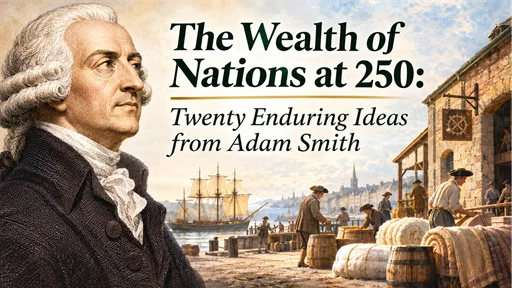
On March 9, 1776, Adam Smith published An Inquiry into the Nature and Causes of the Wealth of Nations. Two hundred and fifty years later, the scale of his achievement deserves patient attention. He made the work of pin-makers, shepherds, merchants, teachers and public officials part of one searching inquiry: how can people with different purposes cooperate to make life more abundant, and what prevents that promise from being fulfilled? Read Smith's book.
Smith (1723–1790) was a Scottish moral philosopher, born in Kirkcaldy and later a professor at Glasgow. His earlier The Theory of Moral Sentiments, published in 1759, explored sympathy and moral judgment. That wider interest in human conduct belongs beside his account of commerce. The same thinker who explained the productive power of specialization also examined ambition, misplaced confidence, injustice and the responsibilities of a commercial society. Smith's life and work.
This tribute follows twenty enduring ideas from his great economic work. Their order traces an argument: from the meaning of wealth to the cooperation that creates it; from exchange and competition to capital and risk; and from the institutions supporting commerce to the people prosperity ought to serve. Each idea has its own historical illustration and a link to the relevant text. Together they reveal a thinker whose questions remain larger than the familiar phrase about an invisible hand.
An investor enters this story through ownership in the productive world Smith examined. We return to that connection at the end, after allowing his arguments, examples and qualifications to speak in their own setting.
Historical scenes and the pencil portrait are AI-generated interpretations, not documentary evidence. The anniversary marks the first publication in 1776; linked Smith texts use later lifetime editions.
01. Wealth Is What a Society Can Make Available
 Useful goods surround a small coin chest. AI-generated historical interpretation of Smith's distinction between money and what it can purchase; no measured wealth total is depicted.
Smith began with a question larger than the contents of a treasury: what enables a nation to supply its people with the necessities and conveniences of life? Gold could purchase provisions, but it could not replace the work, knowledge and resources that produced them. A storehouse of food, cloth and tools revealed something about prosperity that a chest of coins alone could not explain. His inquiry turned attention toward the continuing capacity to provide, rather than the mere possession of a celebrated substance.
This shift made ordinary economic life worthy of serious study. The relevant abundance was connected to the number of people who needed to share it, and to the skill and judgment with which their labor was applied. Smith did not offer a modern national-accounting system. He established a demanding starting point: examine what people can actually obtain and the productive arrangements that make it possible. Introduction and Plan of the Work; Book IV, Chapter I.
02. Dividing the Work Can Multiply What People Produce
 An imagined, stylized pin workshop makes divided tasks visible. Smith's presence is a visual device, not a documented visit; exact tools and reported output are not verified by the scene.
The pin factory gave Smith's argument a scale a reader could grasp. Drawing wire, straightening it, cutting it, sharpening it and attaching a head became connected operations. He reported that ten workers could produce roughly forty-eight thousand pins in a day. Their achievement depended on the division and combination of their work, supported by suitable machinery. The same people working separately, without the relevant training and tools, would have produced far less.
Smith identified three sources of improvement: practiced dexterity, less time lost moving between tasks, and machines that made work easier or shorter. He also saw invention emerging from workers' attention to particular problems. This was an explanation of productive organization, not a claim that every task or occupation could be divided equally far. In the workshop's small objects, he found evidence of a large possibility: people could achieve more by arranging their efforts intelligently. Book I, Chapter I.
03. An Ordinary Coat Contains the Work of Multitudes
 A coat connects many kinds of work to everyday comfort. AI-generated historical composite illustrating Smith's example, not a documented workshop; the garment is an idealized interpretation.
Smith did not leave cooperation inside a single workshop. He asked his reader to consider an ordinary laborer's woollen coat. Shepherds, wool sorters, spinners, dyers, weavers and dressers had contributed to it. Merchants and carriers moved materials between people who might live far apart. Behind their work stood makers of tools, builders of furnaces and those who supplied the materials from which the tools themselves were made.
The coat changed the scale of the inquiry. Its wearer could benefit from knowledge and labor he did not possess and could never assemble alone. What appeared to be a simple possession depended on a wide network of occupations. Smith made that dependence tangible without requiring every participant to direct the whole. The example remains one of his most generous invitations to observation: look closely at a familiar comfort, and recognize the many lives and skills implicated in its making. Book I, Chapter I.
04. Exchange Begins by Recognizing Another Person's Advantage
 A baker and craft worker consider what each can offer. AI-generated imagined exchange, not a documented bargain or a claim about actual prices.
In a commercial society, people need the assistance of far more others than they can personally befriend. Smith therefore examined the ordinary bargain. A person seeking bread or another useful good must offer something the other party has reason to value. Exchange can align different purposes because each participant attends, at least sufficiently, to an advantage the other recognizes. The transaction joins people whose immediate wishes need not be identical.
This is more specific than saying that people are selfish. Smith was explaining how recurring needs can be met through persuasion and reciprocal offers without depending entirely on personal generosity. He also described different talents becoming useful to one another through exchange. The achievement lies in a practical social relationship: someone's specialized ability acquires wider value when its product can answer another person's need. Cooperation can grow from this repeated attention to what others are willing to give and receive. Book I, Chapter II.
05. Specialization Needs a Market Large Enough to Sustain It
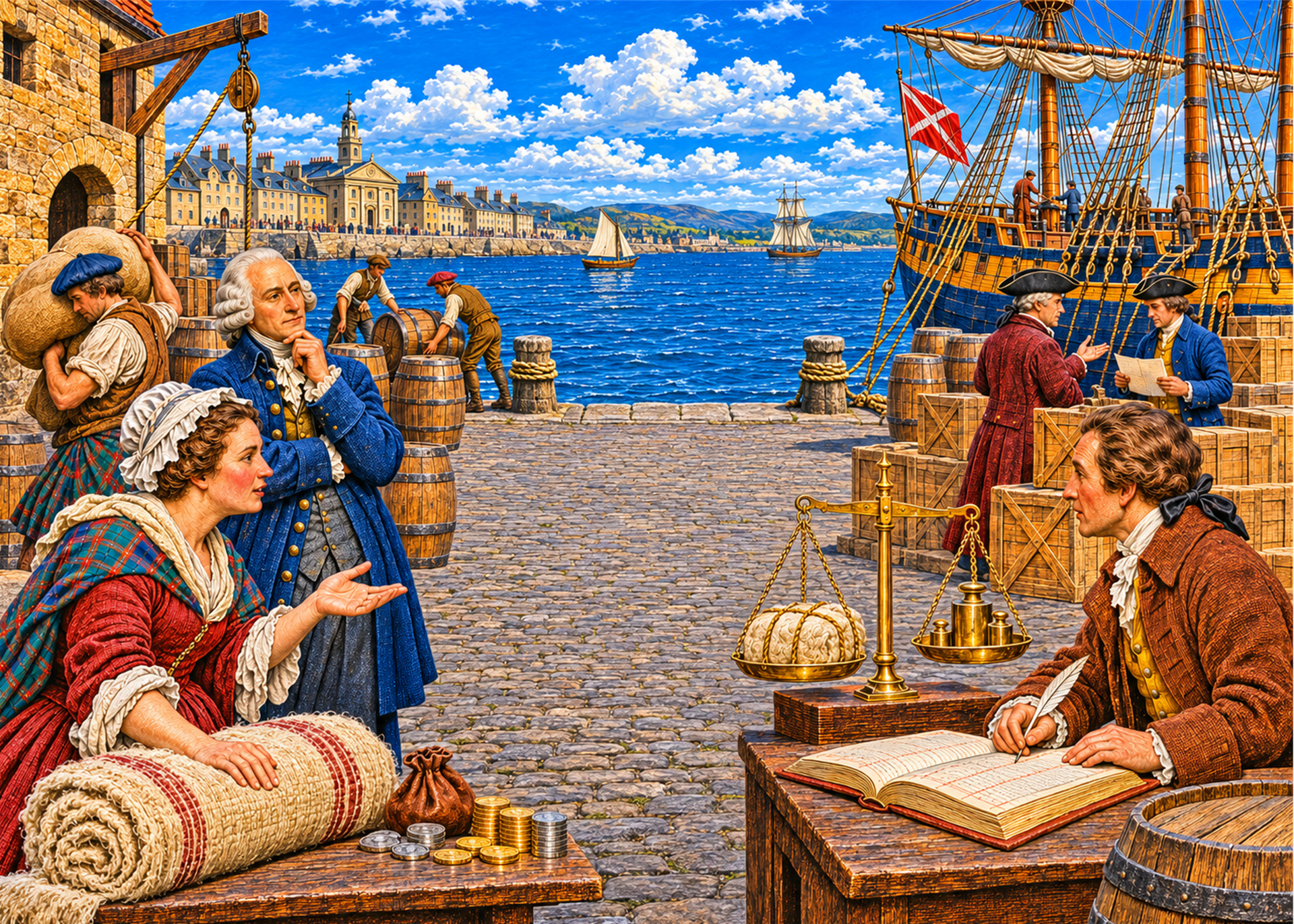 Harbor connections evoke the widening of markets. AI-generated historical reconstruction, not a documented shipment or a measured comparison of transport productivity.
A person can concentrate on one occupation only when enough others will exchange for the surplus it produces. Smith's explanation of specialization therefore led outward from skill to access. A small, isolated market may not sustain a separate maker for every tool or household necessity. Where more buyers can be reached, a narrower occupation may become a viable way of earning a living.
Transport matters because it changes that reach. Smith compared the burdens of moving goods over land with the larger quantities that waterways could carry. Coasts and navigable rivers could connect producers to customers beyond their immediate neighborhood. His historical examples explained why location and communication affected the development of industry. The implication was not that every activity should grow without limit. It was that productive possibilities depend partly on the opportunities people have to exchange the results of their work. Book I, Chapter III.
06. A Neighbor's Prosperity Can Become an Opportunity
 Goods and work meet across a trading quay. AI-generated interpretation of reciprocal commerce; pictured cargo cannot establish equal gains, a trade balance or an actual shipment.
Smith challenged the idea that one trading nation must become poorer when another becomes richer. A prosperous neighbor could buy more of a country's produce and offer useful goods in return. Competition might trouble particular manufacturers, yet the interests of those manufacturers were not identical to the interests of everyone who purchased or exchanged goods. The gain or discomfort of one trade could not settle the question for the whole society.
His argument asked readers to look beyond the jealousy encouraged by commercial rivalry. Trade could connect different capacities and create advantages for people on both sides, without giving every participant an equal gain. Smith also qualified his criticism of restrictions in particular circumstances; his discussion should not be reduced to a rule detached from its exceptions. The enduring contribution is a wider habit of judgment: another society's productive achievement can enlarge the possibilities for exchange rather than simply diminish our own. Book IV, Chapter III; Book IV, Chapter II.
07. Prices Respond to Scarcity, Supply and Competing Demands
 An arriving cart and a bargaining pair evoke changing supply and demand. AI-generated historical scene, not a record of a particular harvest, grain price or market outcome.
Smith distinguished the price a commodity commonly fetched in the market from the price sufficient to cover the customary rewards of the resources used to bring it there. If too little arrived to meet demand backed by the ability to pay, buyers could compete the price upward. If more arrived than could be sold on those terms, sellers might have to accept less. A cart entering a grain market could therefore matter to more than its owner.
These movements also gave people reasons to change what they supplied and where they committed labor or capital. Smith recognized that harvests, secrecy, natural advantages and restrictions could keep outcomes from following a simple pattern. His account was an inquiry into adjustment, not a promise that every observed price was correct or stable. Nor was his concept of a natural price a modern formula for valuing securities. Its force lies in showing how changing circumstances could alter choices throughout an economy. Book I, Chapter VII.
08. An Exceptional Profit Invites a Competitive Response
 Competing glassware sellers attend to customers in an imagined eighteenth-century market. AI-generated illustration of rivalry and choice, not a documented event or measured profit comparison.
A lucrative opportunity rarely remains unnoticed forever. Smith described sellers who tried to conceal unusually favorable prices because new rivals would have reason to enter the same business. Additional supply could then reduce the exceptional return that had attracted them. Competition changed the conditions under which the original success had occurred. A profitable enterprise was operating within a moving field of other people's decisions.
This helped distinguish a society's growing productive capacity from the continued exceptional profits of a particular trade. Smith observed that increasing capital could intensify competition among merchants even while the economy became more prosperous. Secrets, natural limitations and privileges might delay or obstruct the process, so he did not describe instant or universal adjustment. His contribution was to make rivalry part of the explanation. The opportunity that draws effort and resources can, through that response, become a harder opportunity to sustain. Book I, Chapter VII; Book I, Chapter IX.
09. Unintended Benefits Can Emerge from Deliberate Choices
 Imported cloth and domestic work evoke the setting of Smith's argument. AI-generated imagined harbor scene; it establishes no measured advantage and represents no invisible force.
The invisible-hand passage began in a particular setting. Smith considered a merchant who preferred employing capital close to home when the alternatives offered comparable returns. Concern for security and gain could lead that merchant to support domestic production without making the public interest his immediate purpose. The wider consequence and the participant's intention were different things.
The observation was powerful because it made room for coordination that no individual had completely designed. Yet its context matters as much as its memorable phrase. Smith was discussing domestic investment and restrictions on imports, not providing an assurance that every profitable choice served society. Elsewhere he scrutinized monopoly, injustice and the ability of powerful interests to obtain advantages at others' expense. To honor this contribution is to retain both the insight and the scrutiny: purposeful private decisions can have wider benefits, while their consequences still demand examination. Book IV, Chapter II.
10. Defending Competition Requires Scrutiny of Privilege
 A craft worker presents a sample at a workshop threshold while trade continues nearby. AI-generated interpretation of admission rules, not a documented guild decision or a claim that every qualification is restrictive.
Smith's attention to enterprise did not make him an unquestioning defender of business interests. He warned that people in the same trade could combine to raise prices against the public. He also examined rules that limited entry or preserved exclusive advantages. A restriction might improve the position of those already admitted while making opportunities narrower for others and goods dearer for buyers.
The distinction is essential to the tribute. The freedom to compete and the power to exclude competitors are different arrangements, with different consequences. Smith did not propose suppressing every meeting of tradespeople; he recognized the conflict such a course would create with liberty and justice. He argued that law should not unnecessarily facilitate restrictive combinations. His wider contribution was a searching test of claims made in the name of commerce: ask who receives the advantage, who bears the burden, and whether productive activity or protected position explains the result. Book I, Chapter X; Book I, Chapter VII.
11. Saving Gives Future Work Its Resources
 Resources preserved for future work: an imagined workshop of preparation and repair, not a documented event.
The prosperity of tomorrow requires resources that are not all consumed today. Smith traced the accumulation of capital to the part of revenue saved and employed again. That saving could support additional workers through the owner's own business or through resources made available to someone else. The important movement was from present income toward the maintenance and enlargement of productive activity. A society's capacity to produce depended in part on preserving what could sustain its next round of work.
His account made thrift an active economic process. Food, materials and other resources continued to be used, but their employment helped reproduce output rather than ending with immediate enjoyment alone. Smith's historical distinction between productive and unproductive labor needs its original setting; it should not be used to dismiss modern services. The enduring question is how present resources can support future capability. Book II, Chapter III.
12. Capital Has Different Jobs to Do
 Durable tools and resources that must be renewed illustrate Smith's capital distinctions. Imagined historical composite, not a measured inventory.
A workbench and the materials upon it contribute to production in different ways. Smith distinguished fixed capital, which could provide revenue while remaining with its owner, from circulating capital, which moved through successive forms and exchanges. Machines, useful instruments and improvements could serve repeatedly. A merchant's goods, by contrast, had to pass into other hands, and the proceeds had to return to further purchases if the business was to continue.
This distinction directed attention to the process beneath a visible stock of wealth. A workshop needed durable tools, renewed materials and the means to keep people working between the beginning of a task and the sale of its result. Different occupations required different combinations. Smith's categories belong to his own analysis rather than to a modern accounting template. Their strength is the question they make unavoidable: what must a productive undertaking retain, replenish and replace? Book II, Chapter I.
13. Useful Knowledge Is Part of a Society's Wealth
 Study and practical skill contribute to productive capability. Imagined historical study and measuring scene, not a documented lesson or experiment.
Smith included acquired and useful abilities among the forms of fixed capital. Learning a trade required time, instruction and the means to maintain the learner before improved ability could earn a return. The resulting skill formed part of the individual's fortune and of the society's productive resources. A more dexterous worker could perform a task more effectively, just as a better instrument could make that task easier.
This was a striking widening of the inquiry into wealth. The resources of an economy included abilities embodied in people, developed through study, education and apprenticeship. A workshop's tools were only part of what enabled its work; knowing how to use them also had to be acquired. Smith's economic classification did not exhaust the significance he later gave education. Here, its immediate contribution was to show that developing capability could be a substantial commitment of resources with lasting productive consequences. Book II, Chapter I.
14. Confidence Can Outrun What People Know
 An imagined lottery scene illustrates the attraction of a hoped-for prize. It is not a documented drawing, person or outcome.
Smith's people could misjudge themselves. Discussing the attractions of different occupations, he observed how readily people overestimated their own abilities and presumed upon favorable fortune. Lotteries made the tendency especially visible: the prospect of a great prize attracted buyers despite the disadvantage built into the venture. Hope could make a remote gain feel more compelling than a sober assessment of the chance of losing.
The observation belongs within his larger attention to human judgment. People deciding how to commit their work and resources were not infallible calculators. Their ambitions could distort the very comparisons on which those decisions depended. Smith did not discuss today's investment products in this passage. He identified a recognizable difficulty in evaluating uncertain outcomes: the desire to succeed can enter the estimate of how likely success is. Taking that difficulty seriously gives his account of enterprise a necessary measure of humility. Book I, Chapter X.
15. A Fleet Can Bear Some Risks Differently from One Ship
 A merchant fleet evokes Smith's qualified insurance example. The vessels are illustrative; shared dangers remain. AI-generated historical scene, not a documented voyage.
In the same discussion, Smith considered a merchant with twenty or thirty ships at sea. Such vessels might, in a qualified sense, insure one another: resources retained across the whole fleet could compensate for losses encountered in the ordinary course of chances. The example recognized that a larger undertaking might absorb particular losses differently from an owner exposed to the fate of a single vessel.
Smith immediately supplied the warning that makes the passage valuable. Neglecting insurance usually arose from thoughtless rashness and contempt for danger, rather than careful calculation. His fleet was a practical example in an insurance discussion, not a general mathematical theory of portfolios. Nor does the illustration establish that vessels face independent dangers. Its lasting distinction is between deliberately considering how losses may be borne and merely hoping they will not occur. Prudence required examining uncertainty rather than allowing confidence to conceal it. Book I, Chapter X.
16. Entrusted Money Calls for Vigilance
 Resources entrusted to others require care. This imagined banking scene illustrates the question of responsibility, not a documented company or board meeting.
Large undertakings could bring resources together while separating ownership from daily control. Smith observed that many proprietors of joint-stock companies took little trouble to understand their business, while directors managed money that was principally other people's. He doubted that such directors would always watch it with the same anxious care that private partners gave their own resources. The organizational achievement carried a problem of attention and incentives.
His criticism was qualified. Smith recognized applications, including banking and insurance, in which sufficiently regular operations could make joint-stock organization workable. The question was how the form of an undertaking affected the conduct of those responsible for it. Bringing capital together did not settle how faithfully that capital would be supervised. By placing owners, directors and their different positions inside the inquiry, Smith made responsibility part of the explanation of business performance, rather than assuming that a shared pursuit of profit automatically aligned everyone's behavior. Book V, Chapter I.
17. Commerce Needs Dependable Justice
 An imagined earlier European town evokes Smith's history of civic security. The document exchange is illustrative, not a verified charter or legal proceeding.
Smith's account of commercial prosperity rested on institutions. Commerce and manufactures could seldom flourish for long, he argued, where people lacked confidence in the administration of justice, security in their possessions and the support of law for contracts. People making commitments needed grounds to expect that the claims and obligations involved would be recognized beyond the convenience of the moment. Book V, Chapter III.
His history of early European towns supplied another part of this argument: security in the fruits of work encouraged people to seek more than bare subsistence. The freedom to employ resources was exercised within a legal and social setting. A promise concerning goods, payment or property needed more than the immediate willingness of two parties to exchange. Smith connected durable commercial activity with confidence that justice would be administered regularly. The insight widens the tribute beyond the energy of merchants and inventors: prosperity also depends on arrangements that let strangers cooperate across time. Book III, Chapter III.
18. Public Works Help Make Exchange Possible
 Roads, maintenance and a bridge connect productive activities. AI-generated historical composite, not an archival map or a documented public project.
The reach of a market depended on physical connections as well as the desire to trade. Roads, bridges, canals and harbors helped goods and people move. In Book V, Smith treated the erection and maintenance of works facilitating commerce as a serious public concern. Their scale had to suit the activity they served: a bridge needed strength for its traffic, and a harbor needed capacity for the shipping that sought shelter there.
His attention was practical rather than ceremonial. Productive activity could be constrained by the condition of the route between producer and buyer, and useful works had to be maintained after they were built. Smith examined particular arrangements and incentives instead of treating every project as the same problem. This part of his inquiry makes the infrastructure beneath ordinary exchange visible. What appears to be a bargain between two people can depend on connections whose benefits extend through an entire commercial society. Book V, Chapter I.
19. Education Protects More Than Productive Skill
 Education belongs beside the productivity of specialized work. Imagined instruction scene; Smith's presence is a visual device, not a documented classroom visit.
The pin factory's success did not blind Smith to the possible cost of narrow, repetitive employment. A person confined throughout life to a few simple operations might have little occasion to exercise invention or judgment. Smith feared that the habit of understanding could weaken when ordinary work gave it too little use. His concern extended to conversation, the duties of private life and the capacity to judge the wider interests of society.
Education therefore had a place within the inquiry into a prosperous commercial order. Smith argued that reading, writing and arithmetic could be made accessible early enough to reach people destined for ordinary labor. This complements his earlier treatment of useful abilities as capital, but reaches further: people needed opportunities to develop understanding as members of society. A tribute that celebrates specialized production should also preserve this concern for those doing the work. Greater dexterity in one task was not the whole measure of human improvement. Book V, Chapter I.
20. Production Ultimately Serves the People Who Use Its Goods
 Farming, skilled work and exchange sustain ordinary life. AI-generated historical composite; the scene is not a documented place or a measure of prosperity.
The inquiry returns to its human purpose. Smith stated that consumption was the end of production, and that producers' interests deserved attention insofar as they promoted the interests of consumers. His criticism of the mercantile system was that it repeatedly reversed this relationship, sacrificing the people who used goods to the advantages of those who supplied them. A favored trade's prosperity could therefore be a poor test of society's improvement.
This is a fitting destination for the preceding ideas. Specialized work, wider markets, accumulated capital and public institutions matter because of the lives they help sustain. The woollen coat had already made that purpose tangible: many kinds of effort could put useful comforts within an ordinary person's reach. Smith's achievement was to investigate both the cooperation that could create such abundance and the privileges and failures that could obstruct it. Honoring that achievement means keeping the well-being of people within our understanding of wealth. Book IV, Chapter VIII.
What Adam Smith Still Asks of an Investor
The twenty ideas lead back to a human achievement. Smith helped readers see a society of people whose work, knowledge and purposes intersect: the laborer wearing a coat, the maker improving a tool, the merchant committing capital and the child learning to read. Prosperity depended on the quality of those connections, the opportunities to develop them and the institutions that protected them. A tribute to Smith begins with that breadth of understanding.
For readers of Index Fund Advisors (IFA), the inheritance reaches investing through three questions. What productive activity stands behind ownership? A share represents an interest in an enterprise operating within a larger world of workers, customers, suppliers and institutions. Buying an existing share generally transfers money to another owner; it does not automatically supply new capital to the company. Smith's account helps explain the economic world beneath that ownership, while leaving uncertainty about any particular business or price.
Which uncertainties can a household afford to carry? Smith's fleet makes a useful historical distinction between deliberately bearing risk and dismissing it. Today's diversification can reduce dependence on particular companies or exposures, although it cannot prevent broad market losses. Asset allocation divides a portfolio among categories such as stocks, bonds and cash according to goals, time horizon and capacity for loss. These are modern planning applications; Smith supplied no numerical portfolio rule.
What keeps judgment accountable? His warnings about confidence and delegated money encourage scrutiny of both our own decisions and the people entrusted with resources. A written plan gives that scrutiny a purpose. Rebalancing adjusts holdings toward an intended mix as values change; it offers a discipline for risk exposure, without guaranteeing profit or protection from a decline. Changes in a household's circumstances also deserve review.
A fitting commemoration carries Smith's spirit of inquiry forward: understand the work behind wealth, examine the incentives behind a promise, respect the limits of foresight and remember the people whom prosperity should serve. Two hundred and fifty years after publication, the lasting gift is a richer way of asking what makes enterprise productive, ownership responsible and prosperity beneficial in ordinary lives.
Important Disclosures
For Informational and Educational Purposes Only
This article is provided by Index Fund Advisors, Inc. (IFA) for informational and educational purposes only. The content reflects the authors' interpretations of Adam Smith's economic principles and their potential relevance to modern investing. It is not intended to constitute personalized investment, financial, legal, or tax advice, nor should it be construed as a recommendation to buy, sell, or hold any particular security, investment product, or investment strategy.
Historical Interpretations and Investment Principles
The historical discussions and examples presented are intended to illustrate selected economic concepts from Adam Smith's An Inquiry into the Nature and Causes of the Wealth of Nations. Interpretations of Smith's writings may differ, and the application of historical economic principles to modern financial markets involves assumptions and limitations. Adam Smith did not develop or endorse modern index investing, asset allocation, portfolio diversification, or rebalancing strategies as discussed in this article.
Investment Risks and Diversification
All investing involves risk, including the potential loss of principal. Diversification and asset allocation are strategies intended to help manage investment risk; however, neither guarantees a profit nor protects against losses in declining markets. Diversification may reduce certain company-specific or other concentrated risks but cannot eliminate market risk. Rebalancing does not guarantee improved investment performance or prevent losses and may result in transaction costs or tax consequences.
Investment strategies should be evaluated in light of an investor's individual financial circumstances, investment objectives, risk tolerance, and time horizon. No investment strategy is appropriate for every investor.
AI-Generated Illustrations
Certain illustrations and historical scenes accompanying this article were generated using artificial intelligence. These images are artistic interpretations intended solely for educational and illustrative purposes. They should not be considered historically accurate representations, archival materials, documentary evidence, or depictions of actual events, individuals, locations, or economic outcomes.
Third-Party Sources and Opinions
This article includes references and links to historical writings, third-party research, and external websites. Such references are provided for informational purposes and do not constitute an endorsement of the referenced sources or their conclusions. IFA does not guarantee the accuracy, completeness, or continued availability of third-party information. Opinions and interpretations expressed are subject to change without notice.
Investment Advisory Information
Index Fund Advisors, Inc. is an investment adviser registered with the U.S. Securities and Exchange Commission (SEC). Registration does not imply a particular level of skill or training. Additional information about IFA, including its services, fees, and potential conflicts of interest, is available in its Form ADV and Form CRS at www.adviserinfo.sec.gov .