
 Risk Capacity
 Wealth Management
 Outsourced CIO
 Retirement Plans
 Institutional
 Financial
  Open an Account
 IFA App

 Articles
 Charts
 Investor Education ▾
 Fund
Fund
 Store
Store

 Taxes
Taxes Back-testing Disclosures
 Glossary
 Form CRS
The Papers that Changed Investing: Hiring & Firing Investment Managers
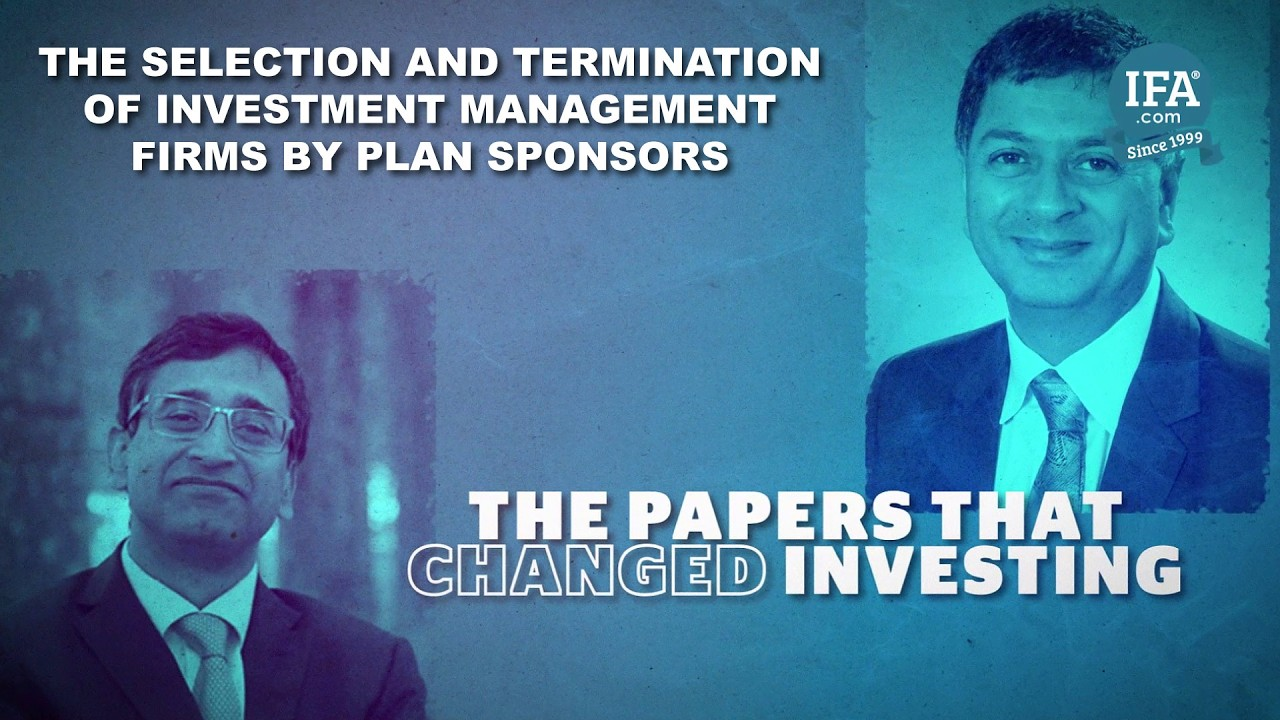

You're running a pension fund. Thousands of retirees are counting on you to grow their savings.
So you do what everyone does — you hire fund managers with the best recent track records. The hot hands. The proven winners.
And when a manager underperforms? You fire them and find someone better. It's common sense.
But here's the question nobody was answering: Does this actually work? Does chasing winners deliver better results?
Two finance professors decided to find out — and what they discovered should change how you think about picking investments.
Welcome to The Papers That Changed Investing.
Before this research, a powerful assumption ruled the investment world: sophisticated investors can identify winning managers before they win.
Pension funds, endowments, and foundations spent enormous resources on manager selection — hiring consultants, forming committees, conducting elaborate searches.
It became an entire industry. An ecosystem of consultants, databases, and beauty contests — all built on the belief that picking the right manager would deliver better results.
And individual investors often do exactly the same thing. We check last year's returns, identify the top performers, and move our money to chase that success.
But nobody was systematically asking: what happens next? Do yesterday's winners keep winning? Do the managers we fire actually deserve it?
Amit Goyal and Sunil Wahal decided to answer those questions — with a decade of real data.
Goyal and Wahal's insight was elegantly simple: don't ask whether managers are skilled. Ask whether the decision to hire or fire them actually improved outcomes.
Think of it like driving while staring in the rear-view mirror. Past performance shows you where managers have been — not where they're going.
The question isn't whether a manager had a great three years. The question is whether hiring them — based on that track record — leads to a great next three years.
And what about the managers who get fired? Would investors have been better off keeping them?
Goyal and Wahal assembled a massive dataset: more than 3,400 pension plans, endowments, and foundations, making nearly 9,000 hiring decisions between 1994 and 2003.
For each decision, they tracked performance before and after. How did managers perform in the years leading up to being hired? And how did they perform afterward?
They did the same for fired managers. And critically, they examined "round-trip" decisions — cases where a sponsor fired one manager and hired a replacement.
So what did Goyal and Wahal find?
First: plan sponsors consistently chased performance. Newly hired managers had delivered strong excess returns — nearly three percent annually above their benchmarks — in the three years before being hired.
Second: after being hired, those impressive returns diminished. Post-hiring excess returns dropped to essentially zero. The hot streak that attracted everyone's attention simply ended.
Third — and this is the most striking finding: managers who were fired went on to deliver returns that were just as good as the managers hired to replace them.
"Managers who are fired subsequently deliver returns that are similar to those of managers who are hired."
All that effort. All those consultant fees. All that due diligence. And the investors who stayed put could have achieved the same result.
Here's why this matters for investors today.
If the most sophisticated investors in the world — with vast resources, expert advisors, and decades of experience — can't reliably identify winning managers in advance, what chance do most investors have?
The urge to chase performance is deeply human. We see success and want to be part of it. But the data shows this instinct leads us astray.
Subsequent research reinforced these findings. A 2016 study showed that investment consultants' recommendations don't add value. A 2023 follow-up found that even personal connections between managers and plan sponsors don't lead to better returns.
This doesn't mean skilled managers don't exist. Some do outperform historically. The problem is identifying them in advance — and the evidence suggests that's extraordinarily difficult to do consistently.
So what can you do? Focus on what you can control: keep costs low, diversify broadly, and resist the powerful urge to chase yesterday's winners.
The rear-view mirror might show an exciting road behind you. But it won't help you navigate what's ahead.
To learn about investment approaches grounded in evidence, explore the research.
Sources
Goyal, A. & Wahal, S. (2008). The Selection and Termination of Investment Management Firms by Plan Sponsors. The Journal of Finance, 63(4), 1805-1847.
Jenkinson, T., Jones, H. & Martinez, J.V. (2016). Picking Winners? Investment Consultants' Recommendations of Fund Managers. The Journal of Finance, 71(5), 2333-2370.
Goyal, A., Wahal, S. & Yavuz, M.D. (2023). Choosing Investment Managers. Journal of Financial and Quantitative Analysis, 58(3), 1179-1216.
Visit https://www.ifa.com/academic-papers
DISCLOSURES:
This material is intended for informational purposes only and is not a solicitation, offer, or recommendation to buy or sell any securities or investment programs. Past performance is not indicative of future results. All investing involves risk, including the possible loss of principal. References to academic studies are provided for educational purposes and may not reflect current market conditions. Assumptions include trading costs, taxes, and other frictions materially impact net returns. Individual circumstances vary, and readers should consult a qualified financial professional before making investment decisions. This video may include content generated or enhanced using artificial intelligence (AI). For more information about Index Fund Advisors, Inc, please review our brochure at https://www.adviserinfo.sec.gov/ or visit www.ifa.com.











 Home
Home 888-643-3133
 Contact Us
 Newsletter Subscribe
 eMoney
 IFA Apps
 Index Funds Book on Kindle
 Index Funds Audiobook
 Careers
 Facebook
 X
X LinkedIn
 Instagram
 Youtube
 Terms
Terms Index Descriptions