
 Risk Capacity
 Wealth Management
 Outsourced CIO
 Retirement Plans
 Institutional
 Financial
  Open an Account
 IFA App

 Articles
 Charts
 Investor Education ▾
 Fund
Fund
 Store
Store

 Taxes
Taxes Back-testing Disclosures
 Glossary
 Form CRS
The Papers that Changed Investing: The Adjustment of Stock Prices to New Information
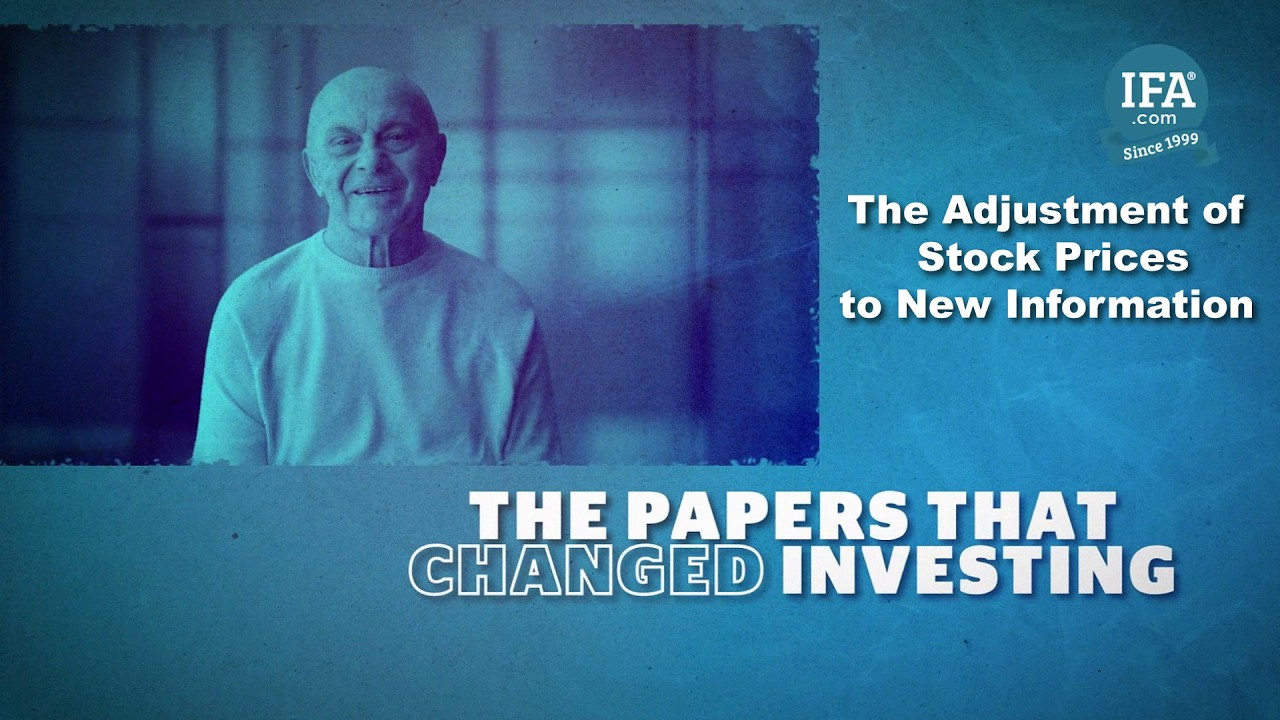

It's 1969. Wall Street traders believe they can outsmart the market by reacting faster to news than anyone else.
Earnings announcement? Buy before anyone else catches on. Stock split coming? Get in quick before the crowd arrives.
But here's the problem: nobody had actually measured how fast markets absorb news. Was there really time to profit, or was it already too late?
Four researchers at the University of Chicago asked that question, and what they discovered changed how we think about investing.
This is the paper that provided direct evidence that markets process information with remarkable speed, and the research tool that launched an entire field of study.
Welcome to The Papers That Changed Investing.
Before this paper, testing market efficiency was like trying to photograph fog. Researchers could observe that prices seemed to move randomly, but that wasn't the same as demonstrating that markets were actually efficient.
Many tools simply didn't exist. There was no comprehensive database of stock prices. No way to track thousands of corporate events systematically. Testing a theory meant manually transcribing prices from old newspapers.
Eugene Fama and his colleagues realised they needed a concrete test. Not elegant theory — hard evidence showing exactly how fast prices adjust to new information.
The team's insight was elegant: use stock splits as a natural experiment.
A split is cosmetic. Owning two shares worth fifty pounds each is identical to owning one share worth a hundred. The company's actual value doesn't change.
But if prices moved around split announcements, that movement had to reflect something else: information the market was processing about the company's future prospects.
They invented what's now called the "event study," a method to isolate the market's reaction to specific news by mathematically filtering out general market movements.
This technique became a widely used tool for testing how markets respond to any corporate announcement, and it's still used today.
The researchers analysed 940 stock splits on the New York Stock Exchange using the brand-new CRSP database, the first comprehensive record of stock prices ever assembled, built from IBM punch cards over four years of painstaking work.
Think of it like this: imagine dropping a stone into a pond. You want to measure that specific splash, but waves are constantly rippling through from other sources.
Their mathematical model filtered out the background waves, isolating just the splash from each split announcement. They called these isolated movements "abnormal returns."
So what did they discover?
First: stock prices rose significantly in the months before a split, not after. Companies often split their shares following good performance, not to create it.
Second: once the split was announced, prices stopped moving. The market had already incorporated all available information. There was no additional gain to capture.
Third: when they separated companies that later raised dividends from those that didn't, the pattern became crystal clear. The market wasn't reacting to the split itself. It was reacting to what the split signalled about future earnings and dividend potential.
Here's why this matters for investors today.
This paper provided the first direct evidence that markets process public information rapidly and completely. By the time you read a headline, the price has likely already moved.
The implications were significant. If markets are this efficient, trying to beat them by trading on public announcements is often likely to disappoint.
This research directly inspired the creation of index funds. David Booth, who studied under Fama at Chicago, helped launch the first institutional index portfolio in 1971. Five years later, Jack Bogle launched Vanguard's index fund for everyday investors.
Eugene Fama won the Nobel Prize in Economics in 2013, with this paper cited as foundational to his work on market efficiency.
Today, information travels even faster. Stock prices can adjust within seconds.
The research suggests that respecting the market's collective intelligence may be a prudent approach.
Curious how evidence-based principles? Visit IFA.com.
DISCLOSURES:
This material is intended for informational purposes only and is not a solicitation, offer, or recommendation to buy or sell any securities or investment programs. Past performance is not indicative of future results. All investing involves risk, including the possible loss of principal. References to academic studies are provided for educational purposes and may not reflect current market conditions. Index funds carry risks including market risk and potential loss of principal; lower costs and broad diversification do not guarantee superior returns. Individual circumstances vary, and readers should consult a qualified financial professional before making investment decisions. This video may include content generated or enhanced using artificial intelligence (AI). For more information about Index Fund Advisors, Inc., please review our brochure at https://www.adviserinfo.sec.gov or visit www.ifa.com.












 Home
Home 888-643-3133
 Contact Us
 Newsletter Subscribe
 eMoney
 IFA Apps
 Index Funds Book on Kindle
 Index Funds Audiobook
 Careers
 Facebook
 X
X LinkedIn
 Instagram
 Youtube
 Terms
Terms Index Descriptions