
 Risk Capacity
 Wealth Management
 Outsourced CIO
 Retirement Plans
 Institutional
 Financial
  Open an Account
 IFA App

 Articles
 Charts
 Investor Education ▾
 Fund
Fund
 Store
Store

 Taxes
Taxes Back-testing Disclosures
 Glossary
 Form CRS
Pioneers of Probability · Episode 1
This video is for informational and educational purposes only and does not constitute a solicitation or recommendation to buy or sell any security. The historical and mathematical concepts discussed are intended to illustrate the development of probability theory and its relevance to investing. Past performance is not indicative of future results. All investing involves risk, including the possible loss of principal. The S&P 500 return data cited reflects a specific historical period (1926-2026) with dividends reinvested and does not account for taxes, fees, or inflation; it should not be interpreted as a forecast of future returns. The examples provided are hypothetical and based on historical index data, not an actual investment. Index returns do not reflect the performance of any actual portfolio or the deduction of advisory fees. Content is AI assisted.
◆ The Question
He went by at least three names. Leonardo Pisano, because he was born in Pisa. Leonardo Bigollo, a nickname that may have meant either "the traveler" or, depending on who was using it, something closer to "the good-for-nothing." And Fibonacci, the name history settled on. The name itself appears as early as 1506 in a notarial reference, and a modern source from 1838 used it in print; it was the French mathematician édouard Lucas who, in 1877, decisively popularized both the name and the sequence that bears it, ensuring the label stuck for good.
Whatever you call him, Leonardo of Pisa was, by most accounts, the most talented mathematician in the Western world during the Middle Ages — though his full historical significance was not apparent in his lifetime.
 The world he was born into, around 1170, had a number problem. Not a shortage of numbers — commerce and trade were booming, particularly in the port cities of northern Italy, where Pisa, Venice, Genoa, and Florence competed fiercely for Mediterranean routes. The problem was the tool. Roman numerals, the system that had served the empire for a millennium, were hopelessly cumbersome for the fast, high-stakes arithmetic of medieval trade. Try calculating compound interest in Roman numerals. Try splitting a cargo six ways and converting the result to four different currencies before the tide changes. The abacus helped, but it required years of specialized training and still couldn't bridge the gap between the speed of commerce and the slowness of Roman-numeral computation.
Meanwhile, across the Mediterranean, Arab merchants were working with something better. Their advantage was a ten-symbol positional system — the digits zero through nine — inherited from Indian mathematicians and arranged so that place determines value. With those ten digits, any number could be written, added, multiplied, and divided with far less specialized training, in a fraction of the time. The question nobody in Europe was asking: what if the numbers themselves were the problem?
◆ The Insight
Fibonacci didn't invent the Hindu-Arabic numeral system. He was its translator.
His father, Guglielmo Bonacci, was a Pisan customs official posted to Bugia, modern-day Béjaïa, in northeastern Algeria — a Mediterranean port city where Pisan merchants traded and where his young son grew up watching Arab merchants calculate with extraordinary fluency. Educated under Muslim mathematicians in Bugia, the young Leonardo then spent years traveling the Mediterranean coast — Sicily, Greece, Syria, Egypt — specifically seeking out the best mathematical minds he could find and learning their methods. He was not a tourist. He was an apprentice to a better way of thinking.
What he brought home was more than technique. It was a philosophy of number — the idea that mathematics should be fluid, portable, and accessible to anyone with a problem to solve. The Roman system locked calculation behind years of specialist training. The Hindu-Arabic system unlocked it. His father had wanted him to become a merchant. He became something more consequential: the man who handed merchants across an entire continent the tools they didn't know they were missing.
It is worth pausing on what this felt like from inside the counting house. Medieval merchants in Pisa or Florence, working with Roman numerals and abacus beads, were performing the cognitive equivalent of carpentry with a stone axe. The work got done — but slowly, with effort, and with significant risk of error. Fibonacci's system was the steel blade. Not just faster, but categorically different — a technology that changed what was even possible to calculate.
◆ The Proof
In 1202, Fibonacci published the Liber Abaci — the Book of Calculation — and dedicated it to Michael Scot, the court astrologer to the Holy Roman Emperor Frederick II. That dedication was not incidental: Frederick II himself was drawn to Fibonacci's work, and members of Frederick's court later posed formal mathematical challenges to Fibonacci to test his abilities. He answered them in print, and his reputation grew accordingly.
The Liber Abaci covered far more ground than the famous rabbit problem suggests. It explained the positional value system for nine digits plus zero. It covered the arithmetic of fractions, the calculation of profits and compound interest, the conversion between currencies, methods for solving simultaneous linear equations, and what we now recognize as the Chinese Remainder Theorem. It discussed perfect numbers and prime numbers. It was not a curiosity — it was an encyclopedic manual for doing the mathematics that commerce, science, and governance actually required.
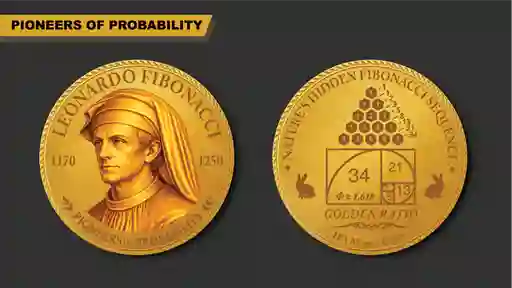
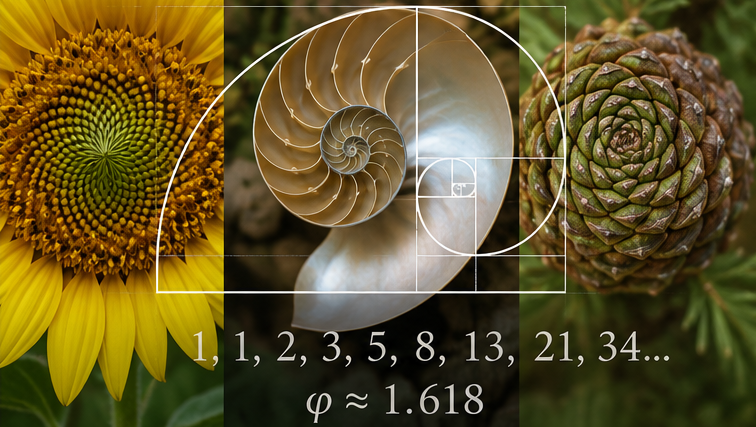 The rabbit sequence — 1, 1, 2, 3, 5, 8, 13, 21, 34, with each number the sum of the two before it — was a small puzzle buried deep in the text, not a centerpiece. Fibonacci never connected it to the Golden Ratio (approximately 1.618), and never investigated its deeper properties. That connection was made later, by Simon Jacob in the sixteenth century and Johannes Kepler shortly after, when they observed that the ratio of consecutive Fibonacci numbers converges on the Golden Ratio as the numbers grow. The IFA MarketCoin® for Fibonacci honors both discoveries on its reverse — the sequence alongside the Golden Ratio — because together they capture what Fibonacci's work embodied: structure hidden in plain sight, waiting for someone to notice and name it. Sunflowers pack seeds in Fibonacci spirals to maximize density. Some natural growth patterns approximate logarithmic spirals, though not all classic examples match the Golden Ratio precisely. The mathematics Fibonacci introduced turns out to describe not just commerce, but nature itself.
Following the Liber Abaci's appearance, something remarkable happened. The teaching of arithmetic spread across Italy with the speed of trade. Merchant schools — the abacus schools, or scuole d'abaco — incorporated Fibonacci's methods within a generation. By conservative estimates, over a thousand handwritten arithmetic texts were produced in Italy over the following three centuries, each one building on what Fibonacci had introduced. Florence, Venice, and Genoa — the cities that would develop the first modern banking instruments, double-entry bookkeeping, the bill of exchange, and the joint-stock company — built their financial innovations on a numerical foundation that Fibonacci had helped lay.
In 1240, the Republic of Pisa formalized its appreciation: a government salary was awarded to "the serious and learned Master Leonardo Bigollo" in recognition of services rendered to the city through teaching and advising on matters of accounting. He was, in modern terms, the city's chief quantitative consultant — respected enough to be paid by official decree.
◆ The Legacy
There is a temptation to give Fibonacci credit for more than is precisely his. The Hindu-Arabic numeral system was not his invention. The Fibonacci sequence was not originally called by his name, and he did not investigate its most famous properties himself. What Fibonacci did — and it was genuinely transformative — was serve as the cultural bridge through which a superior mathematical technology crossed from one civilization into another.
Historian Keith Devlin has compared this to what the personal computer pioneers of the 1980s accomplished: not inventing the underlying technology, but packaging and distributing it in a form that made it useful to millions. Fibonacci made calculation accessible to the European merchant class at the exact moment in history when that class was beginning to reshape the global economy. The mathematical renaissance in the Western world dates from Fibonacci. As Keith Devlin has argued, that is not hyperbole — it reflects the transformation Fibonacci's work brought to commercial arithmetic across Europe.
◆ Your Money
Everything that Fibonacci formalized in the Liber Abaci — the arithmetic of interest, the comparison of values across time, the logic of proportional growth — lies at the foundation of modern finance.
Present value, the concept that a dollar received in the future is worth less than a dollar held today because of what that dollar could earn in the meantime, is the foundational concept underlying many modern investment instruments. Every bond price is a present value calculation. Every discounted cash flow model, every pension projection, every actuarial table rests on the same logic that Fibonacci helped introduce to European readers in 1202.
Compounding, which flows directly from the arithmetic Fibonacci described, is what turns a consistent annual return into extraordinary long-term wealth. A hundred dollars invested in a diversified U.S. market index in 1926 — reinvesting dividends, holding through every crash and recovery — could have grown to approximately two million dollars over the subsequent century, based on historical S&P 500 total-return data. (This illustration does not reflect the impact of fees, taxes, inflation or transaction costs.) That result is not mysterious. It is arithmetic. Things grow by building on what came before. The same recursive logic illustrated by the rabbit problem. The same logic as the sequence.
Fibonacci did not think about investing. He thought about merchants, shipments, currencies, and interest. But the tools he introduced were not limited to the problems that motivated him. They were general-purpose — applicable wherever quantities needed to be compared, grown, or discounted across time. That generality is the mark of truly foundational work. The number system running your financial life today is the system Fibonacci translated, packaged, and carried home from Algeria. Eight hundred years later, the math still works exactly as he described it.
Sources: Leonardo of Pisa. (1202). Liber abaci. Goetzmann, W. N. (2004). Fibonacci and the financial revolution (NBER Working Paper No. 10352). Devlin, K. (2011). The man of numbers: Fibonacci's arithmetic revolution. Walker & Company.
Disclosure: This article is for informational and educational purposes only and does not constitute a solicitation or recommendation to buy or sell any security. Past performance is not indicative of future results. All investing involves risk, including the possible loss of principal. Any historical return examples referenced are hypothetical illustrations based on published index data and are not reflective of actual investor experience
Content is AI-assisted. Index Fund Advisors, Inc. is a registered investment adviser. For additional information, please visit adviserinfo.sec.gov or www.ifa.com.About the pen name: "Claude Hebner" represents a collaboration between Mark Hebner, founder and CEO of Index Fund Advisors, Inc., and Claude, Anthropic's AI. The research, historical narrative, and investment analysis in each article are the result of that partnership — human editorial judgment and decades of financial expertise combined with AI-assisted research and drafting.











 Home
Home 888-643-3133
 Contact Us
 Newsletter Subscribe
 eMoney
 IFA Apps
 Index Funds Book on Kindle
 Index Funds Audiobook
 Careers
 Facebook
 X
X LinkedIn
 Instagram
 Youtube
 Terms
Terms Index Descriptions