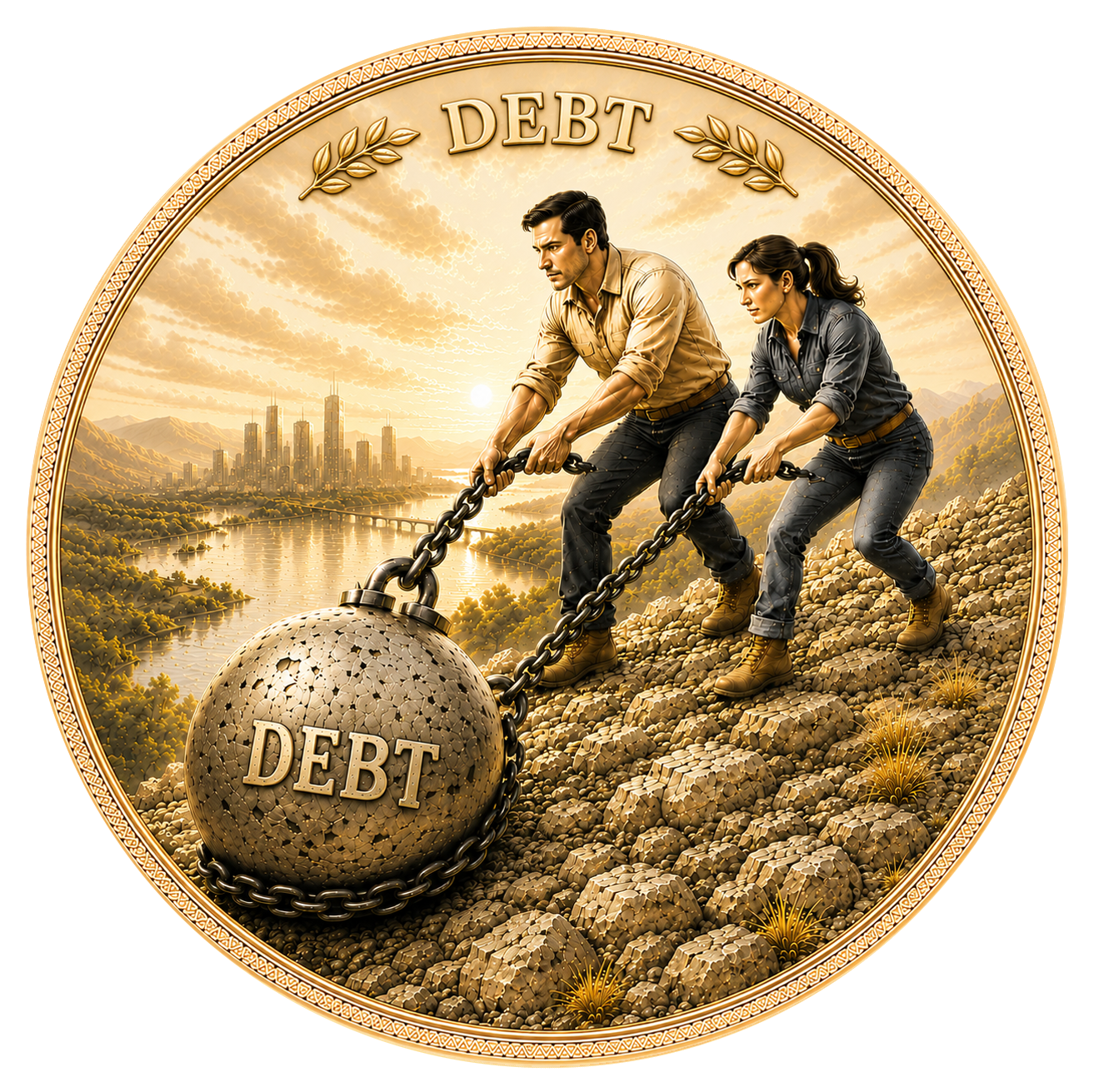
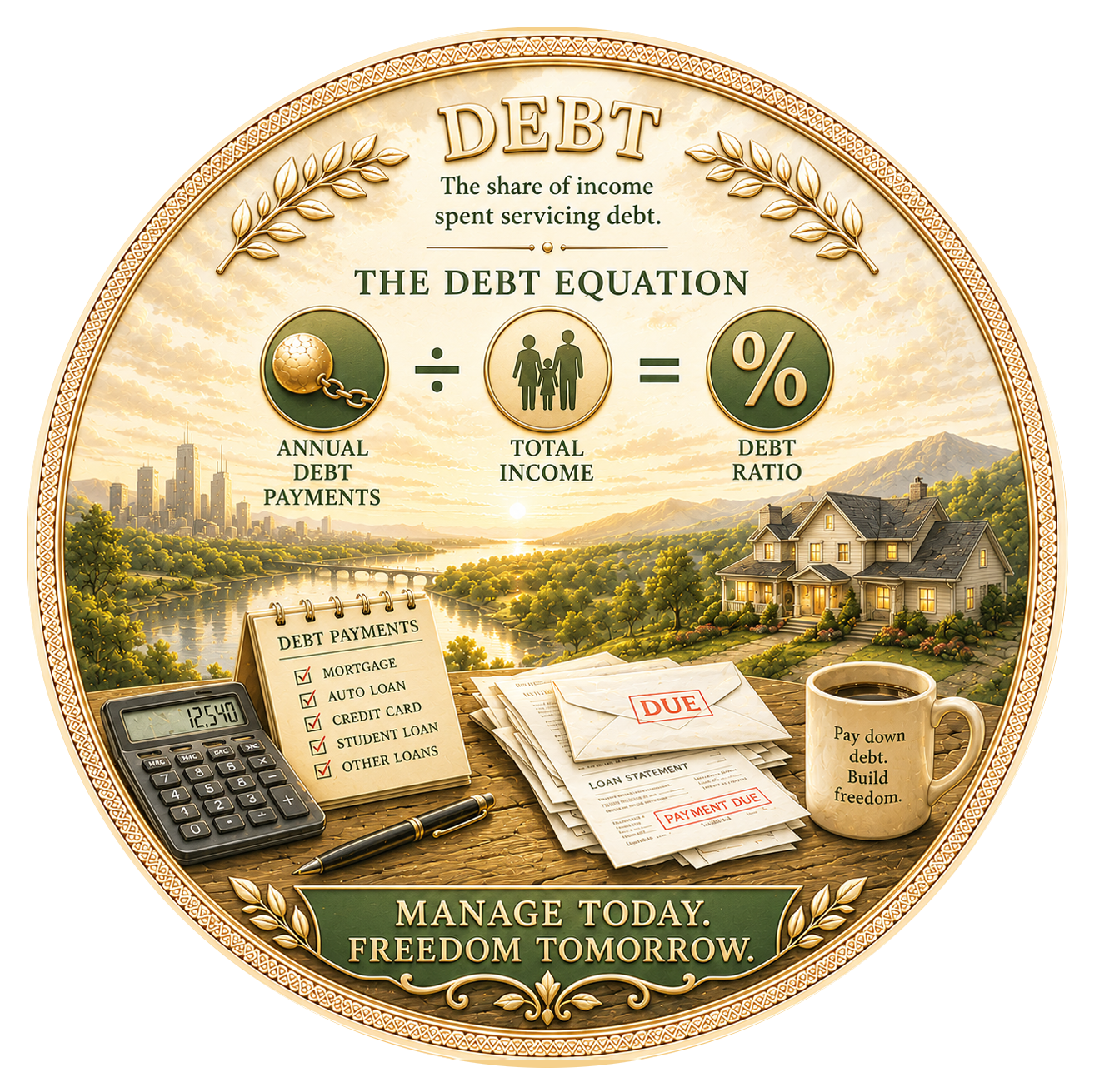
If saving is humanity's oldest financial advice, debt is humanity's oldest financial instrument — and the two have always been the same story told from opposite ends. Every dollar you keep and put to work helps build your future self. Every dollar you borrow, and carry is a dollar your future self must pay back, usually with interest, often for years. The savings coin shows a couple planting a seed. The debt coin shows a couple dragging a ball and chain uphill. That contrast is not decoration. It is the whole subject in a single image.
Hammurabi's Ledger and the First Clean Slate
Debt is not a modern invention, and neither is the worry about it. Babylon was a civilization of lenders, borrowers, and recorded interest rates — the same commercial world that later inspired the parable of saving a tenth of all you earn. The Code of Hammurabi already capped interest rates, regulated loans of grain and silver, and set limits on how long a person could be bound into service to satisfy what they owed. Its clay tablets recorded both assets and obligations side by side, a reminder that saving and borrowing have always traveled together.
Mesopotamian rulers understood something modern policymakers rediscover in every crisis: debt left to compound without limit eventually swallows the borrower whole. So from time to time they proclaimed andurarum — a clean slate that wiped personal debts and freed those bound by them. The idea echoed forward into the biblical Jubilee, and into the usury prohibitions that shaped Jewish, Christian, and Islamic finance for millennia. Across cultures and centuries, societies kept arriving at the same uneasy conclusion: borrowing is useful, and borrowing without discipline is dangerous. Four thousand years later, that is still the entire lesson.
The Mirror of Saving
Here is the mechanical truth that ties debt to everything else on the coin. Your income splits at a fork: the part you consume and the part you keep. Savings is the road that turns present income into future security. Debt is what happens when spending runs past income and the gap has to be filled from somewhere. In that sense consumer debt is the mirror image of saving — future income spent before it arrives, with a fee attached for the privilege.
That is why the debt coin measures a ratio: annual debt payments divided by total income. It answers one question — what share of every dollar you earn is already committed to servicing what you owe before you buy a single bag of groceries or fund a single retirement account? A lower ratio leaves more of every paycheck unclaimed before it arrives — more room to save, more margin when life wobbles, and more freedom to choose. A high ratio means your paycheck is spoken for the moment it lands. As a rough guide, many lenders and planners look for consumer debt payments to stay under roughly twenty to thirty percent of income, and for total obligations including housing to stay somewhere between thirty-six and forty-three percent — useful guardrails, though your own comfort should sit well inside them.
None of this makes all debt a villain. Used with discipline, borrowing has built much of the real wealth in the world — the businesses that leverage capital to grow, the infrastructure financed across generations, the homeownership that a sensible mortgage has put within reach of millions who could never have paid cash. A modestly leveraged home at a low fixed rate, or a business loan that finances real productive capacity, can be entirely rational — cheap, productive debt that buys an asset worth more than the loan and earns more than it costs. The trouble begins when the borrowing funds consumption rather than capacity, and when the interest rate is high enough to work against you the way compounding is supposed to work for you. The question is never simply whether to borrow, but what the borrowing buys, and at what price.
The Revolving Trap
Nowhere is that reversal crueler than in credit card debt. Benjamin Franklin marveled at the astonishing power of compound interest, and it is astonishing — but a revolving balance is compounding pointed the wrong way. At the interest rates most credit cards charge, a balance left unpaid can double the true cost of everything it bought. The saver's greatest ally becomes the borrower's most patient adversary, quietly enlarging the debt every month the minimum payment fails to keep up.
For anyone trying to build toward retirement, this is close to a financial emergency. The math is unforgiving: money that could be growing inside a globally diversified, low-cost index portfolio is instead being paid out as interest to a lender. A worker diligently contributing to a 401(k) while carrying a large card balance may, in some circumstances, be borrowing at a high rate to invest at a market rate — a trade that can be difficult to overcome through investment returns alone. For many households, paying off a high-interest balance may provide a risk-free benefit equivalent to avoiding the associated interest costs. Human capital is a wasting asset that eventually runs out; every year spent servicing consumer debt is a year that asset is being spent on the past instead of banked for the future.
Borrowing Against What You Own
Some of debt's most dangerous forms do not feel like debt at all. They feel like sophistication. Buying securities on margin means borrowing from your broker, against the value of the portfolio you already hold, to buy still more. It is sold as a way to amplify returns, and it does exactly that — in both directions. Leverage magnifies gains and losses alike, and it adds a peculiar cruelty of its own: the margin call. When markets fall, the broker demands more collateral or sells your holdings automatically, forcing you to sell at precisely the moment you should be holding — locking in losses, often near the market's worst point. An investor who would never touch a payday loan will happily lever a portfolio, because margin wears the costume of a strategy. But the market has no memory and cannot be timed. Margin is simply a bet that markets can be timed — with borrowed money.
The same temptation comes dressed in other clothes. A home equity line of credit turns the roof over your head into a checkbook; because the rate is low and the collateral is your house, it can feel almost free. What it actually does is convert hard-won equity — the very thing the real estate coin measures as years of freedom — back into debt, and it puts your home on the line for whatever the money was spent on, whether a remodel or a gap in the monthly budget. A pledged asset line is that same idea tailored for the affluent: borrow against your investment portfolio without selling it, at an attractive rate, with no fixed repayment schedule. It sounds like the free lunch finance famously does not serve. In truth it leverages your portfolio and hands the lender the right to sell your assets if their value slips below a threshold — a margin call by another name, capable of forcing a sale at the bottom just the same.
There are, in the end, an almost infinite number of ways to borrow money and get into trouble, and the cleverest of them are engineered to feel prudent. Card, margin account, home equity line, pledged asset line — each is a different costume worn by the same ball and chain.
Neither a Borrower Nor a Lender: Debt Among Family and Friends
There is a kind of debt that never appears on a credit report and can do more lasting damage than any of it: money lent between people who love each other. Shakespeare's Polonius said it plainly four centuries ago — "neither a borrower nor a lender be, for loan oft loses both itself and friend." The warning survives because the trap is so human. A loan to a struggling brother, a sister, a grown child, or an old friend begins as an act of generosity. It rarely ends as one.
The burden falls on both sides. The lender waits, wonders, and quietly recalculates the relationship at every missed repayment, torn between compassion and resentment. The borrower carries a different weight — gratitude slowly turning into avoidance, the awkwardness of every family gathering, the sense of being watched. What was money becomes something heavier: a standing account of obligation running underneath a relationship that used to be free of it. Holidays grow tense. Trust erodes. Sometimes the debt is repaid in full and the friendship never quite recovers anyway. If you choose to help someone you love, the wisest course is usually to give what you can genuinely afford as a gift, with no expectation of return — or not to do it at all. A relationship is worth more than the sum you were tempted to lend against it.
When the Whole System Borrows
Scale the problem up and you get the defining catastrophes of financial history — and they rhyme across the centuries. In my book, The Great Mirror of Folly — named for the satirical Dutch print collection that chronicled the great financial bubble of 1720 — I trace that crisis, the year the South Sea Bubble in London, John Law's Mississippi scheme in Paris, and a frenzy of Dutch stock promotions all collapsed within months of one another. Fortunes built on borrowed money and speculative shares evaporated almost overnight. The era's engravings capture it exactly: a carousel of Fortune spinning beneath a sky filled with worthless paper shares, crowds of speculators grasping below — and, drawn small on the horizon, the town of Vianen, with a line of carts and carriages already streaming toward it.

"Des Waerelds doen en doolen, is maar een Mallemoolen" ("The world's doings and wanderings are but a merry-go-round"), from The Great Mirror of Folly, 1720. Vianen appears on the horizon at far left, with carts and carriages streaming toward it. From the author's collection.
Vianen was a haven that lay beyond the easy reach of creditors, and ruined investors fled there to hide from debts they could no longer pay. "To go to Vianen" became a byword for ruin. In a companion plate, John Law stands amid his deflating schemes while a signpost — the Wegwyser — points the broken speculators toward the town rising on the hill.

Detail from the same series: John Law with his collapsing paper, the "Zuid" (South Sea) balloon losing its air, and at right the Wegwyser (signpost) directing the ruined toward Vianen on the hill. From the author's collection.
Let that be the image every borrower keeps in mind. The purpose of managing debt is, in the end, to never have to run to Vianen — never to be hiding from the people you owe, your freedom and your good name spent. This is a situation all borrowers should avoid, and avoiding it begins long before any crisis, in the ordinary decision of how much to borrow and why.
Nearly three centuries later, the 2008 crisis told the same story in a new dialect. Mortgages were extended to borrowers with very little money down and relatively low credit scores, on the comfortable assumption that home prices would only rise. That debt was bundled, leveraged, and layered atop yet more debt throughout the financial system. When prices stopped rising, the chain pulled taut and the whole structure dragged everyone downhill together — homeowners, banks, and eventually the global economy.
It was not the first time, and history suggests similar episodes may occur again. Strip away the specifics and most financial crises across the centuries share the same skeleton: too much borrowed against too little, on the assumption that tomorrow will resemble a very good yesterday. Excessive leverage has often been a common accelerant. It magnifies gains on the way up and destroys the borrower on the way down, and it turns an ordinary downturn into a rout. The speculators of 1720 and the central bankers of 2008 were wrestling with the same ancient force — the one the Babylonians tried to tame with their clean slates four thousand years ago.
The Weight on the Coin
This is why the debt coin shows a couple straining against a ball and chain, and not, say, a couple counting cash. Debt is weight. Managed deliberately and kept cheap, it can be a tool. Left to compound at consumer rates, borrowed against your home or your portfolio, extended casually across a family, or piled recklessly across a whole economy, it becomes the thing that drags you back down the hill you are trying to climb — or sends you fleeing to Vianen.
The path forward is the same one that runs through every coin in this series: measure where you stand, match the right strategy, and act with discipline. Know your debt ratio. Retire expensive, unproductive balances first — for many people, this may be among the most financially beneficial steps they can take. Be exceedingly careful about lending to those you love. Keep whatever debt remains cheap, productive, and proportionate to your income. Do that, and the chain loosens. The couple stops dragging and starts walking. Managing debt thoughtfully today can improve financial flexibility in the future.