Pioneers of Probability · Episode 9
This video is for informational and educational purposes only and does not constitute a solicitation or recommendation to buy or sell any security. The historical and mathematical concepts discussed are intended to illustrate the development of probability theory and its relevance to investing. Past performance is not indicative of future results. All investing involves risk, including the possible loss of principal. The examples provided are hypothetical and based on historical index data, not an actual investment. Index returns do not reflect the performance of any actual portfolio or the deduction of advisory fees. Content is AI assisted.
◆ The Question
In the autumn of 1685, a teenage boy sat in a French prison because he attended the wrong church.
Abraham de Moivre was eighteen years old when Louis XIV revoked the Edict of Nantes, the law that had guaranteed French Protestants the right to practice their faith. The revocation triggered an immediate wave of persecution. Huguenot churches were demolished. Protestant schools were closed. Those who refused to convert were arrested. De Moivre, whose father was a Protestant surgeon in Vitry-le-François in the Champagne region, was imprisoned. He read what mathematics he could find in his cell. According to one account, pages of Newton's just-published Principia Mathematica were smuggled to him there, and he read them by whatever light was available.
When he was released, he left France immediately and permanently, arriving in London as a refugee in 1687. He would live in England for the remaining sixty-seven years of his life, becoming a Fellow of the Royal Society, a personal friend of Isaac Newton and Edmond Halley, one of the most accomplished probabilists of his century — and never, despite every effort and qualification, obtaining a university position.
That last detail matters. It shaped everything about de Moivre's life and work. To earn a living, he became a private mathematics tutor, visiting students' homes and conducting sessions in the coffee houses of London, particularly in Slaughter's Coffee House on St. Martin's Lane, where gamblers would seek him out and pay him shillings to calculate odds. Newton himself, when asked mathematical questions he considered beneath his current attention, would reportedly tell visitors: "Go to Mr. de Moivre; he knows these things better than I do." The greatest mathematician alive was directing students to a man who made his living in a coffee house. De Moivre died in poverty at eighty-seven, despite that endorsement.
◆ The Insight
Jacob Bernoulli had proved, in Ars Conjectandi, that the proportion of successes in repeated trials converges toward the true probability. This was a profound result — but it raised an immediate practical question that Bernoulli had not fully answered: how does the convergence happen? How quickly? And while you are accumulating trials — while you are still in the noisy middle of the process — how are your results distributed around the true value? How often do you land close? How often far away?
De Moivre spent years on this question. He was extending Bernoulli's work on the binomial distribution — the probability of getting exactly k successes in n trials when each trial has probability p of success. For small n, this is manageable. For large n, the calculation becomes astronomically complex. De Moivre asked: as n grows very large, what shape does the binomial distribution approach?
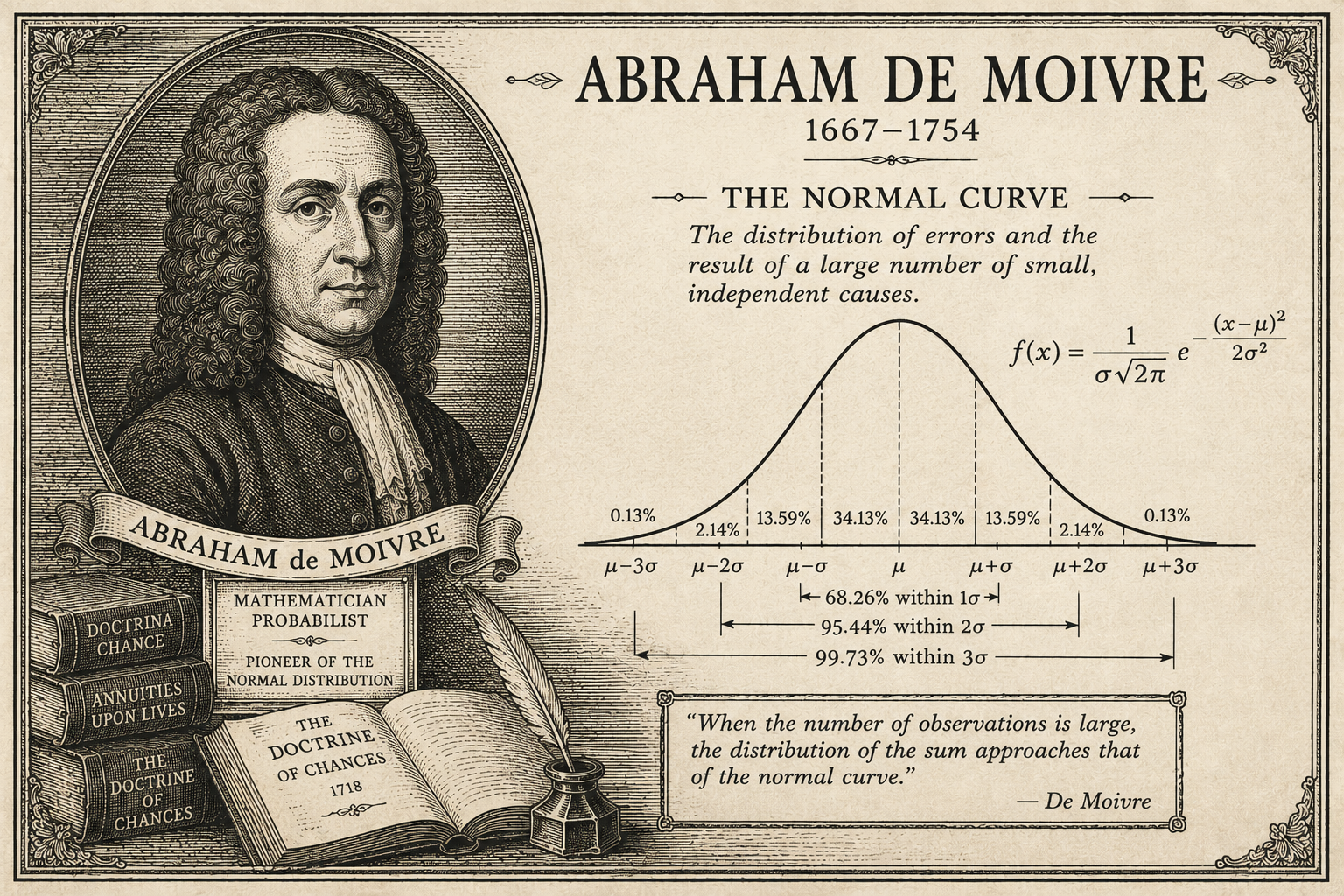
The answer he found was a curve that would eventually be called the normal distribution. The bell curve. The shape that emerges wherever many small independent influences add together to produce an outcome. And what astonished de Moivre — and what has astonished every statistician since — is how universal it is. It appears in the heights of a population, in the measurement errors of astronomers, in the scores of students on an exam, in the returns of financial assets over time. The same shape, drawn from completely different processes, arising from completely different forces. Order emerging from the accumulated chaos of independent events.
◆ The Proof
De Moivre first published his approximation in a privately circulated Latin pamphlet in 1733 — characteristically modest, circulated among a few trusted colleagues rather than published broadly. He later incorporated it into the second edition of his masterwork, The Doctrine of Chances, in 1738, and the third edition in 1756. The core result is the De Moivre-Laplace theorem, displayed on the reverse of the IFA MarketCoin® for de Moivre alongside a histogram transitioning smoothly into a bell curve, beneath the inscriptions "Discoverer of the Normal Curve" and "De Moivre-Laplace Theorem." The formula states that the binomial distribution with parameters n and p is approximately normally distributed with mean np and variance np(1 − p) — written on the coin as Binomial(n, p) ≈ N(np, npq).
The result is not merely a computational convenience. It is a deep statement about why averages behave predictably even when the underlying data does not. When you take the average of many independent random variables — each following its own distribution, which might be skewed or lumpy or anything at all — the average tends toward a normal distribution. This is the seed of what would later be called the Central Limit Theorem, and de Moivre was the first to conjecture it explicitly, if not yet in its most general form. Laplace would later generalize and rigorously prove it. But the shape was de Moivre's discovery, seen first by a French exile doing calculations for gamblers in a London coffee house.
The Doctrine of Chances also contained the first clear statement of statistical independence — the principle that the probability of a compound event composed of independent sub-events is the product of their individual probabilities. This is one of the most frequently used tools in all of probability and statistics. It was stated explicitly by de Moivre and has been used by every probability textbook since.
De Moivre also made major contributions entirely outside probability. His formula in complex number theory — (cosθ i·sinθ)^n = cos(nθ) i·sin(nθ) — is taught in every undergraduate mathematics course. He was also, less famously, the first to discover Binet's formula, the closed-form expression connecting the nth Fibonacci number to the Golden Ratio. The man solving gambling problems at Slaughter's was, in his spare moments, spanning the entire width of mathematical knowledge.
◆ The Legacy
De Moivre lived to eighty-seven — remarkable longevity for any era. Near the end of his life, according to a story that circulated soon after his death, he noticed he was sleeping fifteen minutes more each night than the night before. He applied his professional habit: he calculated. If the increment held, his required sleep would reach twenty-four hours on November 27, 1754. He predicted he would die on that date. He did, reportedly in his sleep, having performed one final probability calculation on himself.
Johann Bernoulli — with whom de Moivre had a difficult relationship, connected partly through his brother Jacob and partly through overlapping mathematical territory — had once begged Leibniz to help de Moivre secure an academic position in Germany. Leibniz tried and failed. Newton and Halley tried in England and failed. De Moivre remained a private tutor for sixty years, the resident statistician of a coffee house, writing books that transformed the field from a marginalized appendage of gambling into the foundation of scientific inference. The normal curve now has Gauss's name on it. The theorem that connects it to the binomial carries de Moivre's. That division of credit seems, on balance, about right.
◆ Your Money
The normal distribution is the foundation of modern quantitative finance — and, in equal measure, its most consequential limitation.
Standard deviation, the primary measure of portfolio volatility, is a concept that only makes full sense within the framework de Moivre built. A portfolio with an annual standard deviation of 15 percent is one where, under the normal approximation, roughly two-thirds of annual returns fall within 15 percentage points of the mean, and roughly 95 percent fall within 30 percentage points. These are exact results for a normal distribution, and useful approximations for many real-world asset classes over typical market conditions.
That framework has underpinned nearly every advance in quantitative finance since Markowitz: portfolio optimization, options pricing, value-at-risk models, factor analysis. All of it rests on the bell curve de Moivre described at Slaughter's Coffee House.
The caveat is equally important. Real market returns have fatter tails than the normal distribution predicts. Extreme events — crashes, crises, sudden dislocations — happen more often than the bell curve suggests. Every serious risk manager knows this. The financial crisis of 2008 produced daily losses that were extremely improbable under normal distributional assumptions — and produced them on multiple consecutive days. The model breaks down in the extremes, and the extremes are precisely where the damage is greatest.
But you cannot understand where the model breaks down until you understand the model. And understanding the model means understanding what de Moivre discovered: that the bell curve is the natural shape of accumulated uncertainty — what chance looks like, in the aggregate, when the noise begins to average out. Build portfolios that can survive what the bell curve says should almost never happen. But begin, as every serious practitioner must, with the curve itself. The one de Moivre drew in a coffee house, three centuries ago, while waiting for the next gambler to need his numbers.
Sources: de Moivre, A. (1756). The doctrine of chances (3rd ed.). A. Millar. Stigler, S. M. (1986). The history of statistics: The measurement of uncertainty before 1900. Harvard University Press. Britannica: Abraham de Moivre.
Disclosure: This article is for informational and educational purposes only and does not constitute a solicitation or recommendation to buy or sell any security. Past performance is not indicative of future results. All investing involves risk, including the possible loss of principal. Any historical return examples, if referenced, are hypothetical illustrations based on published index data and are not reflective of actual investor experience. Statements regarding statistical concepts, market behavior, and portfolio construction reflect educational commentary and should not be construed as forecasts or guarantees of future market outcomes.
Content is AI-assisted. Index Fund Advisors, Inc. is a registered investment adviser. For additional information, please visit adviserinfo.sec.gov or www.ifa.com.
About the pen name: "Claude Hebner" represents a collaboration between Mark Hebner, founder and CEO of Index Fund Advisors, Inc., and Claude, Anthropic's AI. The research, historical narrative, and investment analysis in each article are the result of that partnership, combining human editorial oversight with AI-assisted research and drafting.