Pioneers of Probability · Episode 8
This video is for informational and educational purposes only and does not constitute a solicitation or recommendation to buy or sell any security. The historical and mathematical concepts discussed are intended to illustrate the development of probability theory and its relevance to investing. Past performance is not indicative of future results. All investing involves risk, including the possible loss of principal. The examples provided are hypothetical and based on historical index data, not an actual investment. Index returns do not reflect the performance of any actual portfolio or the deduction of advisory fees. Content is AI assisted.
◆ The Question
In the city of Basel, Switzerland, there is a grave in the Münster cathedral that contains one of the most charming errors in the history of science. Jacob Bernoulli, who died of tuberculosis in 1705 at the age of fifty, had requested that his tombstone display the logarithmic spiral — a curve he had studied obsessively, calling it spira mirabilis, the miraculous spiral, because it reappears, unchanged in shape, after rotation, reflection, and scaling. He had it inscribed with the phrase Eadem mutata resurgo — "Though changed, I rise again the same." The mason who carved the stone, apparently unfamiliar with the distinction, engraved an Archimedean spiral instead. Bernoulli, who spent his career on precise mathematical distinctions, rests beneath the wrong curve.
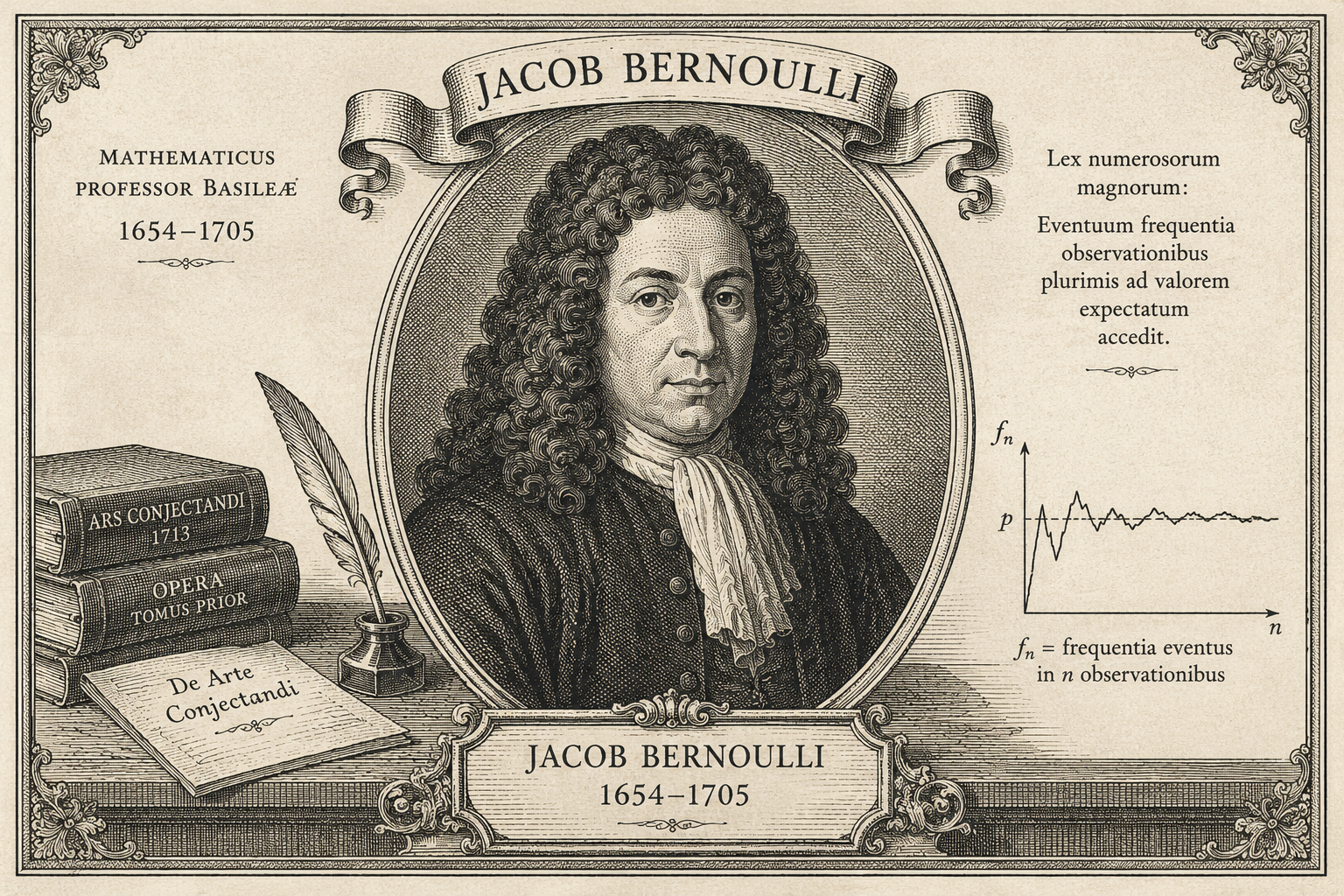
The Bernoulli family is one of the most remarkable dynasties in the history of mathematics — three generations producing at least eight significant mathematicians, a phenomenon with no real parallel in scientific history. The family had fled Antwerp in 1583 to escape the religious persecutions of the Spanish Duke of Alba, settling eventually in Basel, where they became prosperous spice merchants. Jacob's father Nicolaus wanted him to study theology, which Jacob dutifully did, earning his degree and entering the ministry. He also, against his father's explicit wishes, studied mathematics and astronomy on the side. He traveled Europe from 1676 to 1682, meeting Robert Boyle and Robert Hooke in England, studying with Cartesian mathematicians in France, corresponding with Leibniz. By the time he returned to Basel, he was one of the finest mathematicians on the continent. He became professor of mathematics at the University of Basel in 1687 and held the position until his death.
His younger brother Johann, twelve years his junior, studied medicine at Basel but wanted to learn calculus — then brand-new and ferociously difficult. He asked Jacob to teach him. Jacob did. The two collaborated productively for a time, then fell into a rivalry so bitter and public that it was conducted largely through the pages of mathematics journals, each brother attributing incompetence and dishonesty to the other in print. By Jacob's death in 1705, they were barely speaking.
◆ The Insight
Every probability result before Jacob Bernoulli started from the same privileged position: a known probability. A fair die. A fair coin. A well-defined game with countable outcomes. From that starting point, the mathematicians of the seventeenth century built an impressive edifice — expected values, combinations, solutions to gambling problems, frameworks for decision-making under uncertainty.
But Jacob Bernoulli asked the question that all of this had quietly assumed away. What if you don't know the probability? What if, instead of being handed p = 1/2 at the start, you have to discover it — by flipping the coin, again and again, and watching what happens?
This is not an abstract question. It is the central practical problem of inference. The physician who wants to know whether a treatment works, the actuary who wants to know the probability of death at each age, the investor who wants to know the expected return of the market — none of them are given the true probability in advance. They observe data, accumulate evidence, and try to estimate the underlying truth. The question Bernoulli set himself was whether this process could be trusted: whether observation, repeated often enough, actually converges on the truth.
The answer — which he called the Golden Theorem and which we call the Law of Large Numbers — is yes. Provably, mathematically, rigorously yes.
◆ The Proof
The foundation is the Bernoulli distribution, the simplest probability model imaginable: a single trial, two outcomes, success with probability p, failure with probability 1 minus p. The IFA MarketCoin® for Jacob Bernoulli shows this directly on its reverse: P(x; p) = p if x = 1, and 1 − p if x = 0 — beneath the inscriptions "Repetition Reveals Truth," "Bernoulli Distribution," and "Law of Large Numbers." It is the building block: one coin flip, one market day, any binary event anywhere in the world that can be modeled as having two possible outcomes.
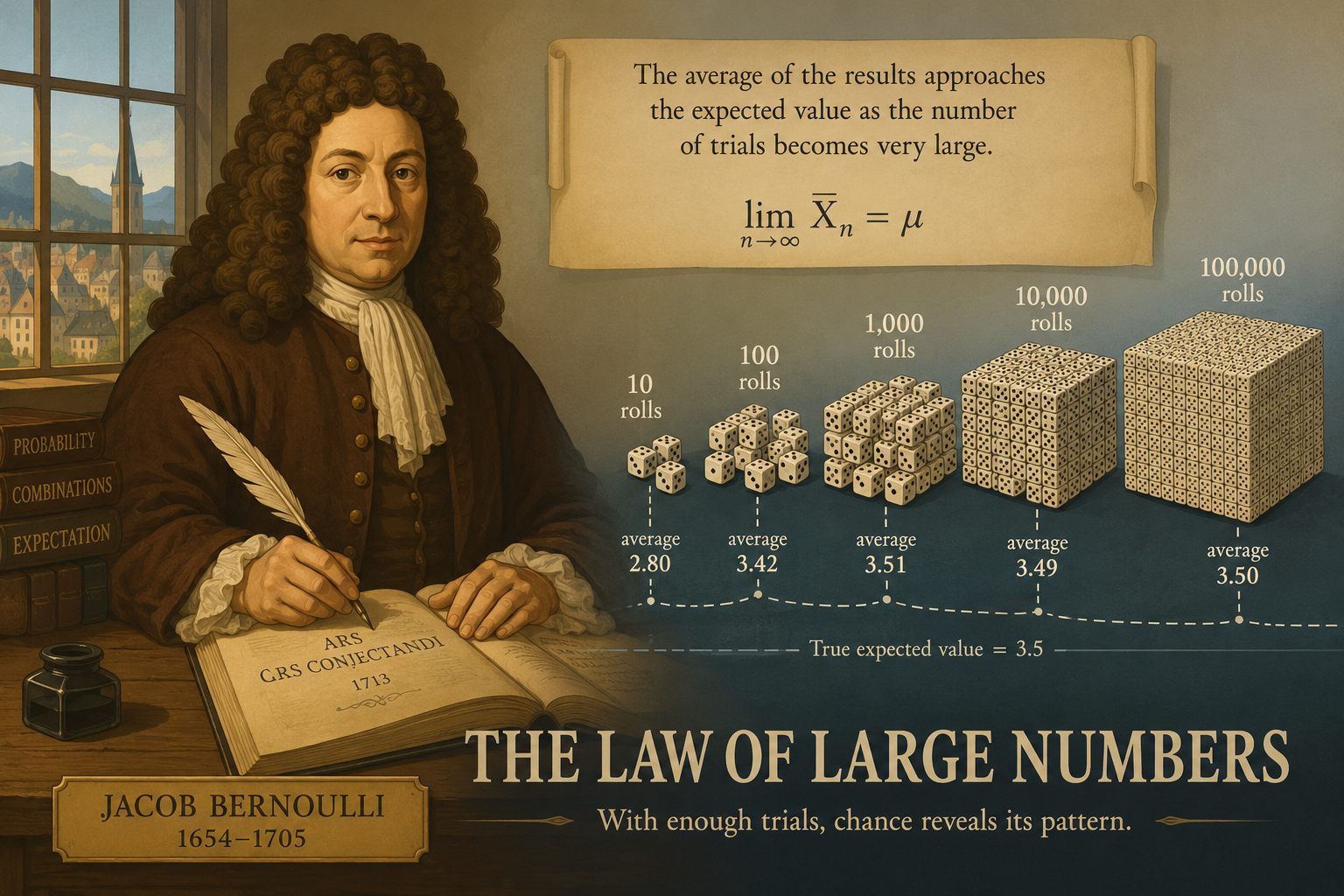
Stack enough Bernoulli trials together and something profound happens. The proportion of successes in n trials converges to the true probability p as n grows. Not just trends toward p — converges to it. The probability of the observed proportion being far from p goes to zero as the number of trials increases. Bernoulli proved this — not as an approximation, not as an observation, but as a theorem, with a proof that occupied him for roughly twenty years.
He worked on it from around 1687, returning to it again and again as the technical difficulties mounted. He needed to show not just that the average converges, but to quantify how large n must be to guarantee a given level of precision with a given level of confidence. That quantification — the relationship between sample size, margin of error, and probability of accuracy — is the mathematical heart of all modern statistics. Bernoulli had it, in substance, more than three centuries before modern textbooks introduced the concept to students.
He was also, in the same work, one of the first to speculate that the law could be applied beyond gambling to "civil, moral and economic" affairs. Not just dice, but birth rates, death rates, insurance, commercial transactions. The Ars Conjectandi — The Art of Conjecturing — is explicitly about applying probability to the decisions humans actually face. Part Four, the section containing the Law of Large Numbers, was intended to demonstrate how observational data from the real world could yield genuine probabilistic knowledge. It was, in embryo, the program of modern empirical science.
Bernoulli died of tuberculosis in August 1705, leaving Ars Conjectandi unfinished. The manuscript sat for eight years. Johann — still bitter, still feuding — declined to edit it. It was finally published in 1713 by Bernoulli's nephew, Nicholas, who had inherited the manuscript and had the mathematical competence to prepare it for print. Eight years from death to publication, for what is arguably the most important book on probability before the twentieth century.
◆ The Legacy
The Law of Large Numbers did something no previous result had fully accomplished. It provided the rigorous mathematical bridge between the theoretical world of known probabilities and the practical world of observed data. Before Bernoulli, the probability of a fair coin was 1/2 by definition — a logical truth about a fair coin. After Bernoulli, you could flip an unfamiliar coin ten thousand times and know, with mathematical precision, how confident to be that your observed proportion was close to the true probability. Observation became a reliable path to knowledge, with a theorem behind it.
Bernoulli also discovered the mathematical constant e — the base of the natural logarithm — while studying compound interest, an origin story that feels almost designed to connect mathematical history to finance. He was an early advocate of Leibnizian calculus and sided publicly with Leibniz in the Newton-Leibniz dispute, which put him in opposition to much of English mathematics for decades. He contributed to the calculus of variations, the theory of differential equations, and the study of infinite series, in each case producing work that the next generation built directly upon.
◆ Your Money
For long-term investors, the Law of Large Numbers is not a metaphor. It is the mathematical argument for patience, stated as a theorem.
Think of each day in a diversified portfolio as a Bernoulli trial — not perfectly binary, not perfectly independent, but carrying the logic of the underlying argument. In any short run, the noise overwhelms the signal. A fund manager who beats the market in a single year may have done so entirely by luck. A strategy that produced strong returns in a three-year window may reflect nothing more than a favorable environment. Bernoulli's logic says: the sample is too small to distinguish the signal from the noise. The Law of Large Numbers has not yet had time to operate.
Over long periods — across decades, across thousands of trading days — the law begins to assert itself. Random variation averages out. Genuine underlying expected returns become visible in the accumulated record. The investor who panics and sells in a downturn, or who chases last year's winner and abandons a sound strategy after a bad quarter, is stopping the experiment before the Law of Large Numbers has had time to operate. They are concluding from too few trials that the coin is unfair, and walking away just as the pattern was about to reveal itself.
Repetition reveals truth. That is the rim of this coin and the lesson of Jacob Bernoulli's twenty years of work. Not patience as a personality trait. Patience as a mathematical necessity — one with a proof behind it, worked out in Basel, by a man who rests beneath the wrong spiral but whose theorem stands without error.
Sources: Bernoulli, J. (1713). Ars conjectandi. Thurneysen Brothers. Stigler, S. M. (1986). The history of statistics: The measurement of uncertainty before 1900. Harvard University Press. MacTutor History of Mathematics, University of St Andrews.
Disclosure: This article is for informational and educational purposes only and does not constitute a solicitation or recommendation to buy or sell any security. Past performance is not indicative of future results. All investing involves risk, including the possible loss of principal. Any historical return examples, if referenced, are hypothetical illustrations based on published index data and are not reflective of actual investor experience.
References to statistical concepts and historical examples are provided for educational purposes and should not be interpreted as guarantees regarding future market behavior or investment outcomes.
Content is AI-assisted. Index Fund Advisors, Inc. is a registered investment adviser. For additional information, please visit adviserinfo.sec.gov or www.ifa.com.
About the pen name: "Claude Hebner" represents a collaboration between Mark Hebner, founder and CEO of Index Fund Advisors, Inc., and Claude, Anthropic's AI. The research, historical narrative, and investment analysis in each article are the result of that partnership, combining human editorial oversight with AI-assisted research and drafting.