
 Risk Capacity
 Wealth Management
 Outsourced CIO
 Retirement Plans
 Institutional
 Financial
  Open an Account
 IFA App

 Articles
 Charts
 Investor Education ▾
 Fund
Fund
 Store
Store

 Taxes
Taxes Back-testing Disclosures
 Glossary
 Form CRS
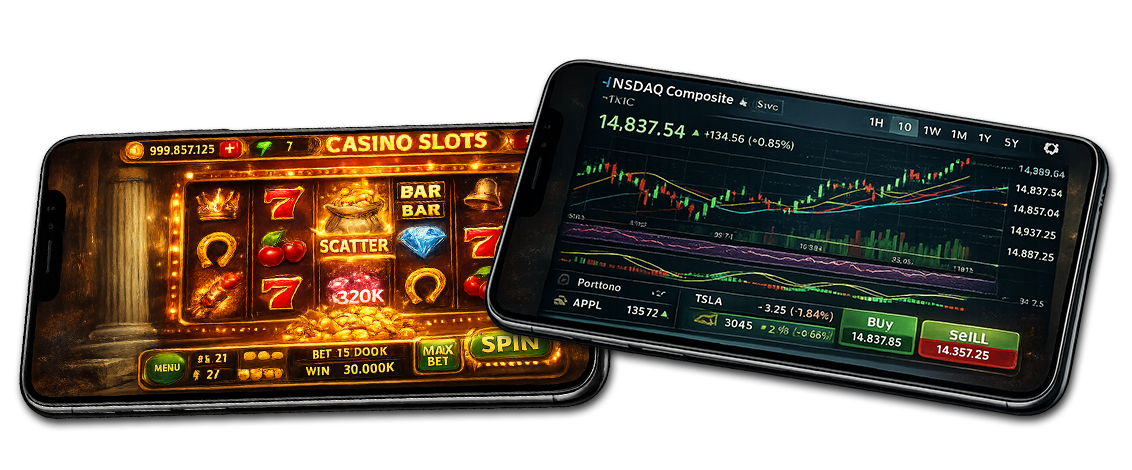
Trading apps don't just make investing easier — they're often built to keep you coming back. The design choices are deliberate: remove friction, add reward loops, eliminate natural stopping points. It looks like financial access. In some respects, it functions more like a casino floor. Robin Powell spoke to one of the researchers now making that case in peer-reviewed academic work. What she found is essential context for anyone who trades.
The story Wall Street told about zero-commission trading apps was a simple one: democratization. Anyone with a smartphone could now access markets that were once the preserve of professionals. What the story left out was the design brief. Frictionless access, reward loops, no closing bell — features borrowed not from financial services, but from the behavioral playbook of casinos and gaming platforms.
The question researchers are now beginning to ask is whether that design is creating something more troubling than a trading habit. Whether, for a meaningful number of users, it is creating disordered behavior.
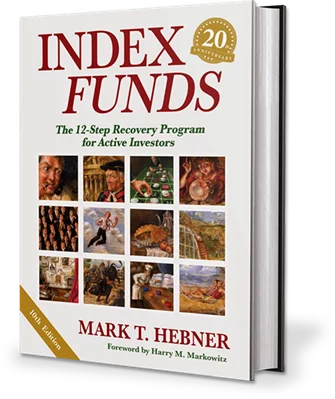
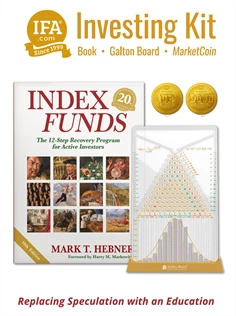
It isn't a new question, just a newly urgent one. IFA founder Mark Hebner was drawing the parallel between active investing and compulsive gambling as far back as 1998. It became the founding insight behind both IFA and his book Index Funds: The 12-Step Recovery Program for Active Investors. The IFA Story explains how he got there, and Step 1 of the book makes the underlying case. What's changed since then is that academia has caught up.
"Trading Disorder": Why the Label Matters More Than You Think
Nizan Geslevich Packin is a Professor of Law at the Zicklin School of Business at Baruch College (City University of New York), specializing in financial regulation and fintech. Her 2025 paper All Bets Are On: Addiction, Prediction, Regulation, and the Future of Financial Gambling, co-authored with addiction expert Sharon Rabinovitz, is among the first to examine compulsive trading through a legal and regulatory lens.
Notice that Packin doesn't call it an addiction. The choice is deliberate. She and Rabinovitz have been careful not to claim more than their research supports. They use the term "trading disorder", described in a recent interview as "a provisional research construct that describes this persistent loss-of-control trading behavior." Without a formal clinical study, they won't assert a validated medical diagnosis.
It's an intellectually honest position. But it comes at a practical cost. As earlier research into the gambling-investing connection has shown, regulators tend to act on named problems. Without a recognized diagnostic category, consumer protection law has little to grab onto. You can't regulate what you can't define.
The Casino in Your Pocket — By Design, Not Accident
So what's actually happening inside these apps? "When we increase accessibility and reduce friction at the same time," Packin says, "we increase engagement frequency. That's obvious." What follows from that is the real concern: when money is on the line, trading more often times leads to earning less.
The design features she describes aren't accidental. Gamified interfaces use what she calls "linguistic framing, feedback cues, and reward structures" that closely resemble gambling environments. Her co-author, an addiction scholar, draws a direct line to what the clinical literature documents: dopamine-triggering feedback loops, continuous engagement patterns, algorithmic nudges toward more activity. These aren't bugs. They're features.
Zero-commission trading sounds like a gift to retail investors. Packin sees it differently: "If there's no fee, who becomes the product?" Someone always pays. The question is whether the cost has been redirected away from transaction fees and onto users in ways that don't appear on any statement. The frictionless model has democratized access to markets, and that's a genuine benefit. Packin's point is that democratization and exploitation aren't mutually exclusive.
Underlying all of this is the stopping cue problem. Behavioral science is clear that removing natural endpoints increases continuous engagement. A bar calls last orders. A casino does neither — no windows, no clocks, no closing time. As IFA has previously examined, the push toward extended and near-continuous trading hours follows exactly this logic. When the exchange never closes, the natural pause that might prompt reflection never arrives.
Barber and Odean's landmark 2000 study found that trading frequency is inversely related to net returns — a relationship that has held across decades of subsequent research. A platform built to maximize engagement is effectively built to maximize trading, which consistently erodes returns.
Controlled experiments are still needed to isolate which design features cause the most harm, and for whom. But the direction of the evidence isn't ambiguous. These apps aren't neutral tools. They're environments, and, as any casino architect knows, environments can be engineered.
Prediction Markets: Where Gambling Becomes "Forecasting"
Stock trading apps at least present themselves honestly as places to buy and sell securities. Prediction markets go a step further — they actively rebrand the activity itself.
Packin and her co-author analyzed five prediction market platforms empirically. Services like Polymarket and Kalshi let users buy event contracts — essentially bets on whether a specific outcome will occur, from election results to sports scores to economic indicators.
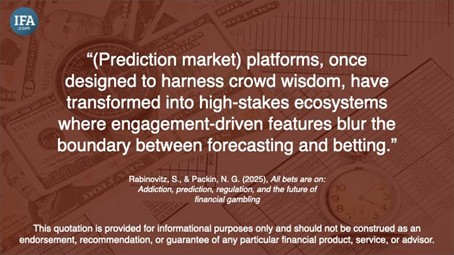
The paper identifies what it calls "terminological washing": systematically replacing betting language with financial and forecasting language. Call it a position, not a bet. Forecasting, not gambling. The behavior is functionally identical; the branding is carefully different, and that gap has significant regulatory implications.
According to Packin, users engage "24/7, on any type of topic — low stakes, high stakes." The apps are jurisdiction less, always available, structured around continuous participation. Natural stopping cues are essentially non-existent.
Earlier this year, the Commodity Futures Trading Commission (CFTC) claimed regulatory authoritiy over prediction markets, classifying them as financial derivatives rather than gambling products. Packin sees an immediate problem: financial regulators aren't built to monitor consumer health risks. "Who are the ones that are going to monitor or address any of these concerns?" The question currently has no clear answer.
Packin doesn't dismiss prediction markets outright. They offer genuine benefits, she says: price discovery, information aggregation, liquidity. The problem is the design and the regulatory gap the rebranding has opened.
A Global Problem With No Consistent Answer
If you were hoping regulators had this under control, the international picture won't reassure you.
According to Packin, responses vary dramatically across countries. Portugal has classified prediction markets as a form of gambling and moved to ban them outright. France has taken a more mixed approach. The US is treating them as CFTC-supervised financial derivatives. The UK produced a substantive report in summer 2024 examining the role of social media influencers in driving speculative behavior on these apps. Across Asia, approaches differ further still. Even within the EU, member states are charting their own paths.
What they share, Packin argues, is the absence of a common evidence base. "Everyone is going based on cultural preferences and historical approaches — either to the financial markets or to anything that could be identified as gambling." Each jurisdiction is improvising, guided by instinct rather than data.
When platforms are wthout jurisdiction and run continuously, divergent national rules invite a predictable result: register where oversight is lightest, serve users everywhere else. The risk of a race to the bottom writes itself.
Putting the Clock Back on the Wall
Packin isn't calling for these platforms to be shut down. Her position is deliberately modest.
Her first priority is transparency. Specifically, "enhanced transparency about trading frequency and cumulative losses." Investors should be able to see, plainly and prominently, how often they're trading and what it's costing them — not buried in account statements, but front and center, where it can actually shape decisions.
Second, friction-based defaults for high-frequency activity: optional cooling-off periods that interrupt the loop without preventing trading entirely. The equivalent of last call at a bar. It doesn't stop anyone determined to keep going, but it inserts a pause where the platform currently offers none.
Third, design standards. Excessive push notifications, celebratory animations for risky trades, misleading odds displays — these are identifiable features that could be restricted under what Packin describes as "fair design" principles. Platforms that comply could earn regulatory certification. Those that don't would face scrutiny.
Age verification and cross-border enforcement remain genuinely hard problems — Packin doesn't pretend otherwise. "There are no easy answers," she says.
Her baseline is clear: "Any intervention should be proportionate and not excessive, but we do need evidence-based intervention that is minimal, but concrete and effective." That's not a call to regulate innovation out of existence. It's a call to put the clock back on the wall.
The Clock Was Always There
What Nizan Packin is documenting in peer-reviewed law journals, Mark Hebner saw coming in 1998. The line between trading and compulsion is thinner than the industry wants you to believe, and the platforms profiting from your engagement have strong incentives to keep it that way.
Knowing that changes how you look at the tools you use.
Three things worth doing now: audit your trading frequency honestly — not just how often you trade, but whether it's actually improving your outcomes. Look at your apps with fresh eyes and ask which features are designed to serve your returns and which are designed to serve their engagement metrics. And if you haven't read Index Funds: The 12-Step Recovery Program for Active Investors, it remains a great frameworkfor understanding, and breaking, the patterns these platforms are built to reinforce.
The clock was always there. Now you know who removed it.
Resources
Barber, B. M., & Odean, T. (2000). Trading is hazardous to your wealth: The common stock investment performance of individual investors. Journal of Finance, 55(2), 773–806.
Rabinovitz, S., & Packin, N. G. (2025). All bets are on: Addiction, prediction, regulation, and the future of financial gambling. Fordham Intellectual Property, Media and Entertainment Law Journal, 36(1), 90–165.
ROBIN POWELL is the Creative Director at Index Fund Advisors (IFA). He is also a financial journalist and the Editor of The Evidence-Based Investor. This article reflects IFA's investment philosophy and is intended for informational purposes only.
DISCLOSURES:
This article is for informational purposes only and does not constitute investment advice, an offer, or a solicitation to buy or sell any security.
Past performance is not indicative of future results. All examples and data cited are based on historical analysis and may not reflect future market conditions. Investing involves risks, including the possible loss of principal. Any third‑party statements or awards referenced relate to the cited books/authors and are not endorsements of Index Fund Advisors, Inc. or its advisory services, and no compensation was provided by Index Fund Advisors, Inc. in connection with them Readers should consult a qualified professional regarding their personal situation.
This article was sourced and prepared with the assistance of artificial intelligence (AI) technology and reviewed prior to publication.
For more information about Index Fund Advisors, Inc, please review our brochure at https://www.adviserinfo.sec.gov/ or visit www.ifa.com.
















 Home
Home 888-643-3133
 Contact Us
 Newsletter Subscribe
 eMoney
 IFA Apps
 Index Funds Book on Kindle
 Index Funds Audiobook
 Careers
 Facebook
 X
X LinkedIn
 Instagram
 Youtube
 Terms
Terms Index Descriptions