
 Risk Capacity
 Wealth Management
 Outsourced CIO
 Retirement Plans
 Institutional
 Financial
  Open an Account
 IFA App

 Articles
 Charts
 Investor Education ▾
 Fund
Fund
 Store
Store

 Taxes
Taxes Back-testing Disclosures
 Glossary
 Form CRS
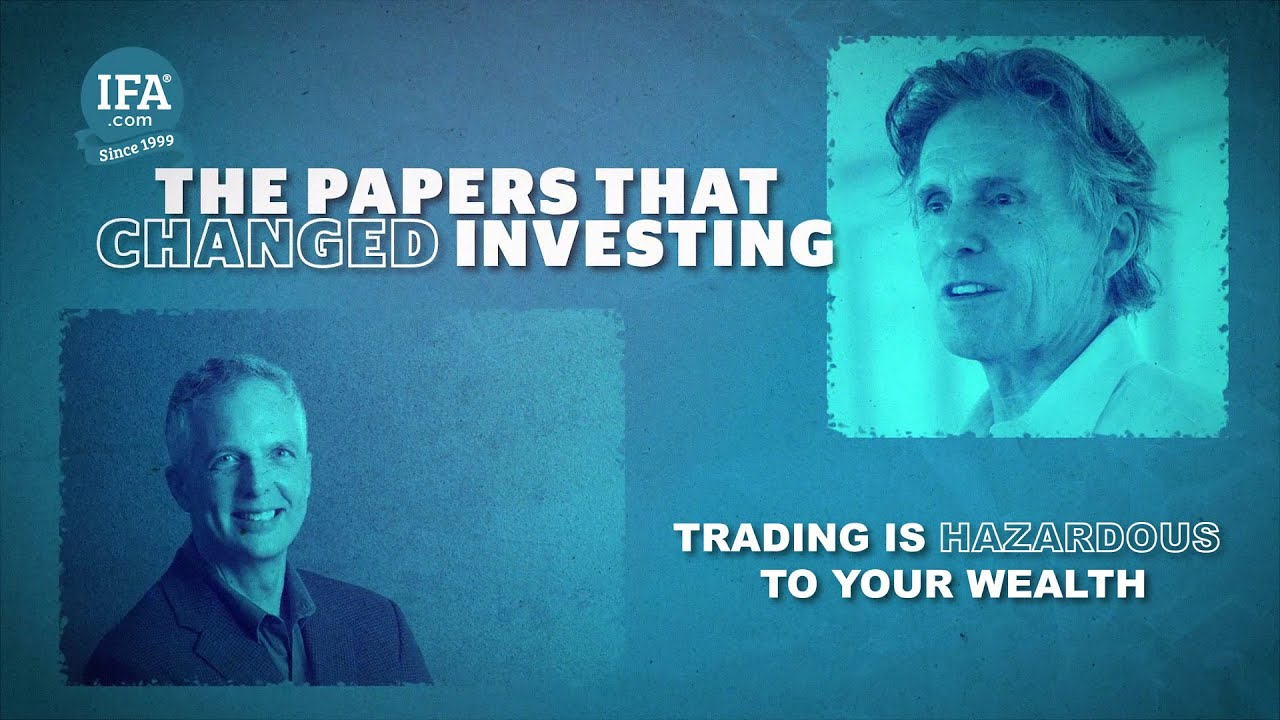
The Papers that Changed Investing: Trading is Hazardous to Your Wealth

It's 1996. The internet is transforming everything — including how Americans invest. Discount brokerages are on TV, promising ordinary people they can trade like the pros.
Suddenly, you don't need a stockbroker. You can buy and sell from your living room. Commissions are falling. Trading feels almost free.
Millions of Americans began clicking "buy" and "sell," believing their research gave them an edge.
But here's the question nobody was asking: Was all this trading actually making investors richer — or poorer?
Two finance professors — Brad Barber and Terrance Odean — decided to find out by analyzing the trading records of 66,000 households.
What they discovered became a wake-up call for anyone who believed they could beat the market in the long run.
Welcome to The Papers That Changed Investing.
Before Barber and Odean, investors assumed their trading was adding value. You read the news. You spot opportunities others miss. You act decisively. Surely that's how you get rich?
The brokerage industry encouraged this belief. Every trade meant commissions. More activity meant more revenue.
Financial media fed the frenzy with stock tips and market predictions. Trading felt like a skill you could master.
But nobody was measuring whether individual investors actually profited from all this activity — or just churned their accounts.
Barber and Odean suspected overconfidence was driving investors to trade far more than was good for them.
Their insight was simple but powerful: if trading added value, frequent traders should outperform. If it didn't, they'd underperform — by exactly the amount of their trading costs.
They obtained something remarkable: six years of trading data from a major discount brokerage.
66,465 households. Every buy. Every sell. Every dollar in and out. Not surveys — actual trading records from 1991 to 1996.
Think of it like a casino. Every time you place a bet, the house takes its cut. The more you play, the more you lose to that invisible edge.
Barber and Odean divided investors into five groups — from those who barely traded to those who traded constantly.
Then they measured two things: gross returns before trading costs, and net returns after paying commissions and spreads.
What they found was staggering. The average household turned over 75 percent of its portfolio annually. The most active traders? Over 250 percent.
That's completely replacing your portfolio two and a half times every year.
As they wrote: "It is the cost of trading and the frequency of trading, not portfolio selections, that explain the poor investment performance."
So what did they discover?
First: before costs, frequent traders and infrequent traders earned virtually identical returns. All that research? All that effort? It did not improve returns in this study.
Second: after costs, the gap was enormous. The most active traders earned just 11.4 percent annually. The market returned 17.9 percent. A difference of 6.5 percentage points a year.
Third: overconfidence was the culprit. Investors believed their information was special. It wasn't.
Here's why this matters for your money today.
Barber and Odean showed how frequent trading is mathematically self-destructive. Instead of beating the market, frequent trading often results in lower net returns after costs.
Every trade carries a cost. Commissions. Spreads. Taxes. There's an old investing adage: a portfolio is like a bar of soap — the more you use it, the smaller it gets. Each transaction, no matter how clever it seems, washes away a little more of your wealth.
This research changed how fiduciary advisors think about investing. The goal isn't to trade cleverly. It's to capture market returns while minimizing the friction that destroys wealth.
Want to learn more about the benefits of a disciplined, low-turnover approach to investing?
Contact us via the website — IFA.com to learn more about our approach to disciplined investing.
DISCLOSURES:
This material is intended for informational purposes only and is not a solicitation, offer, or recommendation to buy or sell any securities or investment programs.
Past performance is not indicative of future results. All investing involves risk, including the possible loss of principal. References to academic studies are provided for educational purposes and may not reflect current market conditions. Assumptions include trading costs, taxes, and other frictions materially impact net returns. Individual circumstances vary, and readers should consult a qualified financial professional before making investment decisions. This video may include content generated or enhanced using artificial intelligence (AI).
For more information about Index Fund Advisors, Inc, please review our brochure at https://www.adviserinfo.sec.gov/ or visit www.ifa.com.











 Home
Home 888-643-3133
 Contact Us
 Newsletter Subscribe
 eMoney
 IFA Apps
 Index Funds Book on Kindle
 Index Funds Audiobook
 Careers
 Facebook
 X
X LinkedIn
 Instagram
 Youtube
 Terms
Terms Index Descriptions