
 Risk Capacity
 Wealth Management
 Outsourced CIO
 Retirement Plans
 Institutional
 Financial
  Open an Account
 IFA App

 Articles
 Charts
 Investor Education ▾
 Fund
Fund
 Store
Store

 Taxes
Taxes Back-testing Disclosures
 Glossary
 Form CRS
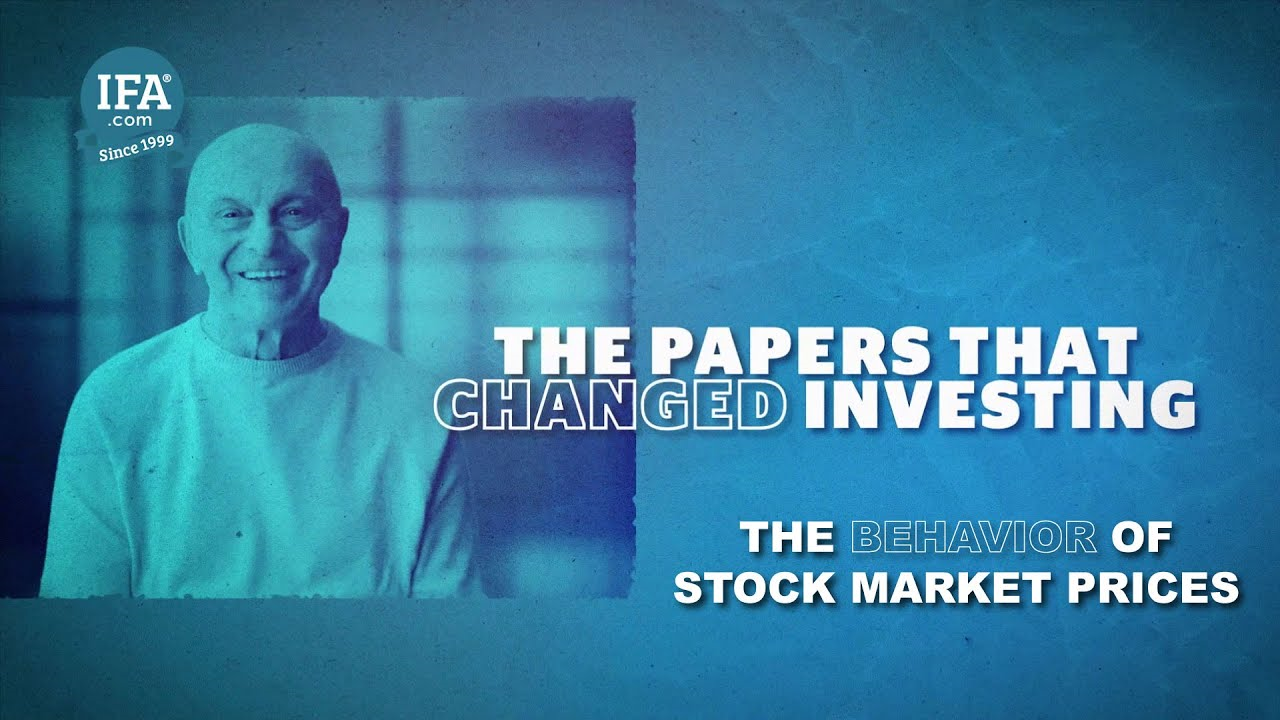
The Papers that Changed Investing: The Behavior of Stock Market Prices

Walk into any Wall Street brokerage in 1965, and you'll see the same thing: analysts hunched over charts, tracing patterns with their fingers.
They're searching for head-and-shoulders formations, Elliott Waves, Fibonacci sequences. Every major firm has entire departments devoted to this. The belief was widespread: study the charts long enough, and the market may reveal its secrets.
But here's the problem. Nobody had actually tested whether this was true.
One young finance professor at the University of Chicago asked that question. His name was Eugene Fama. And his answer changed investing forever.
Welcome to The Papers That Changed Investing.
Before Fama, investment advice rested on a comforting assumption: experts could outsmart the market.
Brokerage firms studied industry trends, analysed balance sheets, interviewed senior managers. Technical analysts read price charts like tea leaves.
Fama realised the emperor might have no clothes. And he had the statistical tools to find out.
What Fama realised was deceptively simple: if markets are doing their job properly, prices should move randomly.
Think of it like this. Imagine you're betting on coin flips. Each flip is independent. Knowing the last ten flips tells you nothing about the next one.
If he was right, it meant technical analysis may not provide value to investors. Chart patterns were illusions. And the only way to beat the market was to know something the market didn't — before the market found out.
Fama didn't just theorise. He built the framework to test it.
He gathered decades of daily stock price data and applied rigorous statistical analysis. His question: Are successive price changes independent?
Think of it like checking weather forecasts. If rain today means rain tomorrow, yesterday's weather helps predict tomorrow's. But if each day's weather is independent, yesterday tells you nothing.
In his own words:
First, successive price changes are independent and uncorrelated. Yesterday's move doesn't predict today's. The market has no memory.
Second, prices incorporate all available information almost instantly. By the time you read about news in the paper, it's already in the price.
Third, technical analysis cannot systematically outperform a simple buy-and-hold strategy. After costs, chart reading, according to Fama's findings, did not provide real value to investors.
This became known as the Efficient Market Hypothesis.
Here's why this matters for your money today.
Fama's research suggested that trying to time the market or pick hot stocks is unlikely to succeed consistently. Not because you're not smart enough. Because the information you need is already in the price.
The proper response? Stop trying to beat the market. Instead, own the market through broad diversification at the lowest possible cost.
Fama's research showed that what matters isn't predicting the future. It's managing risk, controlling costs, and staying disciplined.
For this work — and his later development of factor models with Kenneth French — Fama won the Nobel Prize in 2013.
That single paper became the intellectual foundation for an entire industry. Index funds, passive investing, low-cost portfolios — none of it exists without Fama proving that markets are efficient.
Curious whether your portfolio reflects what Fama discovered? Visit IFA.com to find out.
DISCLOSURES:
This video is for informational and educational purposes only and does not constitute investment advice or a recommendation to buy or sell any security. Investing involves risk, including the potential loss of principal. Past performance is not indicative of future results.
The discussion of Eugene Fama and the Efficient Market Hypothesis is intended to illustrate academic concepts in finance and does not imply any endorsement of Index Fund Advisors, Inc. or its services.
Index Fund Advisors, Inc. is a -registered investment adviser. Additional information is available by reviewing IFA's ADV Brochure at https://www.adviserinfo.sec.gov/ or visiting www.ifa.com.











 Home
Home 888-643-3133
 Contact Us
 Newsletter Subscribe
 eMoney
 IFA Apps
 Index Funds Book on Kindle
 Index Funds Audiobook
 Careers
 Facebook
 X
X LinkedIn
 Instagram
 Youtube
 Terms
Terms Index Descriptions