
 Risk Capacity
 Wealth Management
 Outsourced CIO
 Retirement Plans
 Institutional
 Financial
  Open an Account
 IFA App

 Articles
 Charts
 Investor Education ▾
 Fund
Fund
 Store
Store

 Taxes
Taxes Back-testing Disclosures
 Glossary
 Form CRS
The Papers that Changed Investing: The Case for an Unmanaged Investment Company
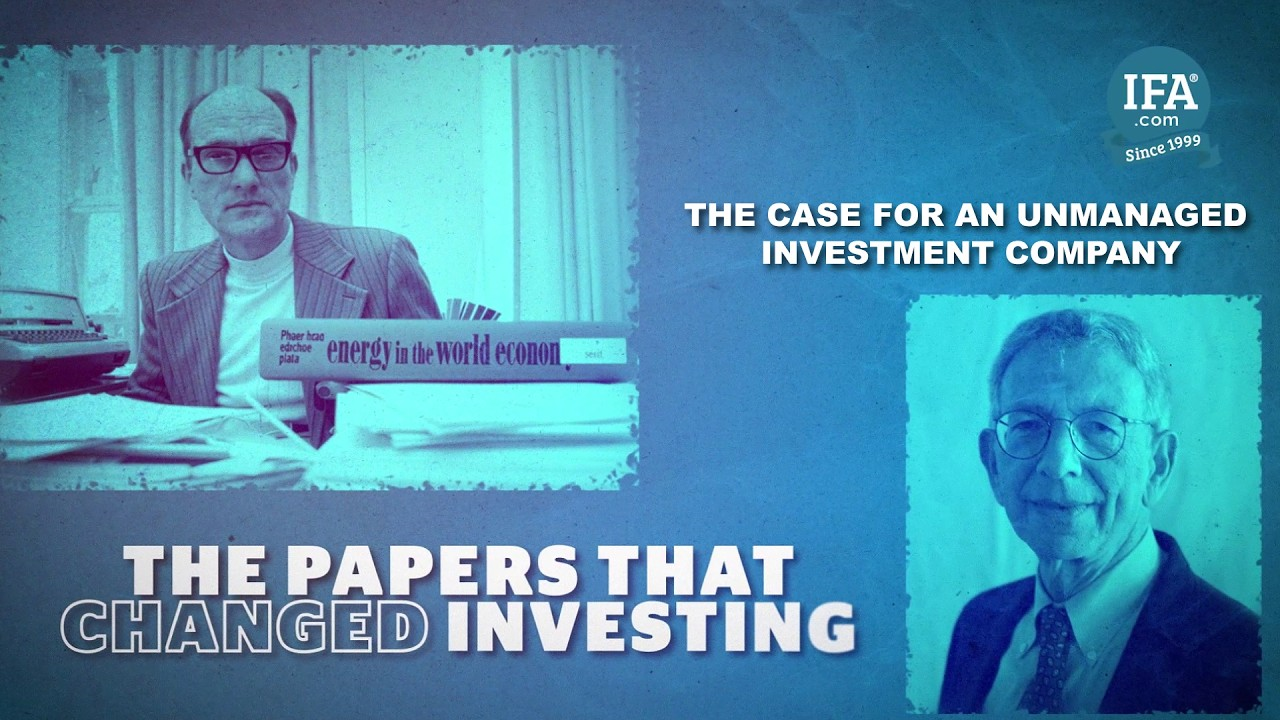

It's 1960. JFK is on the campaign trail, NASA launches America's first weather satellite, and ABC premieres The Flintstones — the first animated series created specifically for prime-time network television.
The mutual fund industry is booming. A new class of professional money managers promises to do something ordinary investors historically have struggled with — beat the market.
But two young economists are about to publish a paper the industry really doesn't want to read.
This is the paper that proposed an early version of what we now call an index fund.
Welcome to The Papers That Changed Investing.
Before Renshaw and Feldstein, the investment industry had a paradox. Investment companies existed to make life easier for ordinary Americans — a professional handling your money so you didn't have to.
But by 1960, there were over two hundred and fifty mutual funds to choose from. Each with different managers, different strategies, and different track records.
Evaluating those options, the authors argued, required nearly as much time and expertise as picking individual stocks yourself.
And here's the deeper problem: all that effort wasn't paying off. The data indicated that funds, on average, had not historically outperformed the broad market averages.
The authors argued that the industry had grown so large it had become the problem.
Renshaw and Feldstein's insight was direct. If the average fund can't beat the market — and choosing between funds is nearly as hard as picking stocks — why not remove the choice entirely?
They argued investors should stop searching for the best manager and instead own the market.
Hold a portfolio designed to track a representative stock market average. No active trading. No research department. No performance fees.
They called their proposed solution the "unmanaged investment company."
What made this radical in 1960 was not the logic. The logic was simple enough. What was radical was that nothing like it existed anywhere.
Now, Renshaw and Feldstein built a practical case. The index they had in mind was the Dow Jones Industrial Average — America's most recognized benchmark.
Today the Dow covers just thirty stocks, far less broad than modern indexes. But in 1960 it was the most widely followed measure of market performance — and the evidence at the time showed it was outperforming the average managed fund.
Think of it like this: imagine a restaurant with two hundred and fifty dishes on the menu. You could spend all afternoon trying to find the single best option. Or choose the fixed-price menu — a little of everything, and no risk of the worst meal in the room.
As the authors wrote: "While investing in the Dow Jones Industrial Average would mean foregoing the possibility of doing better than average, it would also mean that the investor would have avoided doing significantly worse."
So what did Renshaw and Feldstein conclude?
First: investment companies, on average, had not outperformed representative market averages. The underperformance wasn't random — it was the predictable cost of fees and the difficulty of consistently selecting winning stocks.
Second: with hundreds of funds available, choosing between them was itself a hidden burden — in time, complexity, and the likelihood of poor decisions.
Third: a simple, low-cost vehicle tracking a market average would eliminate both problems at once.
This was their proposed solution — the "unmanaged investment company."
Here's why this research matters.
When the paper was published in January 1960, the industry pushed back hard. One rebuttal in the same journal dismissed the unmanaged fund as "fallacious on practical grounds" — and declared that investing was "an art, not a science."
The author was a young fund manager writing under a pen name. His real name was Jack Bogle.
He spent the next fifteen years reconsidering. By 1976, he'd launched the world's first retail index fund — built on the very idea he had once dismissed.
The SPIVA U.S. Year-End 2025 Scorecard found that over fifteen years, 89.5% of large-cap equity funds underperformed their benchmark, after costs.
Every dollar paid in management fees is a dollar that doesn't compound.
At IFA, this is the foundation of every investment philosophy we support — owning the market, minimizing costs, and emphasizing long-term discipline.
An unmanaged approach to investing isn't settling for average. It's a rational response to how markets function.
For more information on IFA's evidence-based investment philosophy, visit our website, IFA.com.
Sources
Renshaw, E. F., & Feldstein, P. J. (1960). The case for an unmanaged investment company. Financial Analysts Journal, 16(1), 43–46.
S&P Dow Jones Indices. (2025). SPIVA U.S. Year-End 2025 Scorecard. S&P Global.
Available at ifa.com/academic-papers
DISCLOSURES:
This video is for informational purposes only and does not constitute a solicitation or recommendation to buy or sell any security, or personal investment advice. The views expressed are based on academic research and are intended for educational use only. Investing involves risk, including the possible loss of principal. Diversification does not ensure a profit or protect against loss in declining markets. Content is AI-assisted. Index Fund Advisors, Inc. is a registered investment advisor. For additional information, please visit adviserinfo.sec.gov or www.ifa.com.















 Home
Home 888-643-3133
 Contact Us
 Newsletter Subscribe
 eMoney
 IFA Apps
 Index Funds Book on Kindle
 Index Funds Audiobook
 Careers
 Facebook
 X
X LinkedIn
 Instagram
 Youtube
 Terms
Terms Index Descriptions