
 Risk Capacity
 Wealth Management
 Outsourced CIO
 Retirement Plans
 Institutional
 Financial
  Open an Account
 IFA App

 Articles
 Charts
 Investor Education ▾
 Fund
Fund
 Store
Store

 Taxes
Taxes Back-testing Disclosures
 Glossary
 Form CRS
The Papers that Changed Investing: The Capital Asset Pricing Model
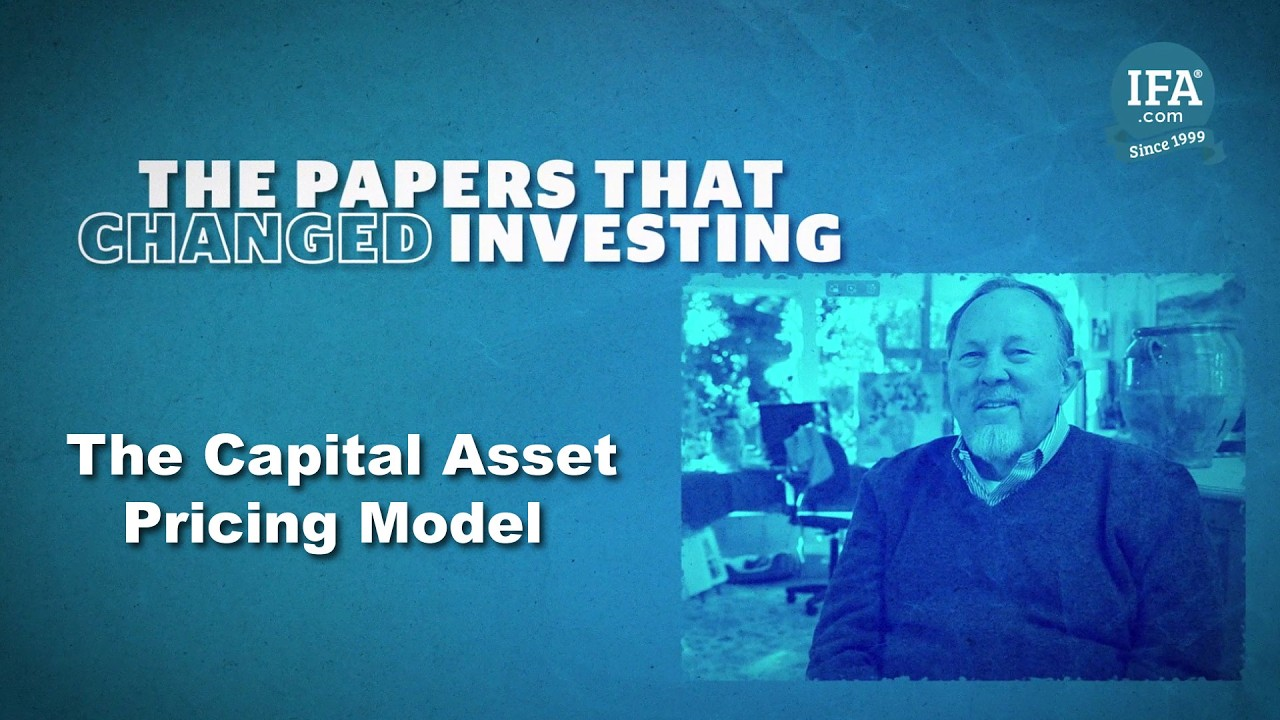

It's 1964. The Vietnam War is escalating, the Civil Rights Act becomes law, and Beatlemania is sweeping America.
Meanwhile, Wall Street is booming. Hundreds of stocks, dozens of mutual funds — and everywhere, the same advice: take more risk, earn more return.
But nobody had built a theory to explain exactly why that should be true.
Harry Markowitz had shown how to build an efficient portfolio. But the harder question remained: how does the market price risk?
One economist at the University of Washington decided to find out. His name was William Sharpe.
Welcome to The Papers That Changed Investing.
Before Sharpe, investors treated all risk as a single, undivided thing. A stock was safe or risky — and that passed for analysis.
Nobody was asking whether all risk was the same. Nobody was asking whether some of it could simply be removed. And critically, nobody was asking whether the market should pay you for risk you chose to keep.
Sharpe recognized that without a rigorous theory of risk, there was no way to judge whether any return was actually worth pursuing.
Sharpe's insight was elegant. Every investment carries two distinct types of risk.
The first is company-specific. What hurts one business doesn't hurt them all — a failed product, a legal dispute, a leadership change.
The second is market risk. When the economy turns, almost everything falls together. No diversification changes that.
Here's the key difference. Company-specific risk can be diversified away. Hold enough different stocks, and bad luck in one gets offset by good fortune in another.
Think of it like this: the market is the tide. Every boat rises and falls with it. You can choose a steadier vessel or a rockier one — but no one escapes the tide. That undiversifiable tide is what Sharpe called systematic risk. And it is the only risk the market rewards.
Now, Sharpe didn't just theorize — he built the framework.
He introduced a single number to capture each stock's sensitivity to the tide: beta. A stock with a beta of one moves in line with the market. A beta of two amplifies every move — rising faster in good times, falling harder in bad. A beta below one is more insulated from market swings.
That relationship between beta and expected return produces a clean straight line: the Security Market Line. In the modelsecon, every asset plots along it.
As Sharpe later reflected: "Yes Virginia, there is a reward, in the form of higher expected returns, for bearing the risk of doing badly in bad times."
So what did Sharpe demonstrate?
First: not all risk deserves a return. Only systematic risk — the market risk you cannot diversify away — is rewarded. The rest can be eliminated for free, so rational markets don't pay you for keeping it.
Second: in CAPM, the optimal risky portfolio for any investor is the market portfolio — every asset, weighted by its market size. The implication is ou don't need to pick stocks. You need to own them all.
Third: a single measure — beta — captures the only risk that matters for pricing any investment.
This became the Capital Asset Pricing Model. CAPM.
Here's why this matters for your money today.
If you hold concentrated positions — sector bets, individual stocks — you are carrying company-specific risk. The model suggested the market may not reward you for it. That's volatility you could simply diversify away.
The rational strategy, CAPM showed, is to own the whole market — seeking to capture the systematic risk premium without the uncompensated noise.
That logic became the intellectual foundation for index funds. Every time someone buys a low-cost, broadly diversified portfolio, they are acting on Sharpe's insight.
In 1990, Sharpe shared the Nobel Prize in Economic Sciences with Harry Markowitz and Merton Miller — recognition that this research had reshaped how trillions of dollars are managed worldwide.
CAPM has been refined and challenged since. But its central finding — that only undiversifiable risk is expecte to earn a premium — remains a cornerstone of modern finance.
Want to understand how these ideas shape a portfolio built on evidence? The research is there. And so is the path.
Source
Sharpe, W. F. (1964). Capital Asset Prices: A Theory of Market Equilibrium Under Conditions of Risk. The Journal of Finance, 19(3), 425–442.
Available at ifa.com/academic-papers
DISCLOSURES:
This material is intended for informational purposes only and is not a solicitation, offer, or recommendation to buy or sell any securities or investment programs. Past performance is not indicative of future results. All investing involves risk, including the possible loss of principal. References to academic studies are provided for educational purposes and may not reflect current market conditions. Index funds carry risks including market risk and potential loss of principal; lower costs and broad diversification do not guarantee superior returns. Individual circumstances vary, and readers should consult a qualified financial professional before making investment decisions. This video may include content generated or enhanced using artificial intelligence (AI). For more information about Index Fund Advisors, Inc., please review our brochure at https://www.adviserinfo.sec.gov or visit www.ifa.com.















 Home
Home 888-643-3133
 Contact Us
 Newsletter Subscribe
 eMoney
 IFA Apps
 Index Funds Book on Kindle
 Index Funds Audiobook
 Careers
 Facebook
 X
X LinkedIn
 Instagram
 Youtube
 Terms
Terms Index Descriptions