
 Risk Capacity
 Wealth Management
 Outsourced CIO
 Retirement Plans
 Institutional
 Financial
  Open an Account
 IFA App

 Articles
 Charts
 Investor Education ▾
 Fund
Fund
 Store
Store

 Taxes
Taxes Back-testing Disclosures
 Glossary
 Form CRS
The Papers that Changed Investing: Market Timing Ability in Investment Newsletters
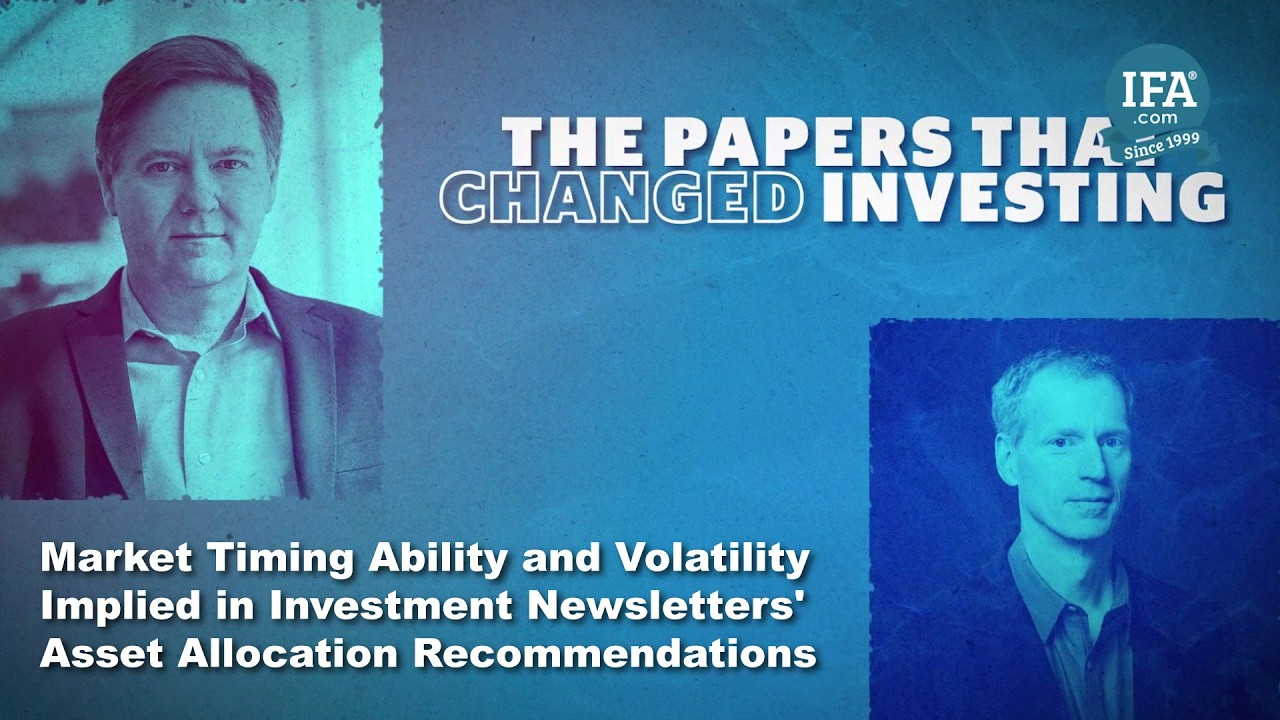

It's 1994. Nelson Mandela becomes South Africa's first democratically elected president. A former Wall Street trader named Jeff Bezos founds an online bookshop called Amazon. And Forrest Gump is packing theaters across America.
Meanwhile, millions of investors are doing something they believe gives them an edge. Every month, they open a printed newsletter: pages of charts, market calls, and confident forecasts on where stocks are headed.
These subscriptions were not cheap. The editors had names and reputations. And their readers believed, with good reason it seemed, that expert timing advice was worth paying for.
But two finance researchers at Duke University decided to test that belief. What they found wasn't pretty.
Welcome to The Papers That Changed Investing.
Before John Graham and Campbell Harvey, few researchers had subjected investment newsletter timing advice to a proper academic test.
That's remarkable, given the scale of the industry. By the early 1990s, Mark Hulbert was tracking nearly 400 newsletters, all making versions of the same promise: follow our asset allocation guidance, and you'll know when to be in the market and when to step aside.
Investors were paying hundreds of dollars a year for that promise. The logic seemed sound. If an editor could call market direction even part of the time, the value was obvious.
But no one had measured it. Not at scale. Not over more than a decade.
Graham and Harvey's approach was elegant. Each newsletter recommended a specific mix of stocks and cash, shifting month to month. The researchers built actual portfolios from those recommendations and asked one question: did following this advice outperform a buy-and-hold strategy at the same level of risk?
Here's what made it powerful. By tracking how each newsletter adjusted its equity weighting, Graham and Harvey could infer what each editor was predicting about market direction, without the newsletter spelling it out. The asset allocation was the forecast.
That gave them a clean, direct test of timing skill that bypassed the usual complications of benchmark selection.
The dataset was formidable. Graham and Harvey analyzed 237 newsletters over 13 years, from June 1980 through December 1992, using data compiled by Mark Hulbert. More than 15,000 monthly observations in total.
Think of it as a coin-toss test. For each month, each newsletter was right or wrong about market direction. Did it raise stock exposure before the market rose? Did it cut exposure before the market fell?
A skilled forecaster gets this right more often than not. A pure guesser lands around 50-50.
What did Graham and Harvey find?
First: the study's newsletters called market direction correctly just 48.8% of the time before market rises, slightly worse than chance. Before declines, the hit rate was 51.4%. Barely above a coin flip.
Second: more than 75% of the newsletters produced returns below the expected returns for the risk. Investors who followed their advice would, on average, have done better with a passive strategy at the same risk level.
Third: past performance showed almost no positive persistence. Strong results rarely predicted future outperformance. Persistent losers, however, were common.
This analytical framework became known as the Graham-Harvey performance evaluation model.
Here's why this matters today.
In 1994, these weren't fringe publications. They were serious, widely-read services with loyal subscribers. But Graham and Harvey's research found that, on average, the timing advice those readers were paying for wasn't working.
Think of a weather forecaster. A good one beats chance, not on every call, but often enough to be worth following. These newsletters, as a group, couldn't clear even that bar.
The Granville Market Letter generated 5.4% annually, which is below the expected return for the risk taken, year after year, for over a decade.
There was a second, less obvious finding. When newsletters disagreed sharply, that collective disagreement predicted higher volatility ahead. Individual letters largely fell short as timing tools, but their combined noise contained a signal.
By 1995, Forbes was covering what they called the Graham-Harvey Test. At IFA, this research is central to why we put clients in diversified, passive portfolios and keep them there. Because the data suggested, then and now: time in the market matters more than timing it.
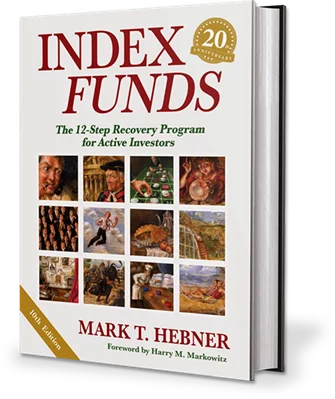
To learn more about market timing read chapter four of Mark Hebner's book "Index Funds: The Twelve Step Recovery Program for Active Investors at ifa.com
Sources
Graham, J. R. & Harvey, C. R. (1996). Market Timing Ability and Volatility Implied in Investment Newsletters' Asset Allocation Recommendations. Journal of Financial Economics, 42(3), 397–421.
Available at ifa.com/academic-papers
DISCLOSURES:
This video is for informational purposes only and does not constitute a solicitation or recommendation to buy or sell any security, or personal investment advice. The views expressed are based on academic research and are intended for educational use only. Investing involves risk, including the possible loss of principal. Diversification does not ensure a profit or protect against loss in declining markets. Content is AI-assisted. Index Fund Advisors, Inc. is a registered investment advisor. For additional information, please visit adviserinfo.sec.gov or www.ifa.com.












 Home
Home 888-643-3133
 Contact Us
 Newsletter Subscribe
 eMoney
 IFA Apps
 Index Funds Book on Kindle
 Index Funds Audiobook
 Careers
 Facebook
 X
X LinkedIn
 Instagram
 Youtube
 Terms
Terms Index Descriptions