
 Risk Capacity
 Wealth Management
 Outsourced CIO
 Retirement Plans
 Institutional
 Financial
  Open an Account
 IFA App

 Articles
 Charts
 Investor Education ▾
 Fund
Fund
 Store
Store

 Taxes
Taxes Back-testing Disclosures
 Glossary
 Form CRS
The Papers that Changed Investing: Portfolio Selection
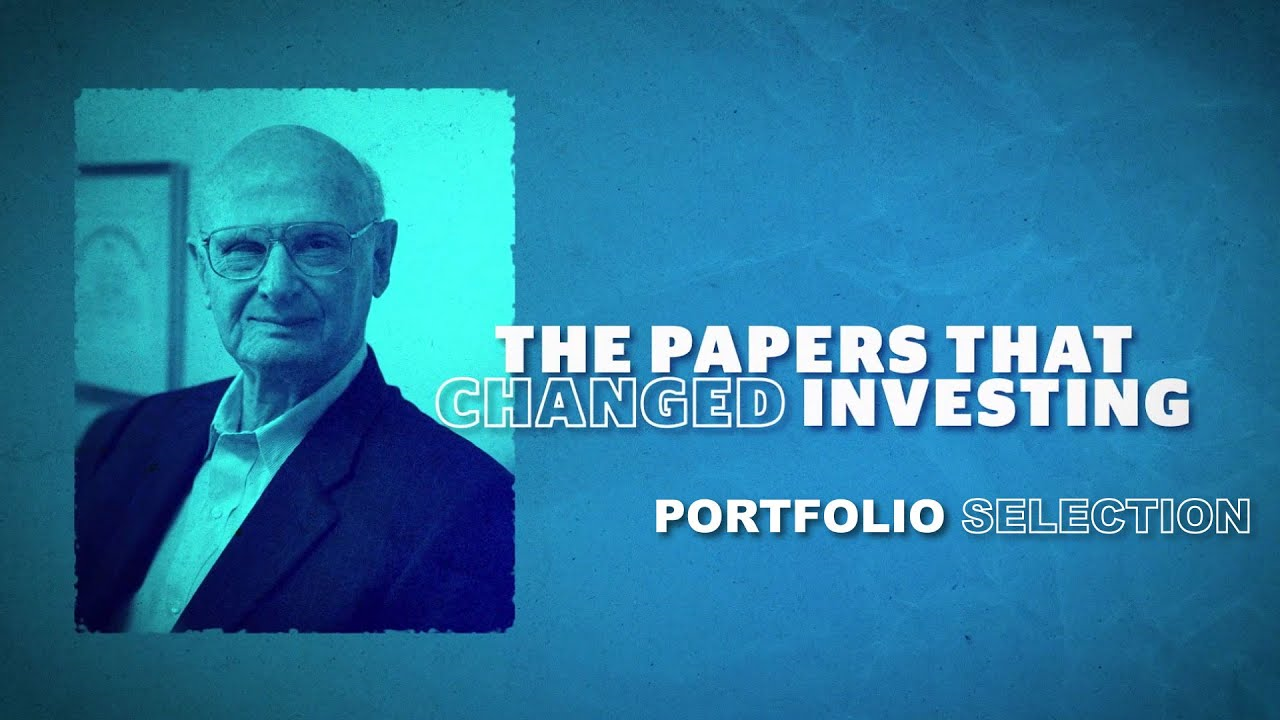

In 1952, investment advice boiled down to one thing — pick winning stocks.
Find the next big company, put your money in, hope it soars.
But here's the problem nobody was asking: What if you're wrong?
One young mathematician asked that question — and changed investing forever.
This is the paper that proved diversification isn't just common sense — it's mathematics.
Welcome to The Papers That Changed Investing.
Before Harry Markowitz, investment advice was dangerously simple. Brokers told clients: focus entirely on expected returns.
Which stock will go up the most? That was the only question that mattered.
Nobody was systematically thinking about risk. Nobody was asking what happens when you're wrong.
Markowitz realized this wasn't a good idea.
Returns matter, obviously — but so does the uncertainty around those returns.
Markowitz's key insight was this: investors should consider expected return a desirable thing, and variance of return an undesirable thing.
Variance means volatility — how much returns jump around. The wider the swings, the less certain your outcome.
Here's the brilliant part: Markowitz proved mathematically that you could reduce this variance — this uncertainty — without sacrificing returns.
How? By combining assets that don't move in lockstep.
When one zigs, another zags. The portfolio as a whole becomes more stable.
He called "these efficient portfolios" — the maximum expected return for any given level of risk.
Now, Markowitz didn't just theorize — he built the framework.
He showed that what matters isn't just each stock's individual behavior, but how stocks move relative to each other.
Think of it like this: if you own an ice cream shop and an umbrella shop, you're protected whether it rains or shines.
That's non-correlation at work. Markowitz formalized this intuition into mathematics.
As he put it: "A good portfolio is more than a long list of good stocks and bonds. It is a balanced whole."
So what did Markowitz prove?
First: risk and return are inseparable. You can't make intelligent investment decisions by looking at returns alone.
Second: diversification actually works — mathematically, not just anecdotally.
He quantified it. Risk equals standard deviation — the spread of possible outcomes around your expected return.
Third: there's an optimal way to combine assets to maximize return for your chosen risk level.
This became Modern Portfolio Theory.
Here's why this matters for your money today.
Markowitz proved that concentration is mathematically foolish. Putting all your eggs in one basket isn't bold — it's inefficient.
Every dollar you invest faces uncertainty. The question isn't whether to take risk — you can't avoid it — but how to manage it intelligently.
Modern portfolio theory shows you're not giving up returns by diversifying. You're eliminating unnecessary risk.
This is why fiduciary advisors build globally diversified portfolios across asset classes, not hot stock picks.
Not guessing which stocks will win. Building efficient portfolios that capture market returns with managed risk.
Markowitz won the Nobel Prize in 1990 for this work.
Today, trillions of dollars worldwide are invested using his principles.
All from asking one question nobody else was asking.
DISCLOSURES:
This video is for informational purposes only and does not constitute investment advice or a recommendation to buy or sell any security. Investing involves risk, including the potential loss of principal. Past performance is not indicative of future results. Diversification and Modern Portfolio Theory do not guarantee a profit or protect against loss in declining markets. The discussion of Harry Markowitz and Modern Portfolio Theory is for educational purposes only. This video does not imply any endorsement of IFA or its services.
This video may include content generated or enhanced using artificial intelligence (AI).
All data and information presented are believed to be accurate but are not warranted or guaranteed. Index Fund Advisors, Inc. is an SEC-registered investment adviser. Registration does not imply a certain level of skill or training. For additional information, please refer to our Form ADV and other disclosures available at https://www.ifa.com/disclosures.













 Home
Home 888-643-3133
 Contact Us
 Newsletter Subscribe
 eMoney
 IFA Apps
 Index Funds Book on Kindle
 Index Funds Audiobook
 Careers
 Facebook
 X
X LinkedIn
 Instagram
 Youtube
 Terms
Terms Index Descriptions