
 Risk Capacity
 Wealth Management
 Outsourced CIO
 Retirement Plans
 Institutional
 Financial
  Open an Account
 IFA App

 Articles
 Charts
 Investor Education ▾
 Fund
Fund
 Store
Store

 Taxes
Taxes Back-testing Disclosures
 Glossary
 Form CRS
The Papers that Changed Investing: Prospect Theory
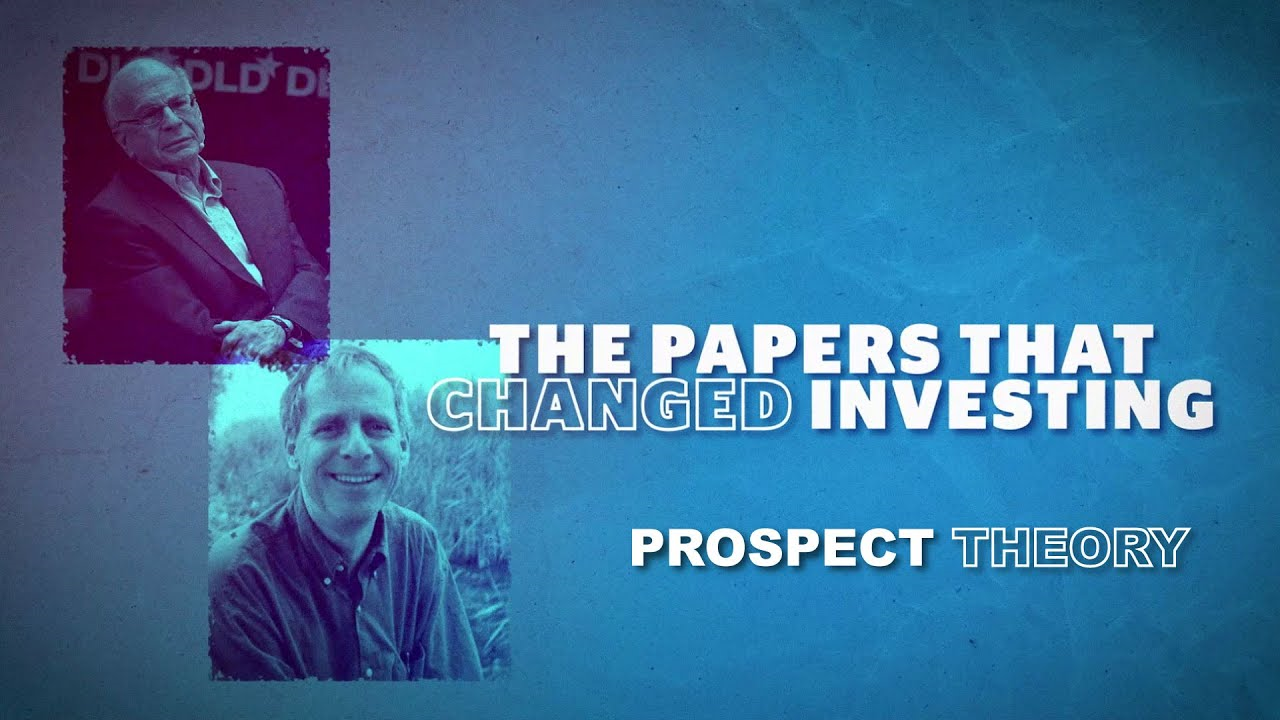

It's 1979. Finance has a comfortable certainty: investors are rational creatures who calculate risk, weigh probabilities, and choose whatever maximizes their utility.
But here's the problem: real investors don't behave that way. They may panic. They may cling to losers. They could obsess over short-term losses while ignoring long-term gains.
Two psychologists asked a simple question: what if the mathematics of rational choice doesn't describe how people actually decide?
Their answer appeared in a paper published in March 1979 — and it changed investing forever.
Welcome to The Papers That Changed Investing.
Before Kahneman and Tversky, mainstream finance was built on expected utility theory.
The logic seemed unassailable: investors evaluate choices, weight outcomes by probability, and select whatever maximizes utility. Rational. Mechanical. Efficient.
But nobody was asking whether this mathematics matched reality.
Kahneman and Tversky saw the blind spot. People don't treat gains and losses symmetrically. The sting of losing $100 feels far worse than the pleasure of gaining $100.
Crucially, losses loom larger than gains.
How? By mapping a value function. It's concave for gains — meaning each additional dollar brings less joy. But convex for losses — each additional dollar lost brings escalating pain.
This asymmetry explains why people are risk-averse with gains but risk-seeking to avoid losses.
Think of it like this: would you rather have $3,000 for certain, or take a gamble with an 80% chance of $4,000 and a 20% chance of nothing?
Most people chose the sure $3,000 — even though the gamble's expected value was higher. That's risk aversion in the domain of gains.
But flip it to losses. Would you rather lose $3,000 for certain, or gamble with an 80% chance of losing $4,000? Now people gamble. They become risk-seeking to avoid a certain loss.
Kahneman and Tversky also introduced probability weighting — showing that people overweight small probabilities and underweight large ones.
First, people don't evaluate wealth in absolute terms — they evaluate changes relative to a reference point. You care more about whether you're up or down today than how much you have in total.
Second, losses hurt about twice as much as equivalent gains feel good. If you lose $50, you need to gain roughly $100 to feel compensated.
Third, people make inconsistent choices depending on how the same problem is framed — whether as a potential gain or as avoiding a loss.
This became Prospect Theory — a descriptive model of how people actually decide under risk, not how economic theory says they should.
Here's why this matters for your money today.
Kahneman and Tversky demonstrated that chasing short-term performance and panicking over volatility isn't just emotionally exhausting — it's mathematically destructive.
Loss aversion explains why investors sell winners too early and hold losers too long — desperate to avoid realizing a loss. It explains myopic loss aversion, where focusing on daily fluctuations makes equities appear riskier than they truly are over decades.
Today, everything from retirement plan defaults to risk questionnaires draws on Prospect Theory. Many fiduciary advisors apply these insights to help clients manage emotional responses and maintain long-term investment discipline.In 2002, Kahneman won the Nobel Prize in Economics — the first psychologist to do so.
Tversky had died in 1996, but their work launched behavioral economics and reshaped how we understand investor behavior.
Want to build a portfolio that accounts for your psychology, not just mathematics? Let's have a conversation.
DISCLOSURES:
This video is for informational and educational purposes only and does not constitute investment advice or a recommendation to buy or sell any security. Investing involves risk, including the potential loss of principal. Past performance is not indicative of future results.
The discussion of Daniel Kahneman, Amos Tversky, and Prospect Theory is intended to illustrate behavioral finance concepts and does not imply any endorsement of Index Fund Advisors, Inc. or its services.
This video may include content generated or enhanced using artificial intelligence (AI).
Index Fund Advisors, Inc. is a registered investment adviser. Additional information is available by reviewing IFA's ADV Brochure at https://www.adviserinfo.sec.gov/ or visiting www.ifa.com.












 Home
Home 888-643-3133
 Contact Us
 Newsletter Subscribe
 eMoney
 IFA Apps
 Index Funds Book on Kindle
 Index Funds Audiobook
 Careers
 Facebook
 X
X LinkedIn
 Instagram
 Youtube
 Terms
Terms Index Descriptions