
 Risk Capacity
 Wealth Management
 Outsourced CIO
 Retirement Plans
 Institutional
 Financial
  Open an Account
 IFA App

 Articles
 Charts
 Investor Education ▾
 Fund
Fund
 Store
Store

 Taxes
Taxes Back-testing Disclosures
 Glossary
 Form CRS
The Papers that Changed Investing: The Arithmetic of Active Management
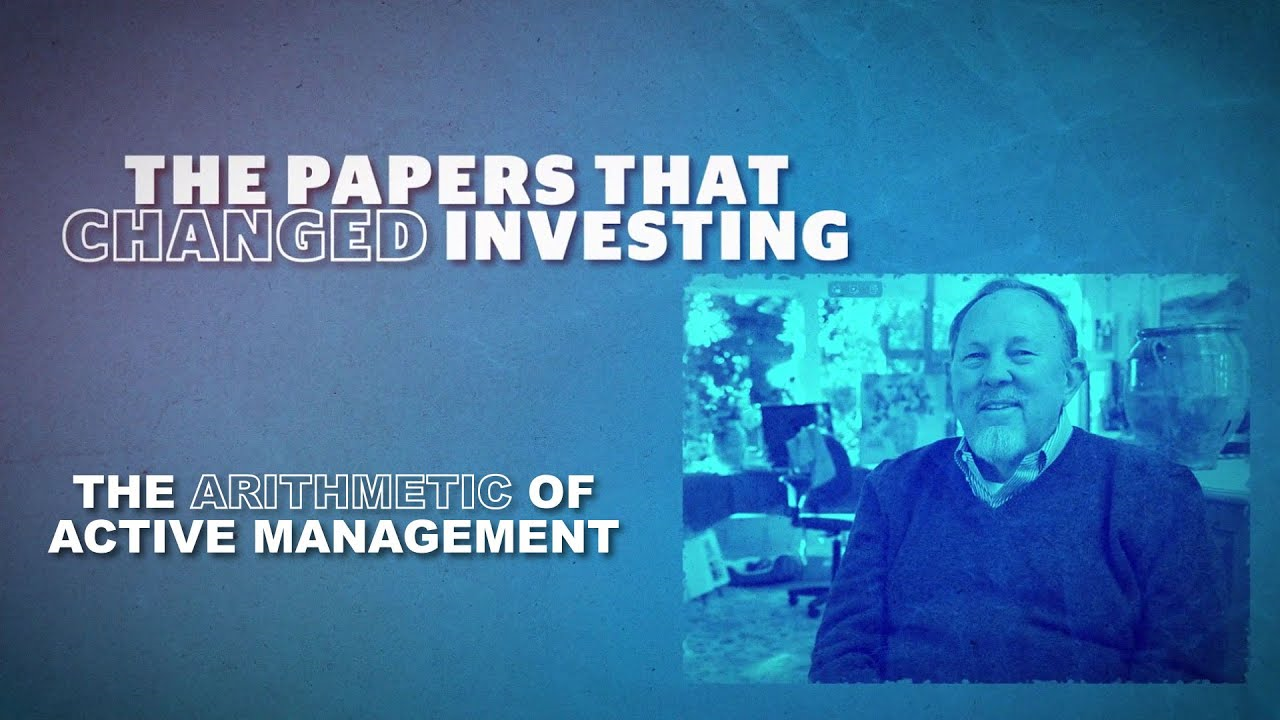

December 1990. William Sharpe receives the Nobel Prize in Economics at Stockholm City Hall.
The prize is for the Capital Asset Pricing Model — a sophisticated framework showing how risk and expected return are related.
Then, just one month later, Sharpe publishes something entirely different. A short paper requiring nothing more than addition, subtraction, multiplication and division. Primary school arithmetic.
Welcome to The Papers That Changed Investing.
Sharpe called his paper The Arithmetic of Active Management. It opens with actual quotes from investment professionals. Things like: "Any graduate of a top business school should be able to beat an index fund." And: "In small stocks, you're probably better off with an active manager."
Sharpe's response was blunt. He wrote that such conclusions "can only be justified by assuming that the laws of arithmetic have been suspended for the convenience of those who choose to pursue careers as active managers."
In other words: the entire industry was ignoring basic mathematics.
Sharpe's insight was elegantly simple. Think of the entire stock market as a pie.
Passive investors, by definition, hold every slice in exact proportion to the market. They get precisely the market's return.
Now here's the crucial bit. Active investors, as a group, hold everything else. But since passive investors already match the market, active investors as a whole must also match the market — before costs. It's the same pie.
Sharpe didn't need complex equations. He simply pointed out that active managers pay more — for research, for analysts, for trading. "Security analysts must eat," Sharpe wrote, "and so must brokers, traders, specialists and other market-makers."
Naturally enough, active managers recoup those expenses from investors in the form of fees.
Passive funds are cheaper to manage, and their fees are considerably lower.
So if active and passive investors earn the same return before costs, and active investors pay higher costs, then after costs, active investors must earn less.
This isn't a theory that might be overturned by new evidence. It's arithmetic.
Sharpe's paper made two assertions. First: before costs, the return on the average actively managed dollar will equal the return on the average passively managed dollar.
Second: after costs, the return on the average actively managed dollar will be less than the return on the average passively managed dollar.
As Sharpe wrote: "These assertions will hold for any time period. Moreover, they depend only on the laws of addition, subtraction, multiplication and division. Nothing else is required."
Here's why this concept may be relevant for investors today. If Sharpe's arithmetic is irrefutable, why do studies sometimes appear to show active managers winning?
Sharpe explained. First, survivorship bias — failed funds disappear from the data, making survivors look better than they were.
Second, improper benchmarks — comparing funds holding cash against all-equity indexes.
Third, equal-weighting — treating small funds the same as large ones distorts the true picture.
Sharpe's conclusion was unsparing: "Empirical analyses that appear to refute this principle are guilty of improper measurement."
The arithmetic hasn't changed. This principle suggests that, on average, active management may face higher costs compared to passive strategies.
Want to find out how reducing the fees you pay may help improve your long-term outcomes? Get in touch via our website, IFA.com.
Source
Sharpe, W. F. (1991). The Arithmetic of Active Management. Financial Analysts Journal, 47(1), 7-9.
Visit ifa.com/academic-papers
DISCLOSURES:
This video is for informational and educational purposes only and does not constitute investment advice or a recommendation to buy or sell any security. Investing involves risk, including the potential loss of principal. Past performance is not indicative of future results.
The discussion of Eugene Fama and the Efficient Market Hypothesis is intended to illustrate academic concepts in finance and does not imply any endorsement of Index Fund Advisors, Inc. or its services.
Index Fund Advisors, Inc. is a -registered investment adviser. Additional information is available by reviewing IFA's ADV Brochure at https://www.adviserinfo.sec.gov/ or visiting www.ifa.com.











 Home
Home 888-643-3133
 Contact Us
 Newsletter Subscribe
 eMoney
 IFA Apps
 Index Funds Book on Kindle
 Index Funds Audiobook
 Careers
 Facebook
 X
X LinkedIn
 Instagram
 Youtube
 Terms
Terms Index Descriptions