Pioneers of Probability: Girolamo Cardano
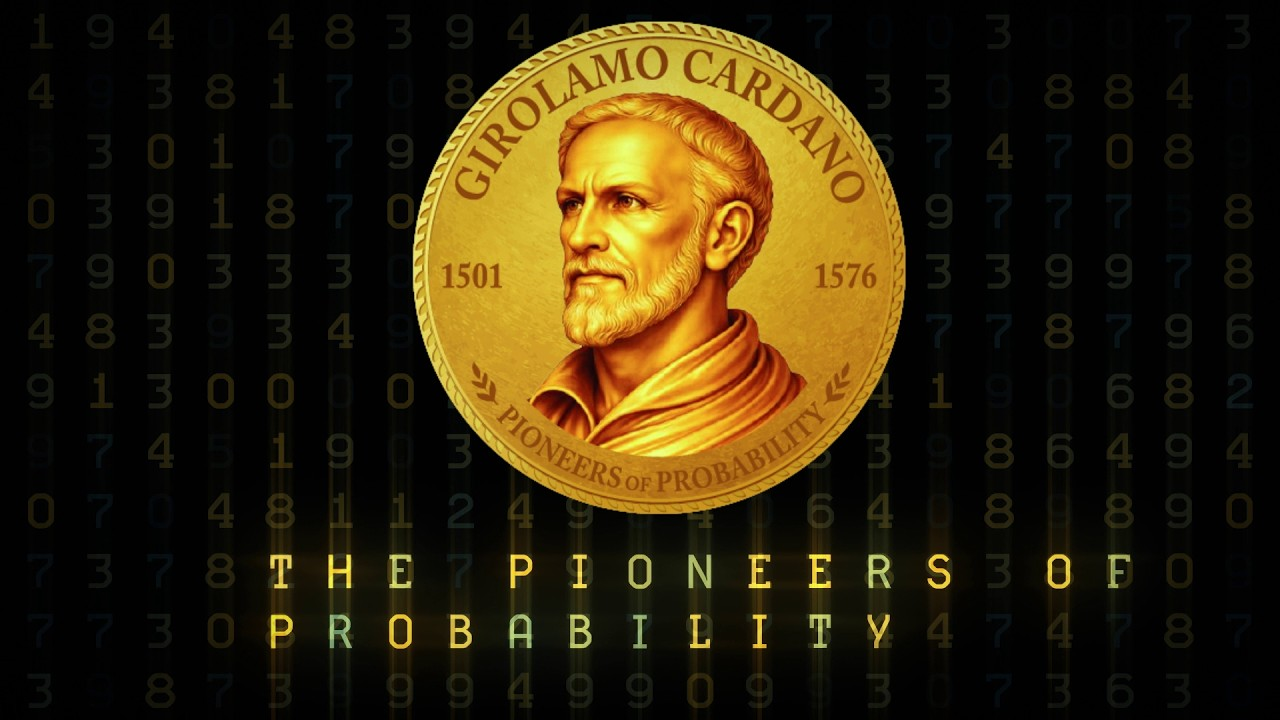

It's 1550, and a physician in Milan has a problem. He's brilliant — one of the most famous doctors in Europe. He's also broke. Again. Because Girolamo Cardano cannot stop gambling.
Cards, dice, chess — he plays them all, almost every day, for decades. He loses the family estate. He pawns his wife's jewelry. And somewhere between the bad bets and the borrowed money, he starts to notice something. The dice aren't random. Not really. They follow rules.
Welcome to Pioneers of Probability.
Before Cardano, gambling was fate. You rolled the dice and God decided. Luck was a mystery — a force you prayed to, cursed at, or accepted. Nobody thought to count it.
Gamblers had superstitions. They had rituals. They had lucky charms. What they didn't have was a single method for working out whether a bet was fair.
Cardano asked the question nobody else was asking. Not "Will I win?" — but "What are the odds that I win?"
His insight was deceptively simple. If you roll a single die, there are six equally likely outcomes. The chance of rolling a three is one in six. You can count possibility. You can measure chance. Luck has a structure — and that structure obeys arithmetic.
That sounds obvious today. In the sixteenth century, it was revolutionary.
Before Cardano, gamblers were navigating a city with no map. He drew the map. He couldn't tell you which street you'd end up on — but he could tell you how many streets there were and your chances of reaching each one.
He wrote it all down in a book called Liber de Ludo Aleae — The Book on Games of Chance. It's among the first serious mathematical treatment of probability ever written. Count every possible outcome, count the ones you want, and the ratio between them is your probability.
Simple. Precise. And five centuries later, still a foundational influence on the statistical approaches used to study markets.
But here's what makes Cardano extraordinary. He didn't just calculate the odds. He calculated the gambler. He warned that losses breed anger, that anger breeds recklessness, and that recklessness breeds ruin. He described the seductive pull of chasing losses — the desperate urge to win back what's gone.
He knew it because he lived it. The man who discovered how to measure luck still couldn't resist it. That tension — between knowing the odds and acting on them — is the central psychological challengs faced by many investors.
Cardano wrote those pages around 1560. They weren't published until 1663 — nearly a century after his death. His ideas survived a hundred years of obscurity.
When the book finally appeared in print, Pascal and Fermat had already begun their own work on probability. But Cardano had been there first — alone, working from the gambling table, a full century ahead of his time.
Here's why both of his discoveries still matter for modern investing — the mathematics and the psychology.
Every rational investment decision starts where Cardano started: by counting the odds instead of guessing. A diversified index fund is designed to do this — to capture broad market returns rather than betting on one stock, one manager, one hunch. It is, in the most literal sense, the application of probability mathematics to wealth building.
But Cardano's warning about the gambler's mind may matter even more than his math. In 2024, DALBAR's annual study of investor behavior reported that the average equity fund investor earned 16.54 percent — while the S&P 500 returned over 25 percent.
An 8.48 percentage point gap — not because the investments were bad, but because investors chased losses, fled downturns, and let emotion override arithmetic. Cardano diagnosed that behavior five centuries ago.
The math tells you what to own. The psychology Cardano identified tells you why holding on is so hard — and why disciplined strategies are often emphasized over short term guesses.
Cardano gave us something fundamental: the idea that uncertainty has structure. That you can put a number on chance. That luck, examined carefully, is not luck at all — it's probability waiting to be counted.
That idea was just the beginning. The mathematicians who came after Cardano took his framework and pushed it further — into mortality tables, into the physics of error, into the behavior of markets. Each one building on what came before.
The same rule as the rabbits. The same rule as the sequence.
We're two steps into an 800-year story. There are sixteen more to go.
Learn more about Girolamo Cardano here.
https://www.ifa.com/coins#pioneers
DISCLOSURES:
This video is for informational and educational purposes only and does not constitute a solicitation or recommendation to buy or sell any security.
The historical and mathematical concepts discussed are intended to illustrate the development of probability theory and its relevance to investing.
Past performance is not indicative of future results. All investing involves risk, including the possible loss of principal. Indices are unmanaged, do not reflect the deduction of fees or expenses, and are not available for direct investment.
Content is AI-assisted.
Index Fund Advisors, Inc. is a registered investment adviser. For additional information, please visit adviserinfo.sec.gov or www.ifa.com. The investor performance data cited is from DALBAR, Inc., Quantitative Analysis of Investor Behavior, 2025. The average equity fund investor return and S&P 500 return are for the calendar year 2024. Individual results will vary.