
 Risk Capacity
 Wealth Management
 Outsourced CIO
 Retirement Plans
 Institutional
 Financial
  Open an Account
 IFA App

 Articles
 Charts
 Investor Education ▾
 Fund
Fund
 Store
Store

 Taxes
Taxes Back-testing Disclosures
 Glossary
 Form CRS
Pioneers of Probability · Episode 2
This video is for informational and educational purposes only and does not constitute a solicitation or recommendation to buy or sell any security. The historical and mathematical concepts discussed are intended to illustrate the development of probability theory and its relevance to investing. Past performance is not indicative of future results. All investing involves risk, including the possible loss of principal. The S&P 500 return data cited reflects a specific historical period (1926-2026) with dividends reinvested and does not account for taxes, fees, or inflation; it should not be interpreted as a forecast of future returns. The examples provided are hypothetical and based on historical index data, not an actual investment. Index returns do not reflect the performance of any actual portfolio or the deduction of advisory fees. Content is AI assisted.
◆ The Question
Girolamo Cardano was born into contradiction. His father, Fazio Cardano, was a Milanese jurist and mathematician skilled enough that Leonardo da Vinci sought his counsel on questions of geometry — a detail that says something about the caliber of the family's intellectual world. His mother, Chiara Micheria, was fleeing the plague in Milan when she gave birth to him prematurely in Pavia in September of 1501. The infant was not expected to survive. He did. He would have been better off, he later wrote in his memoir, if he hadn't.
That memoir, the De Vita Propria, is one of the most disarmingly honest autobiographical documents of the Renaissance. In it, Cardano catalogs his misfortunes with something approaching relish: his illegitimate birth, the years of poverty in Milan during which he was rejected by the College of Physicians and forced to survive by practicing medicine in rural villages without a license, the squandering of two inheritances, the endless years of gambling. He lost the family estate. He pawned his wife's jewelry. There is a particular passage in which he describes being reduced to such destitution that he and his wife were forced to accept charity from a hospital — even as he was, simultaneously, developing ideas that would reshape the mathematics of uncertainty forever.
That is the paradox at the center of Cardano's life. He was, by many measures, the most intellectually gifted man of his era. He was, by his own admission, a compulsive gambler who could not stop destroying himself.
◆ The Insight
The gambling came first, and in a strange way, it saved him. Not financially — it never did that — but intellectually. Because Cardano was too smart to gamble without thinking about what he was doing, and thinking carefully about gambling meant thinking carefully about chance.
The insight he reached was both simple and revolutionary: luck has a structure. When you roll a die, you are not invoking a mysterious force that favors the bold or punishes the reckless. You are selecting randomly from a finite set of equally likely outcomes. One die, six faces, one outcome you want — the probability is exactly 1/6. Not approximately, not as a long-run tendency. Exactly 1/6, every time, for every player, under every condition. The rules of chance are the same for everyone, and they are calculable.
This sounds obvious today. In 1550, it required an effort of genuine intellectual courage. For most of human history, luck was considered a real force — Fortune, fate, the will of the gods. Gamblers had rituals, amulets, and systems. They had hunches. What they did not have was a method for calculating whether any particular bet was actually in their favor. Cardano gave them that method. Count every possible outcome. Count the favorable ones. The ratio between them is your probability.
He extended it further: the probability of rolling a specific number on each of two dice is not 1/6 plus 1/6, but 1/6 multiplied by 1/6. Independent events multiply. This multiplication rule, which Cardano recognized if not always applied with perfect consistency, is a cornerstone of probability theory. His book may also contain the first use of the word "probability" in written form with anything like its modern mathematical meaning.
But there was a second insight, rarer and more personal. Cardano didn't just discover the mathematics of gambling. He discovered the psychology of it — and what he found was not flattering, because he was describing himself. He wrote that losses breed anger, anger breeds recklessness, recklessness breeds ruin. He identified the phenomenon we now call loss aversion — the desperate urge to win back what has been lost, which leads gamblers to take larger and larger risks to recover smaller and smaller amounts. He knew this trap from the inside, having fallen into it hundreds of times. He also knew, with absolute clarity, that knowing the trap exists does not help you avoid it.
◆ The Proof
The Liber de Ludo Aleae — The Book on Games of Chance — was written in stages across roughly four decades, somewhere between 1520 and 1565. It was never published in Cardano's lifetime. When it finally appeared in print in 1663, as part of his collected Opera Omnia, Pascal and Fermat had already completed their correspondence and built their own probability framework. Cardano's contribution sat in obscurity for a century, unread by the very men who built on foundations he had already laid.
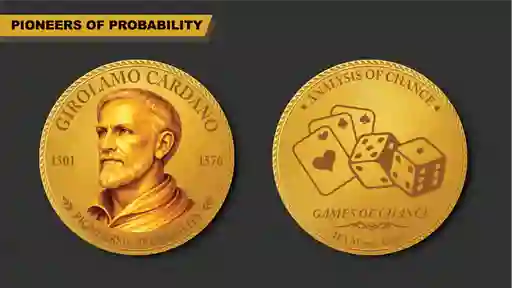
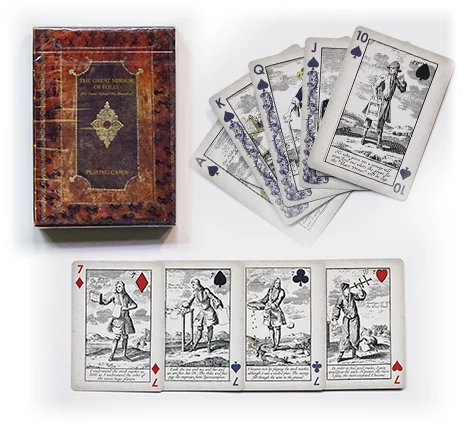
The IFA MarketCoin® for Cardano shows dice and playing cards on its reverse — the two games Cardano analyzed with the greatest rigor — beneath the inscription "Analysis of Chance" and "Games of Chance." The image is fitting. Dice gave Cardano the sample space idea: count all possible outcomes, treat each as equally likely, then count the favorable subset. Playing cards gave him something more subtle — the way probability changes as cards are removed from a deck, an early gesture toward what we now call conditional probability.
To place Cardano in full context: the Liber de Ludo Aleae was not his only significant work, nor his most celebrated in his own time. The Ars Magna, published in 1545, was a landmark of algebra — containing the first published solution to the general cubic equation, as well as his student Lodovico Ferrari's solution to the quartic. That achievement, built in part on a formula Cardano had obtained under oath of secrecy from the mathematician Niccolò Tartaglia and then published anyway, ignited one of the most bitter priority disputes in the history of mathematics. Tartaglia was publicly humiliated. Cardano was denounced. The feud lasted decades.
His later years were defined by compounding tragedy. His wife died. His beloved eldest son Giambattista was arrested, tried, and executed for poisoning his own wife. His other son Aldo became a criminal who eventually informed on Cardano himself to the Inquisition. In 1570, Cardano was imprisoned on charges of heresy, partly for casting the horoscope of Jesus Christ — an act of astrological hubris that not even his patrons could defend. He died in Rome in 1576, having reportedly predicted the date of his own death in advance and having outlived most of what had mattered to him.
◆ The Legacy
Cardano was the first person to treat chance events as objects of systematic mathematical inquiry rather than as the will of fortune. He was the first to write down, clearly and explicitly, that luck has a structure — that you can count possibility and measure chance. That idea was the seed from which the entire edifice of probability theory eventually grew.
The Liber de Ludo Aleae had no direct influence on Pascal or Fermat; it was published after they did their work. But it demonstrates that the mathematics of chance was independently discoverable — that anyone willing to look at a gambling table with sufficient patience and rigor would arrive at the same foundational truths. Cardano arrived there first, alone, a century earlier, and watched his manuscript sit in a drawer while history caught up.
◆ Your Money
Both of Cardano's discoveries travel directly into the world of investing — the mathematical one and the psychological one — and the second may matter more than the first.
The mathematical insight is straightforward: every rational investment decision begins with counting the odds. A diversified index fund applies a simlar principle to what Cardano did with his dice. Rather than betting on one outcome from a finite universe of possibilities, the index investor holds all of them — capturing the aggregate return of the entire sample space rather than selecting a single stock and hoping it outperforms. It reflects an application of probability mathematics at portfolio level.
Cardano's psychological insight, however, is the one investors violate daily. He knew, from his own ruinous experience, that understanding the odds provides no protection against the emotional pull of bad decisions. DALBAR's 2025 study of investor behavior documented this precisely: in 2024, the average equity fund investor earned 16.54 percent while the S&P 500 returned roughly 25 percent. That 8.48 percentage-point gap has been attributed in part to the same impulses Cardano cataloged five centuries ago — panic selling during downturns, performance chasing after rallies, the conviction that losses were about to reverse if only you changed something.
The mathematics tells you what to own. The psychology tells you why holding it is so hard. Cardano was the first person to write both truths down in the same book — which makes it all the more poignant that he could never follow his own advice.
Sources: Cardano, G. (1663). Liber de ludo aleae. In Opera omnia. Ore, O. (1953). Cardano: The gambling scholar. Princeton University Press. DALBAR, Inc. (2025). Quantitative analysis of investor behavior.
Disclosure: This article is for informational and educational purposes only and does not constitute a solicitation or recommendation to buy or sell any security. Past performance is not indicative of future results. All investing involves risk, including the possible loss of principal. Any historical return examples referenced are hypothetical illustrations based on published index data and are not reflective of actual investor experience
Content is AI-assisted. Index Fund Advisors, Inc. is a registered investment adviser. For additional information, please visit adviserinfo.sec.gov or www.ifa.com.About the pen name: "Claude Hebner" represents a collaboration between Mark Hebner, founder and CEO of Index Fund Advisors, Inc., and Claude, Anthropic's AI. The research, historical narrative, and investment analysis in each article are the result of that partnership — human editorial judgment and decades of financial expertise combined with AI-assisted research and drafting, which is reviewed and approved by the human author.












 Home
Home 888-643-3133
 Contact Us
 Newsletter Subscribe
 eMoney
 IFA Apps
 Index Funds Book on Kindle
 Index Funds Audiobook
 Careers
 Facebook
 X
X LinkedIn
 Instagram
 Youtube
 Terms
Terms Index Descriptions