
 Risk Capacity
 Wealth Management
 Outsourced CIO
 Retirement Plans
 Institutional
 Financial
  Open an Account
 IFA App

 Articles
 Charts
 Investor Education ▾
 Fund
Fund
 Store
Store

 Taxes
Taxes Back-testing Disclosures
 Glossary
 Form CRS
Pioneers of Probability: Christiaan Huygens
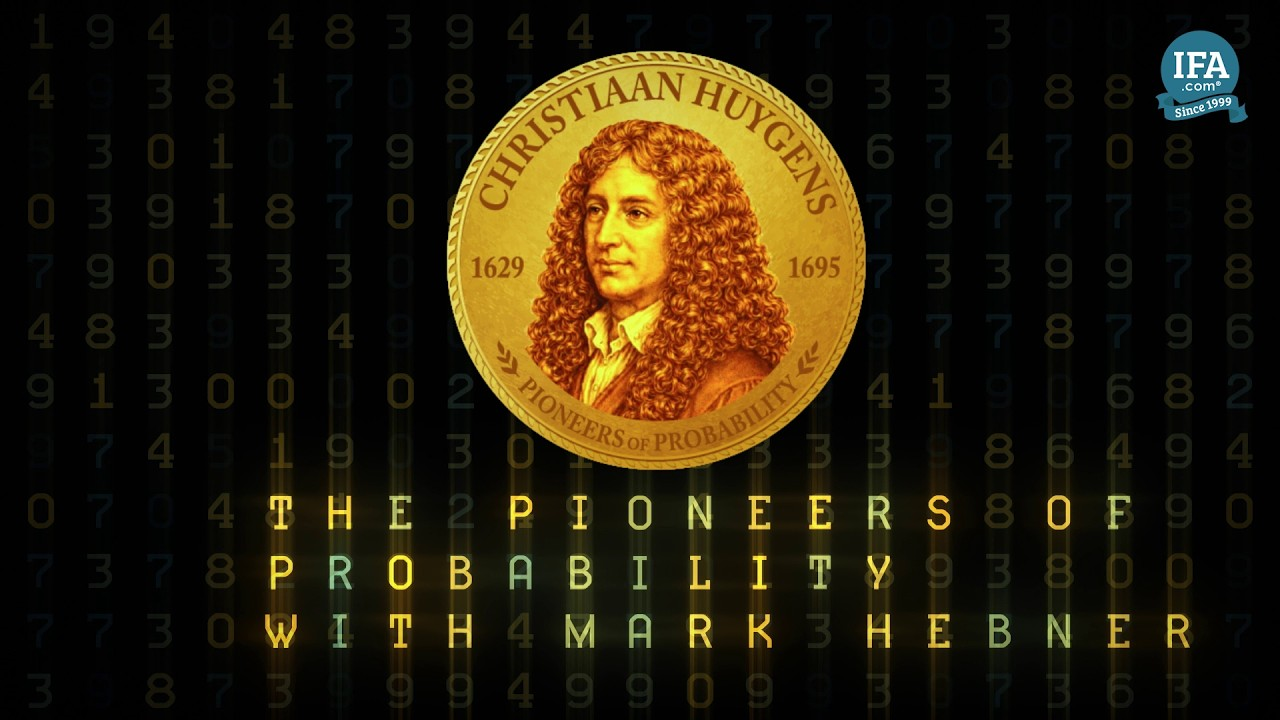

If you could write one rule to make every gamble fair, what would it be?
By 1655, word had spread through the mathematical circles of Paris that something remarkable had happened the previous summer. Two mathematicians — Pascal and Fermat — had exchanged a series of letters that solved a centuries-old gambling problem and, in doing so, helped establish a new field of study.
A young Dutch physicist visiting the city heard the rumors. He tried to get hold of the letters. He couldn't.
So Christiaan Huygens did what any serious mathematician would do. He worked it out for himself.
Welcome to Pioneers of Probability.
You may know Huygens from a different story entirely. He invented the pendulum clock — at the time, the most accurate widely used timekeeping device. He discovered Titan, Saturn's largest moon. He developed the wave theory of light that would later challenge Newton. By any measure, he was one of the great scientific minds of the seventeenth century.
And yet the contribution that earns him a place in this series was, in some sense, a side project — a short book he wrote in his late twenties, almost as an exercise.
It became one of the most influential texts on probability of its century.
When Huygens returned to the Netherlands from Paris, he sat down with what he knew of the Pascal-Fermat problem and reconstructed the logic from scratch. He solved it. He then went further — generalizing the approach beyond the specific gambling problem that had prompted it, and building what amounted to the first systematic framework for calculating expectations under uncertainty.
In 1657, he published De Ratiociniis in Ludo Aleae — On Reasoning in Games of Chance.
It is widely regarded as the first printed textbook on probability ever written.
This matters more than it might seem. Pascal and Fermat had solved the problem, but their correspondence stayed private, circulating only among a small network of scholars. Without publication, ideas don't spread. Without spread, there is no field. Huygens was the one who put the mathematics into print — and in doing so, he gave a generation of mathematicians something to read, teach, build on, and argue with.
The core of the book was the formalization of expected value.
Pascal had used the concept intuitively — his Wager was an expected value argument in everything but name. Fermat's enumeration method implicitly depended on it. But neither man had written it as a clean mathematical formula.
Huygens did. E(X) equals the sum of every possible outcome multiplied by its probability. That's the formula on the coin. It looks simple. Its implications are not.
Expected value is the answer to what is perhaps the most fundamental question in decision-making: what is a fair price for an uncertain outcome? Not the best outcome. Not the worst outcome. The probability-weighted average of all outcomes. That number — and that number alone — is what a rational actor should be willing to pay.
Huygens proved this formally through a series of propositions, building from first principles, using only the assumption that a fair game is one where each player's expected gain equals zero. From that single axiom, he derived a complete framework for valuing uncertain prospects.
That framework sits at the foundation of many modern approaches to financial risk.
When a portfolio manager calculates the expected return of an asset, she is computing E(X) — summing every possible return, weighted by its probability. When a risk model assigns probabilities to different market scenarios, it is doing exactly what Huygens formalized. When an index fund holds every stock in proportion to its market weight, it is reflects the expected value of the market as a whole — rather than a bet on individual stock outcomes .
The insight Huygens codified is often cited as the sharpest argument against active stock-picking. If markets are reasonably efficient — if prices already reflect the expected value of future cash flows — then trying to beat the market means betting that your estimate of expected value is more accurate than the collective estimate of every other participant. That is a high bar. Much evidence suggests most investors clear it only by luck, and only temporarily.
Huygens didn't know he was arguing for passive investing. He was writing about dice. But the logic travels.
There is a pattern running through every episode of this series that is worth naming here.
Fibonacci was a merchant's son solving a commercial problem. Cardano was a physician gambling away his estate. Galileo was an astronomer asked about dice by a duke's courtiers. Fermat was a lawyer who did mathematics in his spare time. Pascal was a theologian making an argument about God. And now Huygens — primarily a physicist, primarily concerned with pendulums and planets — writes the probability textbook that defines the field for a century.
None of them set out to build the mathematical foundations of modern finance. They were solving the problems in front of them. The generality came later — when the next person picked up the tool and found it worked somewhere new.
That is still how knowledge builds.
We're six steps into an 800-year story. There are twelve more to go.
Sources
Huygens, C. (1657). De ratiociniis in ludo aleae [On reasoning in games of chance]. In F. van Schooten, Exercitationum mathematicarum. Elsevier. Hacking, I. (1975). The emergence of probability. Cambridge University Press.
DISCLOSURES:
This video is for informational and educational purposes only and does not constitute a solicitation or recommendation to buy or sell any security. References to investment approaches are illustrative and not intended as a guarantee of performance. The historical and mathematical concepts discussed are intended to illustrate the development of probability theory and its relevance to investing. Past performance is not indicative of future results. All investing involves risk, including the possible loss of principal. Content is AI-assisted. Index Fund Advisors, Inc. is a registered investment adviser. For additional information, please visit adviserinfo.sec.gov or www.ifa.com.












 Home
Home 888-643-3133
 Contact Us
 Newsletter Subscribe
 eMoney
 IFA Apps
 Index Funds Book on Kindle
 Index Funds Audiobook
 Careers
 Facebook
 X
X LinkedIn
 Instagram
 Youtube
 Terms
Terms Index Descriptions