Pioneers of Probability: Blaise Pascal
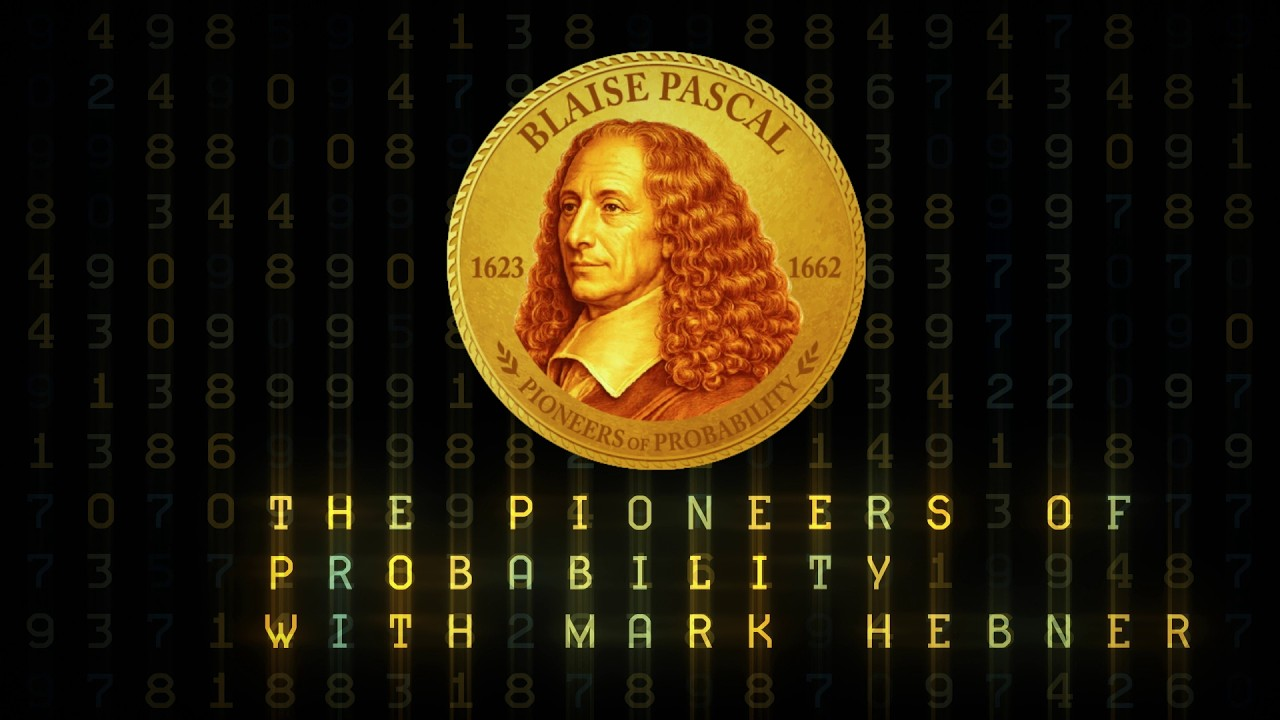

If a game is interrupted halfway through, how do you fairly split the pot? (Je ne sais pas)
Okay, we asked that in the last episode, but bear with me…
In the summer of 1654, Blaise Pascal and Pierre de Fermat exchanged a series of letters about the Problem of Points — how to divide a gambling pot when a game is stopped early.
We told Fermat's side of that story in the last episode. His method was combinatorial: enumerate every possible future, count the wins, calculate the ratio.
Pascal arrived at the same answers. But he got there a different way — using a triangle of numbers he had been studying for years. And in doing so, he built a tool so powerful that it reshaped not just mathematics, but influenced how decisions are made under uncertainty.
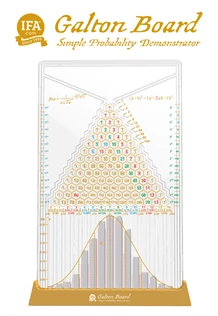
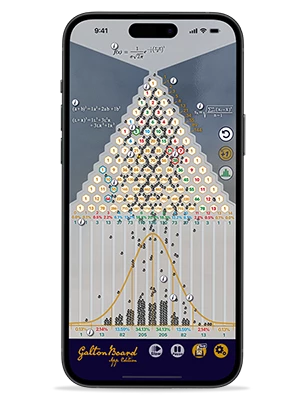
Pascal's Triangle looks deceptively simple. Start with a one at the top. Each row below it is built by adding the two numbers directly above each position. One, one. One, two, one. One, three, three, one. One, four, six, four, one.
The numbers seem almost trivial. But hiding inside those rows are the answers to some of the most important questions in mathematics — including the probability calculations needed to solve the Problem of Points.
Here's the thing: Pascal didn't invent this triangle. Our coin acknowledges it directly. The Chinese mathematician Jia Xian had described it around 1050. Omar Khayyam — better known in the West as a poet — had written about it in Persia around 1100. The triangle had been sitting in mathematical literature for six centuries before Pascal was born.
What Pascal did was develop a deeper understanding of it – and apply it systemically to probability.
When Pascal looked at the Problem of Points through the triangle, he saw that the answer to any version of the problem was already encoded in the rows.
Let's say a game is interrupted at 9-1, with 10 being the winning score. Player A needs 1 more point to win, and Player B needs 9. First, find the maximum number of rounds left to play—which is actually 9 rounds .Next, look at the corresponding ninth row of Pascal's triangle, which has 10 numbers across it. Added together, those numbers represent all the possible paths the remaining game could take. Since Player B must win every single one of those 9 rounds to take the game, they only get the very last number in the row (1 path). Player A only needs 1 point, so they win in every other scenario, which you get by adding up all the rest of the numbers in the row (511 paths). 511/512 is the proportion of the pot that A would get.
There was no need to enumerate every possible future sequence the way Fermat did.
Two methods. Same answers. And that agreement — two brilliant minds reaching identical results by completely different routes — is what gave both men confidence they had found something real. Not a trick, not an approximation, but a durable result.
Pascal wrote up his findings in a short treatise, Traité du Triangle Arithmétique, completed in 1654. Like so much of the work we've traced in this series, it was published posthumously — in 1665, three years after his death at the age of thirty-nine.
Thirty-nine. One of the most consequential mathematical minds in history, gone before he turned forty.
But before he died, Pascal did something that extended probability mathematics far beyond gambling — into philosophy, theology, and the foundations of rational decision-making.
He asked: how should a rational person make a decision when the outcome is uncertain, but the stakes are infinite?
His answer — known as Pascal's Wager — was the first formal application of expected value to a real-world decision. The argument itself is theological about the risk and reward of believing in God or not. But the mathematical structure underneath it is pure probability: multiply each possible outcome by its probability, sum the results, and choose the option with the highest expected value.
That framework underlies many serious financial decisions made today.
When an asset manager builds a portfolio, they may evaluate expected returns across a range of possible future states — weighting outcomes by their probability and choosing the allocation with the best risk-adjusted expected value. When an actuary prices an insurance policy, they are doing the same. A passive index strategy seeks broad market exposure rather than individual stocks. Diversification is designed to reduce risk without sacrificing expected return, and broad exposure may help investors avoid the negative expected payoff of trying to beat the market after costs.
Pascal helped build core conceptual machinery for much of it — in a theological argument, in a mathematical treatise, in a series of letters to a lawyer in Toulouse, before he was forty years old.
There is something worth sitting with here. Pascal, Fermat, Galileo, Cardano, Fibonacci — none of them were building financial theory. They were solving the problems directly in front of them: gambling disputes, commercial arithmetic, questions about dice. The investment applications came centuries later.
But the logic traveled. Each insight about uncertainty, counting, and expectation proved to be more general than its original context — applicable wherever decisions have to be made without knowing what comes next.
That is still the situation many investors face every day. And the tools for navigating it were built, piece by piece, by people like these.
We're five steps into an 800-year story. There are thirteen more to go.
https://www.ifa.com/coins#pioneers
Connect with an Advisor now!
Sources
Pascal, B. (1665). Traité du triangle arithmétique. Guillaume Desprez. (Original work completed 1654) Devlin, K. (2008). The unfinished game: Pascal, Fermat, and the seventeenth-century letter that made the world modern. Basic Books. Hacking, I. (1975). The emergence of probability. Cambridge University Press.
Disclosure:
This video is provided for informational and educational purposes only and does not constitute investment, legal, tax, or other professional advice, nor is it a solicitation or recommendation to buy, sell, or hold any security or investment strategy. References to probability theory, diversification, passive investing, expected returns, risk, or other investment concepts are intended solely to illustrate historical, mathematical, and financial principles. Such concepts are based on assumptions and theories that may not reflect actual market outcomes and should not be interpreted as guarantees of future performance or investment results.
Investment markets are uncertain, and all investing involves risk, including the possible loss of principal. Diversification does not ensure a profit or protect against loss. Past performance is not indicative of future results. Content is AI-assisted and may contain errors or omissions. Index Fund Advisors, Inc. is a registered investment adviser. For additional information, please visit adviserinfo.sec.gov or www.ifa.com.