
 Risk Capacity
 Wealth Management
 Outsourced CIO
 Retirement Plans
 Institutional
 Financial
  Open an Account
 IFA App

 Articles
 Charts
 Investor Education ▾
 Fund
Fund
 Store
Store

 Taxes
Taxes Back-testing Disclosures
 Glossary
 Form CRS
Pioneers of Probability · Episode 5
◆ The Question
The first thing you should know about Blaise Pascal is that he was a child prodigy so obviously extraordinary that his father, a mathematician himself, initially tried to hide mathematics from him. étienne Pascal had decided that young Blaise would first master languages, and so he locked away his mathematical books and banned the subject from conversation. He apparently believed the material was too stimulating — that exposure too early might somehow overwhelm the boy's development.
Blaise discovered geometry on his own, at age twelve, working it out from scratch on tiles in the floor. He had reconstructed the first thirty-two propositions of Euclid before his father discovered what was happening. étienne immediately reversed course and handed over everything. By sixteen, Pascal had published a significant paper on projective geometry — a result so advanced that Descartes, when he read it, refused to believe a teenager had written it. By nineteen, he had built the first mechanical calculator, the Pascaline, to help his father process tax calculations. Fifty functioning units were eventually manufactured.
He was also in almost perpetual poor health. From the age of eighteen, he suffered from what biographers describe as a progressive and painful illness — possibly a combination of neurological and digestive disorders — that would accelerate sharply in his thirties and kill him at thirty-nine. The remarkable thing about Pascal's mathematics is not only its quality but the physical conditions under which it was produced: much of it written while ill, in pain, and between episodes of intense religious crisis. He was, by any standard, burning.
◆ The Insight
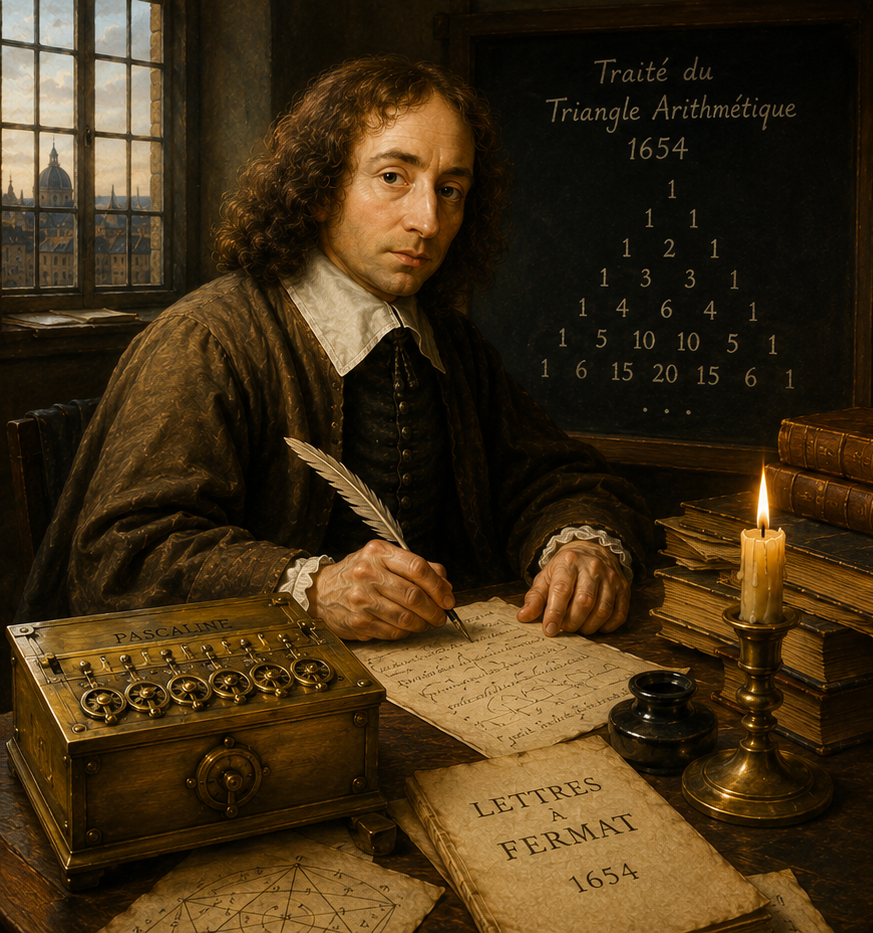 The summer of 1654 was one of the most productive periods in the history of mathematics. Pascal, then thirty years old and in one of his "worldly" phases between bouts of Jansenist fervor, was being pestered by the Chevalier de Méré, a gambler-philosopher who had two mathematical problems he couldn't resolve. The first involved the dice problem — how many throws of two dice are needed to make a double-six more likely than not. The second was the Problem of Points, the question of how to divide a gambling pot when a game is stopped early.
Pascal brought the second problem to Pierre de Fermat in Toulouse via letter. What followed was five letters across a few months in which two of the greatest mathematical minds in France argued out the problem, agreed on answers, and disagreed vigorously on method. Fermat enumerated all possible futures directly. Pascal used a tool he had been studying for years — a triangular arrangement of numbers that turned out to encode the answer to every possible version of the problem simultaneously.
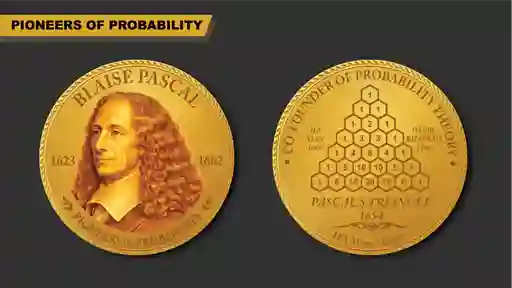
The tool was not originally his. Chinese mathematician Jia Xian had described it around 1050. Omar Khayyām — better known in the West as a poet — had written about it in Persia around 1100. It had been sitting in mathematical literature for six centuries before Pascal was born. The IFA MarketCoin® for Pascal acknowledges this on its reverse, where the honeycomb lattice of the triangle is shown alongside the inscription "Co-Founder of Probability Theory" and "Pascal's Triangle 1654." The year is the key: Pascal was not the first to notice the triangle, but he was the first to understand it deeply enough to turn it into a tool for calculating probability.
◆ The Proof
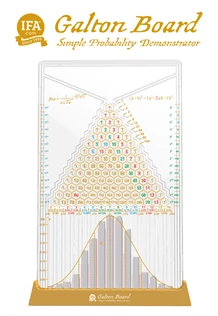
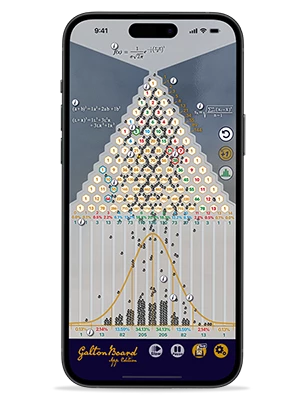
The triangle works like this: start with a 1 at the apex. Each subsequent row is built by adding the two numbers directly above each position. Row 1: 1. Row 2: 1, 1. Row 3: 1, 2, 1. Row 4: 1, 3, 3, 1. Row 5: 1, 4, 6, 4, 1.
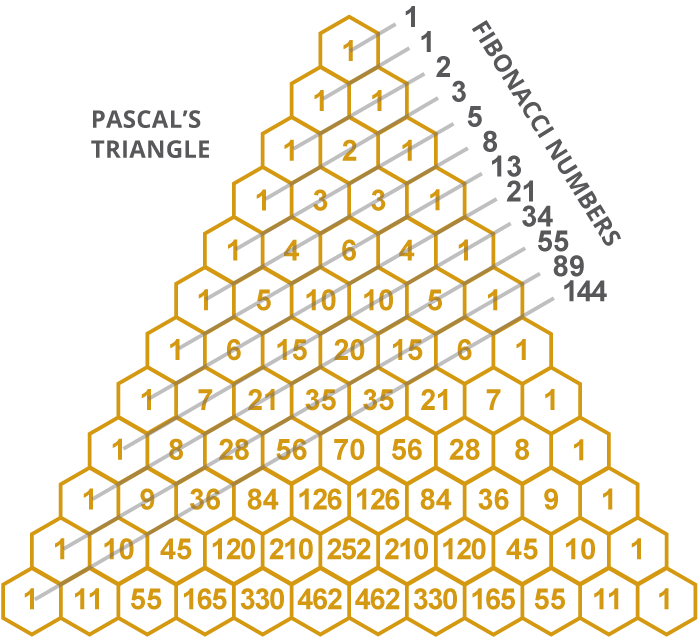 The numbers in each row are the binomial coefficients — the number of ways to choose k items from n, which is exactly the calculation you need to count the paths in a probability problem. If player A needs r more wins and player B needs s more wins to finish the game, Pascal showed that the fair division of the pot is readable directly from the relevant row of the triangle. You don't have to enumerate every possible future sequence the way Fermat did. The triangle has already done the counting for you.
That agreement — Fermat's exhaustive enumeration and Pascal's triangular encoding arriving at exactly the same numerical answers for every case they tested — was what gave both men confidence they had found the truth rather than an approximation. Two completely different paths to the same place. This is how mathematics confirms itself.
Pascal compiled his findings in a short treatise, Traité du Triangle Arithmétique, completed in 1654. Like so much of the work in this series, it was published posthumously — in 1665, three years after his death. He also extended the triangle's applications to the principle of mathematical induction, demonstrating in that same year a proof technique that now underlies vast areas of formal mathematics.
Pascal's other great contribution to probability in 1654 was what became known as Pascal's Wager. The Wager was, structurally, the first formal application of expected value reasoning to a real-world decision. Pascal argued that belief in God is the rational choice because it is the bet with the highest expected value: if God exists, belief yields infinite reward; if God does not exist, the cost of believing is finite and small. The argument has been debated by philosophers and theologians ever since, but its mathematical structure — multiply outcomes by their probabilities, choose the option with the highest expected value — is the engine running beneath every serious financial decision made today.
◆ The Legacy
Pascal's correspondence with Fermat was never published in their lifetimes. It circulated among the mathematical intelligentsia of Paris and would likely have remained obscure if not for Christiaan Huygens, who visited Paris the following year, heard about the work, and wrote it up as the first printed textbook on probability. Pascal's triangle traveled more widely — it appears in every textbook on combinatorics, statistics, and the binomial theorem, usually without acknowledgment that it predates its most famous ambassador by six centuries.
In the last years of his life, Pascal largely abandoned mathematics for theology. He became a central figure in the Jansenist movement, writing the biting Provincial Letters under a pseudonym to defend Jansenism against the Jesuits. His Pensées, a collection of philosophical and religious fragments assembled after his death, remains one of the most widely read texts of French literature. The man who built probability theory died at thirty-nine, having spent the last portion of his life arguing that reason alone is insufficient for the human condition.
There is a biographical irony in that. Pascal built the mathematical tools for reasoning about an uncertain future. He also concluded, from direct personal experience, that those tools could not answer the deepest questions a person faces. He held both convictions simultaneously, with what appears to have been genuine sincerity. That combination — rigorous mathematician and anguished believer — made him one of the most fascinating figures of the seventeenth century.
◆ Your Money
Pascal's expected value framework is not a historical relic. It is the conceptual core of modern portfolio theory, option pricing, risk management, and actuarial science. Every time a financial analyst asks "what is the probability-weighted average return of this investment?" they are asking Pascal's question.
The practical implication for investors is straightforward. A portfolio decision is not a single outcome. It is a distribution of possible outcomes, each weighted by its probability. The rational investor doesn't ask "Will this fund go up?" — a binary question that collapses the distribution. They ask: "What is the expected return of this strategy across the range of plausible futures, and how does that compare to alternatives with similar or lower costs?"
That question, asked honestly and answered with evidence, tends to point in a consistent direction. The expected return of a diversified, low-cost index strategy exceeds the expected return of active stock-picking — not because every active manager is incompetent, but because the probability-weighted outcome across all active managers is negative after fees, while the index captures the market return by construction. Pascal didn't design the index fund. But he built the mathematical framework that explains why it works.
Sources: Pascal, B. (1665). Traité du triangle arithmétique. Guillaume Desprez. Devlin, K. (2008). The unfinished game. Basic Books. MacTutor History of Mathematics, University of St Andrews.
Disclosure:
This article and video is provided for informational and educational purposes only and does not constitute investment, legal, tax, or other professional advice, nor is it a solicitation or recommendation to buy, sell, or hold any security or investment strategy. References to probability theory, diversification, passive investing, expected returns, risk, or other investment concepts are intended solely to illustrate historical, mathematical, and financial principles. Such concepts are based on assumptions and theories that may not reflect actual market outcomes and should not be interpreted as guarantees of future performance or investment results.
Investment markets are uncertain, and all investing involves risk, including the possible loss of principal. Diversification does not ensure a profit or protect against loss. Past performance is not indicative of future results. Content is AI-assisted and may contain errors or omissions. Index Fund Advisors, Inc. is a registered investment adviser. For additional information, please visit adviserinfo.sec.gov or www.ifa.com.
About the pen name: "Claude Hebner" represents a collaboration between Mark Hebner, founder and CEO of Index Fund Advisors, Inc., and Claude, Anthropic's AI. The research, historical narrative, and investment analysis in each article are the result of that partnership — human editorial judgment and decades of financial expertise combined with AI-assisted research and drafting.












 Home
Home 888-643-3133
 Contact Us
 Newsletter Subscribe
 eMoney
 IFA Apps
 Index Funds Book on Kindle
 Index Funds Audiobook
 Careers
 Facebook
 X
X LinkedIn
 Instagram
 Youtube
 Terms
Terms Index Descriptions