
 Risk Capacity
 Wealth Management
 Outsourced CIO
 Retirement Plans
 Institutional
 Financial
  Open an Account
 IFA App

 Articles
 Charts
 Investor Education ▾
 Fund
Fund
 Store
Store

 Taxes
Taxes Back-testing Disclosures
 Glossary
 Form CRS
For roughly two decades, one corner of the outsourced chief investment officer (OCIO) market stood apart from the rest. While most OCIO providers sold endowments and foundations on complex portfolios full of active managers and alternative investments, Vanguard offered a discretionary service rooted in the low-cost, index-based philosophy its founder, Jack Bogle, made famous. IFA's tribute to Jack Bogle and the HMS Vanguard is shown below.
In December 2023, Vanguard agreed to sell the OCIO business. This article traces how it began, why it resonated with nonprofits, how it grew, what is known about why Vanguard let it go, and how Index Fund Advisors is responding.
A new model sweeps the institutional market
To understand Vanguard's entry, it helps to understand the market it was entering. The OCIO model, in which an outside firm takes discretionary control of an institution's portfolio, has become widespread. Commonfund, one of the pioneers of OCIO services for nonprofits, says it generally applies the endowment model of investing, an approach associated with the Yale University Endowment and its longtime chief investment officer, David Swensen, that has emphasized external managers and alternatives such as hedge funds, private equity, and venture capital.
The model grew enormously. According to Cerulli Associates, U.S. assets managed by OCIO providers totaled $2.9 trillion at the end of 2023 and had grown at double-digit annual rates over the prior five years. Institutional Investor reported that this growth has drawn a wave of new entrants, from boutique firms to major asset managers.
Vanguard's entry
Vanguard's institutional advisory roots reach back to at least the 1990s. A 2017 proposal from Vanguard Institutional Advisory Services (VIAS) noted that its longest-running client relationship at the time began in 1997. Vanguard itself stated in 2018 that it had provided OCIO services to pension plans, foundations, and endowments for more than 20 years, offering both advisory and discretionary services and working as an extension of the board and investment staff.
VIAS was dedicated to helping endowments, foundations, health systems, religious and cultural organizations, and other institutional investors develop and implement investment strategies and policies, and it operated from Vanguard's headquarters in Malvern, Pennsylvania.
The need it met
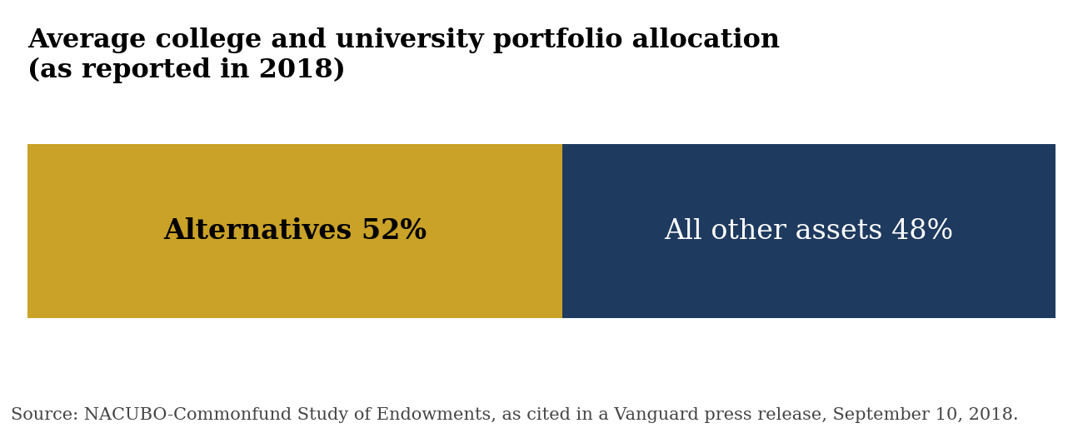
Vanguard also made the cost argument directly to nonprofits. In 2018, VIAS head Christopher Philips framed investment underperformance as a potential direct cost to a nonprofit's ability to fulfill its mission. In that same release, Vanguard pointed out that colleges and universities allocated an average of 52% of their portfolios to alternatives the prior year (data reported in 2018; current allocations may differ), per the NACUBO-Commonfund Study of Endowments (NACUBO is the National Association of College and University Business Officers), and described those as high-cost strategies.
Smaller institutions were a particular strength. OCIO search consultant Brad Alford noted that Vanguard consistently did well with endowments and foundations having less than $100 million to invest.
It is worth being precise here: Vanguard's OCIO was index-centric, not index-only. Alford observed that the firm used a fair amount of passive investments but did include alternatives in client portfolios. Vanguard's own marketing highlighted access to unaffiliated active managers with fees negotiated at scale, and in 2020 it announced a private equity partnership with HarbourVest, explaining that many institutional clients seek return sources not readily available in public markets.
Growth
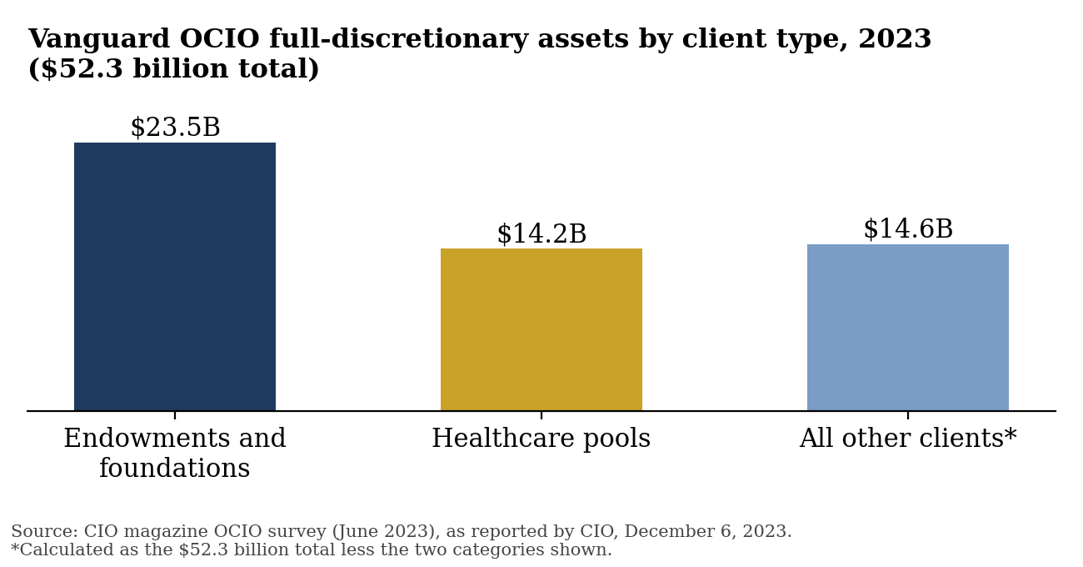
As of December 31, 2019, VIAS managed over $50 billion across nonprofit organizations, pension sponsors, and other institutional investors, and Vanguard described it as one of the world's largest OCIO providers. By 2023, VIAS reported 1,162 full-discretion clients and $52.3 billion in full-discretionary assets in CIO magazine's OCIO survey, while Charles Skorina's annual OCIO report estimated the business at $59 billion. Its assets included $23.5 billion in endowment and foundation assets and $14.2 billion in healthcare pool assets. Alford called it a crown jewel of the endowment and foundation OCIO business.
— Brad Alford, OCIO search consultant, Institutional Investor, December 2023
The sale
On December 5, 2023, a large global investment consulting firm announced an agreement to acquire Vanguard's OCIO business serving not-for-profit organizations and other U.S. institutional investors. Neither firm disclosed terms. The deal closed on March 15, 2024, and about 120 former Vanguard employees joined the acquiring company (as reported by PLANADVISER). In a March 15, 2024 press release announcing the closing, the acquiring company said incoming clients could elect to keep the same investment approach and team they had at Vanguard.
Why Vanguard sold
Vanguard never gave a detailed public rationale. RIABiz reported that the firm did not explain the sale's purpose but alluded to challenges keeping pace with increasingly complex rules. Vanguard's official statement said the acquiring company was well positioned to help OCIO clients navigate the evolving OCIO landscape.
Industry observers offered several explanations. Shekhar Mukherjee of Clearwater Analytics suggested the OCIO market had become a scale game, with the largest players having the infrastructure to make the business work. He also pointed to changing client demand, noting more appetite for third-party options and varied strategies such as alternatives.
The sale came amid other changes at Vanguard. RIABiz reported that in November 2023 Vanguard closed its operations in China and Germany and ended its relationship with American Express, and it later agreed to move its Individual 401(k), SEP, and SIMPLE IRA businesses to Ascensus, saying it was focusing on areas where it could provide the highest value.
Options for former clients
PLANADVISER reported that Vanguard OCIO clients moving to the acquiring company could keep their existing investment strategies and teams or consider the acquirer's other resources, which include solutions from third-party managers across asset classes, from traditional equities and bonds to alternatives such as infrastructure and private credit. Whether an institution keeps an index-centric approach is a decision for its board.
A new chapter: IFA OCIO
Following Vanguard's exit from the OCIO business, Index Fund Advisors has decided to follow Jack Bogle's core idea of low-cost index investing and offer a new index-based, independent, fiduciary-based, globally diversified, designed to be relatively low cost (measured against OCIO portfolios that lean on active managers and alternatives), and guided and disciplined OCIO model through its IFA OCIO division*. The model is intended for foundations, endowments, and nonprofits that prefer an index-based approach to the active-management and alternative-investment strategies associated with the endowment model described above.
Some IFA OCIO consultants have an IFA MarketCoin that embodies our principles, while reminding the coin holder of the random walk down Wall Street. The front bears the consultant's image, name, credentials, and title, as on the coin of Senior Investment Consultant Nick Piccarreta shown below, and the back lists six concepts around its rim: Fiduciary, Independence, Indexing, Diversification, Costs, and Discipline.
*IFA is not affiliated with Vanguard or with the firm that acquired Vanguard's OCIO business, and IFA OCIO is not a continuation of Vanguard's OCIO services.
Each one describes a commitment IFAOCIO.com makes to the institutions it serves. In total, IFA has nine advisors/consultants who provide these services to institutional clients. The IFA client service specialist team includes eight team members who support both high-net-worth individuals and OCIO clients. In total IFA has a team of about 55 employees and assets under management of $6.6 billion as of September 30, 2026.

Front and back of an IFA OCIO consultant coin: Nick Piccarreta, Senior Investment Consultant (credentials shown on the coin: CFA, Chartered Financial Analyst; CFP, Certified Financial Planner; CAIA, Chartered Alternative Investment Analyst).
Fiduciary
Index Fund Advisors is an SEC-registered investment adviser; however, such registration does not imply a certain level of skill or training and no inference to the contrary should be made. Like every investment adviser registered under the Investment Advisers Act of 1940, IFA has a fiduciary duty to its advisory clients, which means it must act in their best interest. When an institution gives an OCIO discretion over its portfolio, it relies on that duty in every decision made on its behalf. For IFA OCIO, that fiduciary duty is the foundation of the client relationship.
Independence
Independence means that recommendations are intended to be driven by the evidence and by the client's investment policy, not by the sale of particular investment products, and IFA receives no commissions, sales loads, 12b-1 fees, or other compensation from any mutual fund company, exchange-traded fund company, or broker-dealer; the only compensation it receives from client investments is the asset-based advisory fee paid by clients (described in IFA's current Form ADV Part 2A). IFA OCIO is designed so that the advice a board receives reflects what the evidence supports, although even the evidence related to investing is often subject to debate by experts and academics.
Indexing
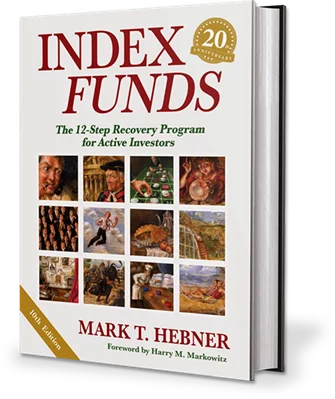
Indexing means holding the securities of a market index rather than trying to pick winners. IFA's founder and CEO Mark Hebner's book, Index Funds: The 12-Step Recovery Program for Active Investors, and the IFA.com website make the case for index investing, including IFA's analysis of S&P Dow Jones Indices' SPIVA Scorecards, which indicates that over the long periods measured a majority of actively managed funds have underperformed their benchmarks. David Swensen, Yale's longtime chief investment officer, concluded in a 2012 speech that almost all individual investors and most institutional investors would be better off investing passively unless they have direct access to "incredibly high-qualified professionals". IFA OCIO is built around index funds for this reason. Index funds do not remove market risk; when markets fall, an index portfolio falls with them, and its value can decline significantly.
The primary source for this statement is David Swensen's speech at the John C. Bogle Legacy Forum, which was hosted by Bloomberg on January 31, 2012. [1]
During this event honoring Vanguard founder Jack Bogle, Swensen stated that there are only two sensible approaches to investing—either 100% active or 100% passive. He concluded that unless an investor has direct access to "incredibly high-qualified professionals," they should be 100% passive, explicitly noting that this recommendation applies to almost all individual investors and most institutional investors. [1, 2, 3]
Diversification
Diversification means spreading assets across many securities, industries, countries, and asset classes so that the results of any single company or market have a limited effect on the whole portfolio. Investors have long understood the idea of not putting all their eggs in one basket, but it was Harry Markowitz who turned that intuition into a rigorous theory of portfolio choice. His 1952 essay "Portfolio Selection," later expanded in his 1959 book Portfolio Selection: Efficient Diversification, set out a framework for investing in assets that differ in expected return and risk. In 1990, that work earned Markowitz a share of the Nobel Memorial Prize in Economic Sciences, awarded together with William Sharpe and Merton Miller for their pioneering work in financial economics. [1]
Markowitz's central insight was that a portfolio's risk depends not only on the risk of each holding, but also on how the holdings move in relation to one another. [2] Combining assets that do not rise and fall in lockstep can make the portfolio as a whole less volatile than its individual parts. That principle guides portfolio design at IFA OCIO: rather than concentrating in a handful of securities or managers, IFA OCIO uses diversified index portfolios for the institutions it serves. Markowitz also found that diversification has its limits. [2] When markets decline broadly, a diversified portfolio will decline too. Diversification does not guarantee a profit or protect against loss in declining markets.
Costs
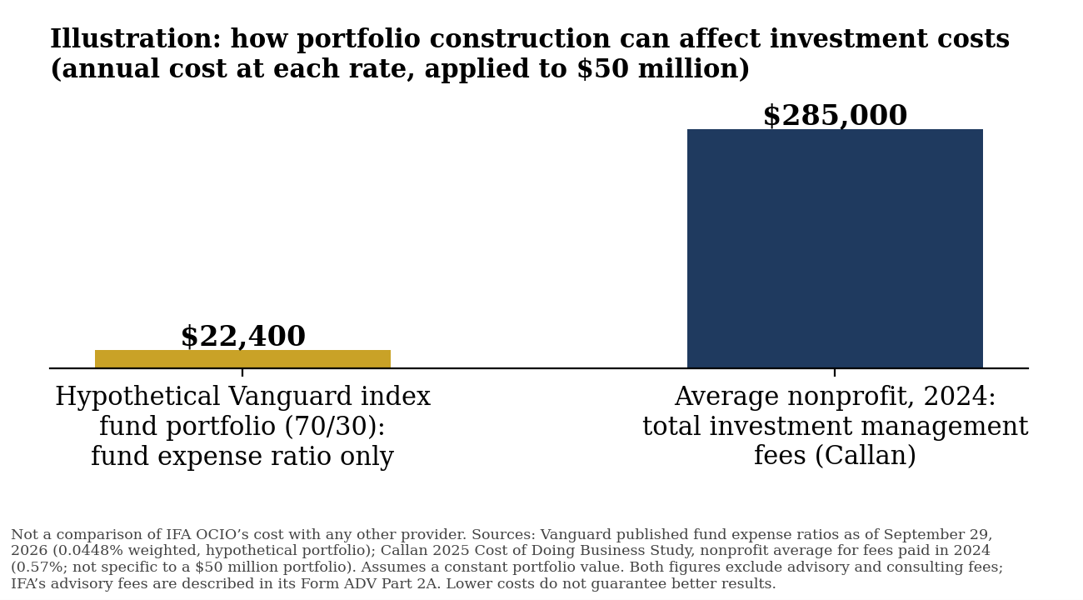
Every dollar paid in investment costs reduces the amount otherwise available for the mission. In 2018, Vanguard described the alternative investments that made up an average of 52% of college and university portfolios as high-cost strategies. The weighted fund expense ratio for a hypothetical Vanguard Fund Portfolio of 70% stock funds and 30% bond funds is about 0.0448% annually, based on expense ratios published on Vanguard's website as of September 29, 2026. At these allocations and expense ratios, that equates to approximately $22,400 per year on a $50 million portfolio, assuming a constant portfolio value. Separately, Callan's 2025 Cost of Doing Business Study found that nonprofits continued to pay the highest total investment management fees among the institutional investors it studied, averaging 0.57% in 2024, or about $285,000 per year on a $50 million portfolio, which Callan attributes in part to larger allocations to alternatives. [1] Both figures exclude advisory and consulting fees, so neither represents the total cost of an OCIO program. These two figures are offered to illustrate how portfolio construction, and in particular allocations to alternatives and active managers, can affect what an institution pays for investment management; they are not a comparison of IFA OCIO's cost with the cost of any other provider. They also differ in material ways: the first is the fund expense ratio alone of a hypothetical portfolio of Vanguard index funds, which may differ from the funds IFA OCIO would use for a given client, while the second is an average of total investment management fees actually paid by a group of nonprofits, including fees for active managers and alternatives, and is not specific to a $50 million portfolio. IFA's advisory fees are in addition to fund expenses and are described in IFA's current Form ADV Part 2A (Brochure), available upon request and at https://adviserinfo.sec.gov/firm/summary/109143. For IFA OCIO, paying close attention to costs is part of serving a nonprofit's mission. Lower costs do not guarantee better results.
Discipline
Discipline means following a written investment policy through all market conditions rather than reacting to short-term market movements or chasing recent performance. For IFA OCIO, discipline means helping boards stay committed to the policy they adopt. It also requires patience: an index-based portfolio may sometimes trail other approaches, and staying the course through those periods is part of the commitment.
"An index-based portfolio will sometimes trail other approaches, and staying the course through those periods is part of the commitment." — IFA
Together, these six principles describe the approach IFA OCIO brings to nonprofits that want an index-based investment office. All investing involves risk, including the possible loss of principal, and past performance does not guarantee future results.
Sources
- Vanguard Institutional Advisory Services proposal document, 2017 (arkansasjustice.org).
- Vanguard press release on RiskFirst PFaroe partnership, September 10, 2018 (cites NACUBO-Commonfund Study of Endowments).
- Vanguard press release, "Vanguard and HarbourVest Announce Private Equity Partnership," February 5, 2020.
- Vanguard OCIO for Nonprofits web page, institutional.vanguard.com.
- Press releases from the acquiring company, December 5, 2023 and March 15, 2024.
- CIO magazine (ai-cio.com), December 6, 2023 (CIO OCIO survey data).
- Institutional Investor, December 2023 (Skorina estimate; Alford comments; new OCIO entrants).
- PLANADVISER, December 6, 2023 and March 15, 2024 (Mukherjee comments; staffing; options for transitioning clients).
- RIABiz, December 6, 2023 and May 2, 2024.
- Callan, 2025 Cost of Doing Business Study (callan.com/blog/2025-cost-of-doing-business/), fee data for 2024.
- Vanguard published fund expense ratios as of September 29, 2026 (fund list and dated captures to be retained in the substantiation file).
- Bloomberg, January 31, 2012 (David Swensen, John C. Bogle Legacy Forum); Yahoo Finance and IFA.com/quotes/david_swensen (same remarks).
- Nobel Prize 1990 Economic Sciences press release (nobelprize.org); Morningstar.ca article on Harry Markowitz (morningstar.ca/ca/news/187607/).
- Cerulli Associates, "U.S. Outsourced Chief Investment Officer 2024," as reported by Fidelity Institutional (institutional.fidelity.com), U.S. OCIO assets at year-end 2023.
- Commonfund OCIO web page (commonfund.org/outsourced-cio), description of the endowment model; Chief Investment Officer, "Is the Yale Model Broken?", March 27, 2017 (ai-cio.com).
- S&P Dow Jones Indices, SPIVA U.S. Scorecard and Persistence Scorecard, year-end 2025 (spglobal.com/spdji); IFA, "Active Fund Managers vs. Indexes: Analyzing SPIVA Scorecards" (ifa.com/articles/spiva-report-active-vs-passive).
- IFA, as the source for IFA's own staffing, asset, and research statements: IFA.com, Mark Hebner's book Index Funds, and IFA records.
- IFA Form ADV Part 2A (Brochure), adviserinfo.sec.gov/firm/summary/109143.
Disclosures
This material is provided for informational and educational purposes only and is not intended as individualized investment advice or a recommendation to buy, sell, or hold any investment. Information attributed to third parties is derived from sources believed to be reliable, but IFA does not guarantee its accuracy or completeness. Opinions and statements identified as those of IFA reflect IFA's views as of the date of publication and are subject to change. Investing involves risk, including possible loss of principal. Past performance does not guarantee future results. Index Fund Advisors, Inc. is an SEC-registered investment adviser. Registration does not imply a certain level of skill or training. Additional information about IFA, including its services and fees, is available in its Form ADV Part 2A.














 Home
Home 888-643-3133
 Contact Us
 Newsletter Subscribe
 eMoney
 IFA Apps
 Index Funds Book on Kindle
 Index Funds Audiobook
 Careers
 Facebook
 X
X LinkedIn
 Instagram
 Youtube
 Terms
Terms Index Descriptions