
 Risk Capacity
 Wealth Management
 Outsourced CIO
 Retirement Plans
 Institutional
 Financial
  Open an Account
 IFA App

 Articles
 Charts
 Investor Education ▾
 Fund
Fund
 Store
Store

 Taxes
Taxes Back-testing Disclosures
 Glossary
 Form CRS
If saving is the art of keeping a portion of what you earn, budgeting is the older and humbler craft that makes saving possible: knowing where the rest goes. The two are mirror images of a single decision. Every dollar you earn faces one fork in the road — saved or spent — and the size of the portion you keep is decided, almost entirely, by the discipline you bring to the portion you spend. A budget is nothing more than that decision made on purpose, and made before the money arrives rather than after it has quietly disappeared.
The Household as an Economy
The word economy carries its origins in plain sight. It descends from the Greek oikonomia — from oikos, the household, and nomos, the law or management of it. The first economics was not a theory of nations or markets; it was the ordering of a single home so that its provisions met its needs and something remained. Xenophon devoted an entire dialogue, the Oikonomikos, to the well-run household around 370 BC, and Aristotle treated the management of the oikos as a discipline worthy of a philosopher. Long before ledgers or currencies, the fundamental problem was already fixed in place: a household takes in a certain amount, it must spend some of it, and its fate often turns on the gap between the two.
The Little Leather Bag
The word budget has an origin just as concrete. It comes from the Old French bougette, a small leather pouch. For centuries the British Chancellor of the Exchequer carried the nation's accounts to Parliament in such a bag, and "to open the budget" meant, literally, to open the bag and lay out before the country what it expected to take in and what it intended to spend. Once a year, in public, the state performed the exercise that every household must perform continuously and in private: it set its outflows honestly against its income and showed the difference. The ritual endures because the arithmetic is inescapable. Whether the accounts belong to an empire or a family, they generally balance when spending is measured against what actually comes in — not against what one hopes will come in, and never against what one can borrow.
Knowing Where It Goes
It is generally difficult to control what you do not count. In 1494 the Franciscan mathematician Luca Pacioli published his Summa and set down the Venetian method of double-entry bookkeeping, giving merchants a way to see, at a glance, whether their affairs were prospering or quietly draining away. Benjamin Franklin famously kept moral ledgers in the same spirit, convinced that a penny watched was a penny governed. The humble twentieth-century version was the envelope system — cash sorted into labeled envelopes for rent, food, and fuel, with an iron rule: when an envelope was empty, that category's spending stopped. Crude as it was, it often proved effective, because it externalized a discipline that can be difficult to maintain mentally. Modern behavioral economics has since named the reason. Richard Thaler described our tendency toward mental accounting, and researchers have measured the "pain of paying" — the friction cash imposes and that a swiped card removes. The card is convenient precisely because it is painless, and painlessness is exactly what a budget exists to restore.
Income, Consumption, and the Forty-Five-Degree Line
Beneath the household ledger lies an identity so simple that economists reduce it to a single equation: Income = Consumption Saving. In simplifed econimic terms, every dollar of after-tax income is treated as either spent on current goods and services or set aside — and whatever is not consumed is saved. Consumption is simply spending on goods and services for immediate use: housing, food, utilities, the ordinary business of living. In economics, what a household calls its expenses, economists call consumption — two names for the same flow of money. Saving, in this light, is not a separate feat of willpower but the residue of a spending decision already made. Expenses and savings are two readings of one number.
In 1936, John Maynard Keynes gave the relationship its formal shape in what he called the consumption function, built on a "fundamental psychological law": as income rises, consumption rises with it, but by less than the full increase. We spend more as we earn more, yet a widening share of each new dollar is left free to be kept. Economists track that split with two mirror measures — the marginal propensity to consume (MPC), the fraction of an additional dollar that is spent, and the marginal propensity to save (MPS), the fraction that is kept. The two always sum to one. An MPC of 0.9 means ninety cents of the next dollar is consumed and a dime saved, an MPS of 0.1. IFA's counsel to keep at least ten percent of your income carries the same spirit: hold back at least a dime of every dollar before it can drift into the consumption column.
The familiar consumption diagram makes the relationship visible at a glance. Plot consumption against income and draw a straight line at forty-five degrees from the origin; every point on that line marks where consumption exactly equals income. The real consumption curve begins above the line — people must eat even when income is low — and then climbs more gently, crossing the forty-five-degree line at a single break-even point where saving is exactly zero. To the left of that crossing, consumption exceeds income and the household is dissaving, drawing down past savings or borrowing to close the gap. To the right, income outruns consumption and the surplus becomes saving. An important aspect of building wealth is the work of living to the right of that point and staying there, so that the wedge between what you earn and what you spend widens, year after year, in your favor.
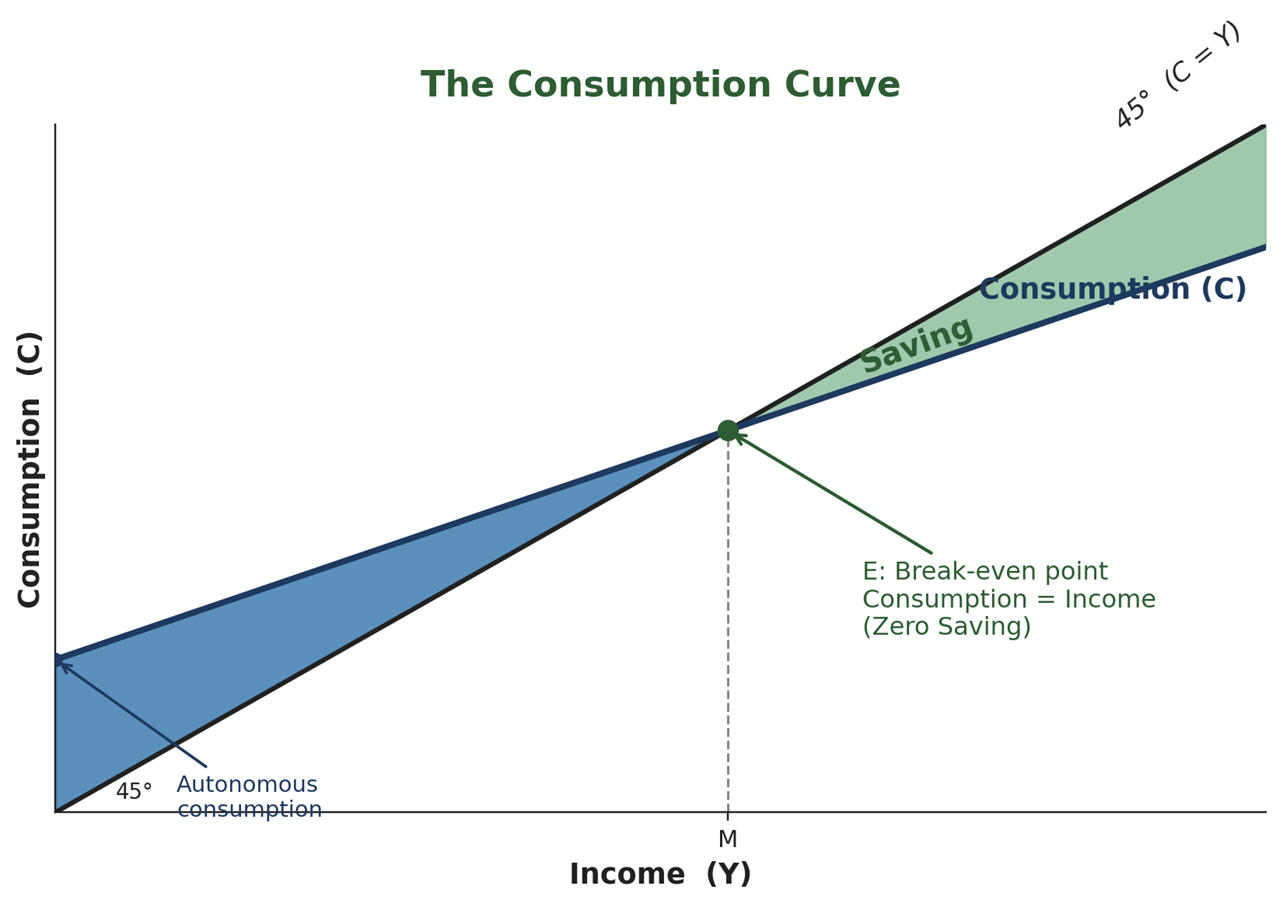
The consumption curve. The straight 45-degree line marks every point where consumption equals income. The consumption curve begins above it at the level of autonomous consumption and rises more gently, crossing at the break-even point E, where saving is exactly zero. To the left, consumption exceeds income and the household dissaves; to the right, income exceeds consumption and the surplus becomes saving.
The Three Kinds of Spending
Most expenses you have falls into one of three families, and knowing which is which is the beginning of control. Fixed expenses are set by contract or structure and recur at roughly the same amount no matter how you behave in a given month: rent or the mortgage payment, property taxes, insurance premiums, a car loan, tuition, the standing roster of subscriptions. Variable expenses rise and fall with daily choices: groceries, dining out, fuel, travel, entertainment, clothing, gifts.
The distinction matters more than it first appears. Fixed costs are the floor of your life. They are difficult to move quickly, and — this is the danger — they commit tomorrow's income before it has been earned. Variable costs are where day-to-day discipline actually lives, and where most people focus their budgeting energy. But a household that trims its coffee and its takeout while its fixed commitments quietly climb is fighting the small battle and losing the large one. Some of the most consequential budgeting decisions you will ever make are the big, infrequent, fixed ones: the house you buy, the car you finance, the lease you sign. Each locks in years of outflow with a single signature. Keep the floor low, and the rest of the budget breathes.
A third kind hides between the other two, and it is the one that quietly wrecks budgets: the surprise expense — the cost you did not plan for and could not have scheduled. The roof that gives way, the transmission that fails, the medical bill insurance did not fully cover, the trip you suddenly had to take. Any single surprise is unpredictable; in the aggregate they are a near-certainty. They belong to no monthly line, which is exactly why a budget assembled only from fixed and variable spending is always, quietly, incomplete: it plans for the expected and is ambushed by the inevitable. The surprise expense is not a failure of budgeting but a permanent feature of it — and met without a reserve, it has only one place to go: onto a credit card, at interest, where an unplanned cost hardens into a lasting debt.
The Trap That Runs the Wrong Way
Franklin called compound interest astonishing, and it is — when it works for you. Run in reverse, it is merciless. A credit card balance is compounding turned against its owner, often at rates north of twenty percent, and few legitimate, diversified investments reliably earn enough to outrun it. The card itself is a fine instrument; the balance is the danger. To carry one from month to month is to rent your own past spending at a price that quietly consumes your future. Consumer revolving credit is a recent invention — the Diners Club card dates only to 1950 — and it arrived without any of the discipline the leather bag once enforced. So the first rule of expenses is short and non-negotiable: pay the card in full, every month. Debt service is the one line in your budget that grows while you sleep and buys you nothing.
The Eighty-Five Percent Rule and the Cushion
Here the discipline of spending rejoins the discipline of saving. Pay yourself first — IFA's long-standing counsel is to set aside at least ten percent of your income before taxes, before the money is ever in reach. What then lands in your account is your after-tax income, and that figure — not your gross salary — is the true budget you live inside.
Our guideline is simple: keep your total living expenses to no more than roughly eighty-five percent of your after-tax income. The remaining fifteen percent is not slack to be spent later; it is a cushion, deliberately unspent, standing ready for exactly that third kind of spending — the surprise expenses that never appear on a tidy monthly budget. If your after-tax income is $80,000, that means living on about $68,000 and holding roughly $12,000 in reserve. The Expenses Ratio — annual living expenses divided by income — is the exact mirror of the savings ratio. The lower you hold it, the more room remains.
That cushion is not a luxury; it is the answer to a certainty. The roof may need replacing, the transmission may fail, the insurance deductible may come due, an urgent flight may have to be booked, and one memorable year the furnace and the water heater can surrender in the same week. These are the very contingencies that a thirty-year retirement must absorb again and again — the same roofs, cars, and medical surprises the retirement math turns on. A budget with no margin treats every surprise as an emergency and every emergency as a reason to reach for the card. A budget with a cushion has already met these guests; they arrive as line items, not as crises.
Control Today, Freedom Tomorrow
From the Greek oikos to the Exchequer's leather bag to the labeled envelope on a kitchen table, the instruction has scarcely changed. Measure what comes in. Decide before the month begins where it will go. Hold the fixed commitments modest, because they mortgage the future. Keep the variable ones honest, because they reveal your real priorities. Never let a credit card carry a balance, because compounding is a servant or a master and nothing in between. And leave a margin for the surprises that are certain to come even when their timing is not. Do that, and the expenses coin becomes more than a record of consumption; it becomes an instrument of freedom — one disciplined month laying the groundwork for a great many relaxed years.


















 Home
Home 888-643-3133
 Contact Us
 Newsletter Subscribe
 eMoney
 IFA Apps
 Index Funds Book on Kindle
 Index Funds Audiobook
 Careers
 Facebook
 X
X LinkedIn
 Instagram
 Youtube
 Terms
Terms Index Descriptions