
 Risk Capacity
 FinPlan
 Wealth Management
 Retirement Plans
 Institutional
 Financial
  Open an Account
 IFA App

 Articles
 Charts
 Investor Education ▾
 Fund
Fund
 Store
Store

 Taxes
Taxes Back-testing Disclosures
 Glossary
 Form CRS
The Papers that Changed Investing: False Discoveries in Mutual Fund Performance
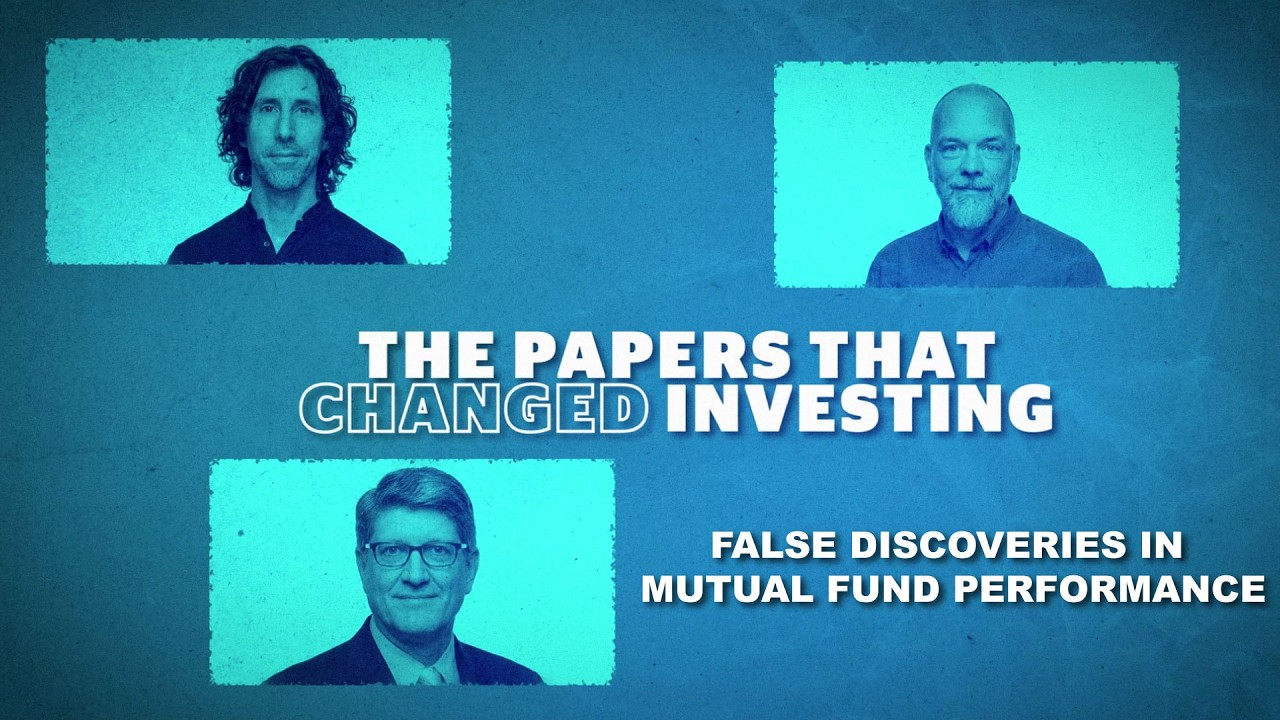

It's 2010. The US economy is clawing back from the worst financial crisis since the Great Depression, the Affordable Care Act reshapes American healthcare, and Apple launches the iPad.
In the world of investing, one question is finally getting a rigorous answer: of the thousands of mutual funds competing for investor assets, how many beat the market through genuine skill — and how many simply got lucky?
Three researchers — Laurent Barras of the Swiss Finance Institute, Olivier Scaillet of HEC-University of Geneva, and Russ Wermers of the University of Maryland — publish a paper in the Journal of Finance with an answer that makes for uncomfortable reading.
Welcome to The Papers That Changed Investing.
For decades, identifying skilled fund managers followed one straightforward approach: look for funds with statistically significant returns above the market — what the industry calls alpha. If the numbers looked impressive enough, the conclusion followed naturally: this manager is skilled.
But here's the problem. When you test thousands of funds simultaneously, some will appear to beat the market by chance alone. It's a statistical certainty. Even if no manager in the world possessed genuine skill, a handful would still appear to show positive alpha. That's just how probability works.
Nobody was properly accounting for this. The entire industry was
The breakthrough came from an unlikely source: medical science.
Geneticists testing thousands of genes simultaneously for disease markers had long faced the same challenge. Run enough statistical tests and some will return false positives — not because of real biology, but because chance occasionally mimics signal. Their solution was a statistical tool called the False Discovery Rate.
Barras, Scaillet, and Wermers borrowed that tool and pointed it at the mutual fund industry. Here's the brilliant part: it doesn't just identify which funds look skilled — it estimates how many apparent winners are statistical accidents, and how many represent something genuine.
The team didn't just theorize — they applied their framework to 2,076 US domestic equity mutual funds, tracking performance data from 1975 to 2006.
Think of it like this. Imagine two thousand people each flipping a coin one hundred times. By pure chance, a handful will flip sixty or more heads. They weren't skilled. They got lucky. The old approach to measuring fund performance would have called those people gifted. The False Discovery Rate asks a smarter question: given how many coins were being flipped, how many apparent winners should we expect by chance — and what's genuinely left over?
So what did Barras, Scaillet, and Wermers find?
First: approximately 75% of funds had zero alpha — neither skilled nor unskilled. After fees and trading costs, their managers historically generated nothing extra for investors.
Second: around 21% were genuinely unskilled, consistently destroying investor value not through bad luck but through measurable, persistent underperformance.
Third: only about 2% showed genuine skill, and by 2006, even that fraction had collapsed to near zero — statistically indistinguishable from none.
The researchers called this the False Discovery Rate framework — and it gave finance its first genuinely rigorous method for separating luck from skill at scale.
Here's why this research matters today.
Every year, billions of dollars flow into funds with strong recent performance. Investors see a few years of impressive returns and reach a natural conclusion: this manager knows what they're doing.
This research demonstrated that many of those conclusions are false discoveries — statistically demonstrable errors.
The findings grew more troubling over time. Before 1996, a meaningful proportion of genuinely skilled managers existed. By 2006, they had declined significantly — absorbed into an industry that had grown too large for real outperformance to survive.
Barras, Scaillet, and Wermers didn't simply cast doubt on active management. They measured the luck involved. And they found it almost everywhere. Advisors informed by this research build portfolios focusing on market returns, not manager selection.
To find out more about our evidence-based investment philosophy, visit our website at ifa.com.
Sources
Barras, L., Scaillet, O., & Wermers, R. (2010) False Discoveries in Mutual Fund Performance: Measuring Luck in Estimated Alphas The Journal of Finance, 65(1), 179–216
Available at ifa.com/academic-papers
DISCLOSURES:
This video is intended for informational and educational purposes only and does not constitute investment advice or a solicitation to buy or sell any security. The research discussed — "False Discoveries in Mutual Fund Performance: Measuring Luck in Estimated Alphas" by Laurent Barras, Olivier Scaillet, and Russ Wermers, published in The Journal of Finance in 2010 — is presented to help investors understand academic findings related to mutual fund performance measurement and the statistical challenge of distinguishing genuine skill from luck. Findings reflect the authors' research and do not constitute predictions of future performance. Past performance is not indicative of future results, and investment returns are not guaranteed. This content was produced with the assistance of artificial intelligence. Index Fund Advisors, Inc. is a registered investment advisor. For regulatory information, please visit adviserinfo.sec.gov. For more information about IFA and its investment approach, please visit www.ifa.com.











 Home
Home 888-643-3133
 Contact Us
 Newsletter Subscribe
 eMoney
 IFA Apps
 Index Funds Book on Kindle
 Index Funds Audiobook
 Careers
 Facebook
 X
X LinkedIn
 Instagram
 Youtube
 Terms
Terms Index Descriptions