
 Risk Capacity
 Wealth Management
 Outsourced CIO
 Retirement Plans
 Institutional
 Financial
  Open an Account
 IFA App

 Articles
 Charts
 Investor Education ▾
 Fund
Fund
 Store
Store

 Taxes
Taxes Back-testing Disclosures
 Glossary
 Form CRS
The Papers that Changed Investing: Anticipated Prices and Random Fluctuation
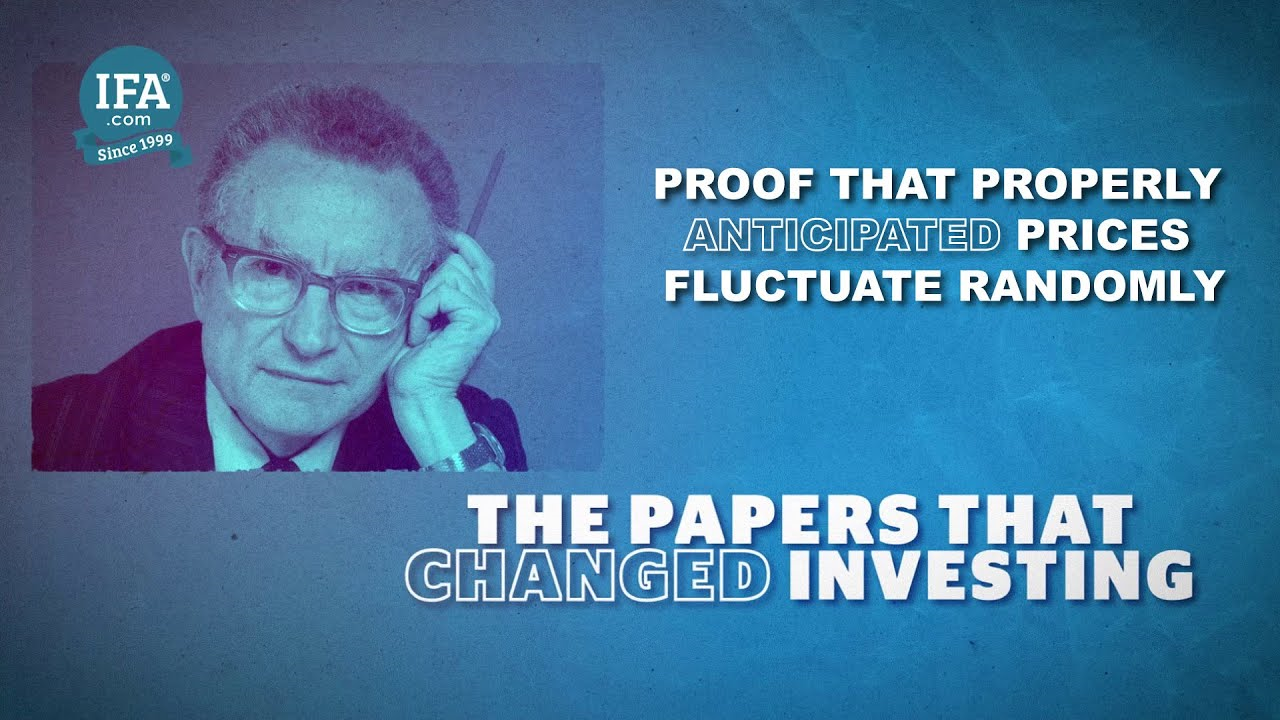

It's 1965. Computers fill entire rooms. On Wall Street, armies of analysts pore over balance sheets, earnings reports, and economic data — hunting for the next big winner.
The belief is universal: with enough research and skill, you can predict where stock prices are heading.
But here's the problem: if markets are full of intelligent people all competing to find the same opportunities, why do prices move so unpredictably?
One MIT economist asked that question — and his answer would shake the foundations of Wall Street.
His name was Paul Samuelson. Welcome to The Papers That Changed Investing.
By the mid-1960s, researchers had noticed something troubling. Stock prices showed no reliable patterns. They seemed to wander aimlessly — like a drunk staggering home.
The French mathematician Louis Bachelier spotted this randomness back in 1900.
At the same time as Samuelson, Eugene Fama was gathering fresh statistical evidence. But observation isn't explanation.
Samuelson set out to prove the answer — not with statistics, but with pure mathematics.
Samuelson's insight was elegant — and counterintuitive. Randomness isn't a flaw in the market. It's evidence the market is working.
Here's the logic. If everyone knows a stock will rise tomorrow, what happens?
Traders don't wait. They buy today. That buying pressure pushes the price up immediately. The predicted rise vanishes before it arrives.
Any pattern that can be spotted gets traded away the instant someone spots it. Competition destroys predictability.
Samuelson called this "properly anticipated" prices. When prices fully reflect all available information, only one thing can move them: news.
And news — by definition — is what nobody expected. If you could have predicted it, it wouldn't be news.
Think of it like this. A twenty-dollar bill falls on a busy high street. How long does it stay there?
Someone picks it up instantly. You never see money lying around in crowded places — the opportunity vanishes the moment it appears. Markets work the same way.
So what did Samuelson demonstrate?
First: when markets work properly, the best forecast of tomorrow's price is today's price.
Second: this doesn't mean prices are always correct, but it means they are fair, In that any predictable movement has already been acted upon.
Third: trying to forecast price changes isn't just difficult — it's mathematically unfounded. The randomness is proof that competition is doing its job.
Here's why this matters for your money today.
Samuelson showed that chasing market predictions isn't just difficult — it's a game where consistent success is not supported mathematically.
Samuelson put it memorably: "Investing should be like watching paint dry or grass grow. If you want excitement, take $800 and go to Las Vegas."
In 1970, Samuelson became the first American to win the Nobel Prize in Economics.
His proof gave ordinary investors a powerful new perspective: that broadly diversified, low-cost index funds may offer a way to participate in overall market returns without relying on predictions.
This research is widely cited as the intellectual foundation of index investing.
Curious how Samuelson's insight relates to modern investing concepts? The answers may be simpler than you think.
Source
Samuelson, P. A. (1965). Proof That Properly Anticipated Prices Fluctuate Randomly. Industrial Management Review, 6(2), 41–49.
Visit ifa.com/academic-papers
DISCLOSURES:
This material is intended for informational purposes only and is not a solicitation, offer, or recommendation to buy or sell any securities or investment programs. Past performance is not indicative of future results. All investing involves risk, including the possible loss of principal. References to academic studies are provided for educational purposes and may not reflect current market conditions. Assumptions include trading costs, taxes, and other frictions materially impact net returns. Individual circumstances vary, and readers should consult a qualified financial professional before making investment decisions. This video may include content generated or enhanced using artificial intelligence (AI). For more information about Index Fund Advisors, Inc, please review our brochure at https://www.adviserinfo.sec.gov/ or visit www.ifa.com.












 Home
Home 888-643-3133
 Contact Us
 Newsletter Subscribe
 eMoney
 IFA Apps
 Index Funds Book on Kindle
 Index Funds Audiobook
 Careers
 Facebook
 X
X LinkedIn
 Instagram
 Youtube
 Terms
Terms Index Descriptions