Pioneers of Probability: Thomas Bayes

Disclosure:
This presentation is provided for educational and informational purposes only and should not be construed as investment, legal, or tax advice. The views expressed are those of the presenter as of the date of recording and are subject to change without notice. References to investment principles, market behavior, or investment strategies are illustrative in nature and are not recommendations to buy, sell, or hold any security. All investing involves risk, including the possible loss of principal. Past performance is not indicative of future results. Content is AI-assisted. Index Fund Advisors, Inc. is a registered investment adviser. For additional information, please visit adviserinfo.sec.gov or www.ifa.com.
Imagine you visit a doctor. She runs a test for a rare disease, one that affects one person in a thousand. The test is very accurate. It correctly identifies the disease 99% of the time, and it gives a false positive only 1% of the time. Your test comes back positive. How worried should you be?
I'm sorry to tell you that it's a positive result.
Most people's instinct is very worried. The test is 99% accurate. That sounds nearly certain. But the mathematics tells a different story, and it is one of the most counterintuitive results in all of probability. Here's why.
The test was accurate in two different ways. Among the small group of people who had the disease, it caught 99% of them. Those are true positives. Among the much larger group who did not have the disease, it correctly cleared 99% of them true negatives. But look at the 1% it got wrong. Those are healthy people the test flagged as sick. False positives. Let me show you. Start with 10,000 people. About 10 have the disease. 9,990 do not. Among the 10, roughly 10 true positives. Among the 9,990, about 100 false positives. 1% of a very large group is bigger than 99% of a very small one. So, put the two side by side. About 10 true positives, about 100 false positives. 110 positive results in total, and only 10 of them are real. 10 divided by 110 is roughly 9%. A positive result on a 99% accurate test does not mean a 99% chance of disease. In this example, there is only about a 9% chance that a positive result means the person actually has the disease.
That result is shocking the first time you encounter it.
Yes, it certainly is.
It was also for most of Western history incalculable. No general systematic method was widely available for combining prior knowledge, the rarity of the disease with new evidence, the test result, to arrive at an updated probability until a minister in Tundridge, Wales, England, worked it out in private sometime in the middle of the 18th century. Welcome to the pioneers of probability with me, Mark Hebner.
Thomas Bayes was a Presbyterian minister, a fellow of the Royal Society, and by all accounts, a quiet and private man. He published almost nothing in his lifetime. He left no record of why he was working on probability, what prompted his investigation, or what he thought of his own results.
What he left was a manuscript found among his papers after his death in 1761 by his friend Richard Price, a moral philosopher who immediately recognized what he was looking at. Price edited the paper, wrote an introduction explaining its significance and submitted it to the Royal Society. It was published in 1763, two years after Bayes died, under the title, "An Essay Towards Solving a Problem in the Doctrine of Chances."
Without price, the theorem disappears entirely. It is one of the great acts of intellectual rescue in the history of science. The problem Bayes was solving was the one Leibniz, who we met in episode 7, had identified a century earlier, but never formalized. Leibniz's knew that rational belief should update when new evidence arrives. But how? By how much? In what proportion? Bayes provided the first clear mathematical answer.
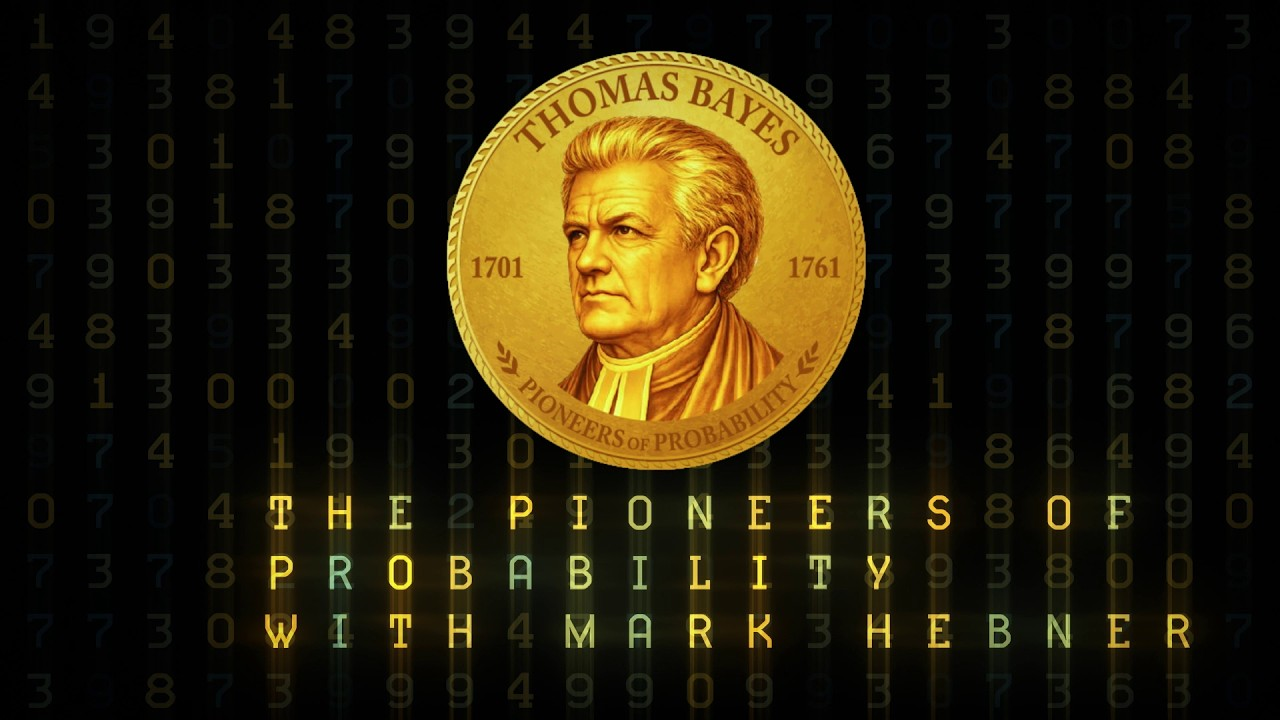
The theorem on our coin is compact but profound. P of A is your prior probability. What you believed was likely before seeing the new evidence. P of B given A is the likelihood. How probable the evidence would be if A were true. P of B is the normalizing constant, the total probability of seeing this evidence under all possible scenarios. And P of A given B is your updated belief after incorporating the evidence. I know it's a lot to take in. The formula is a mathematical framework for rational belief revision. You begin with what you know. You observe evidence. You update. The prior becomes the updated belief. And that is then prior for the next update. Each new piece of evidence updates your belief in a mathematically consistent way. Not in a single leap, but in a systematic, disciplined series of steps. This is what our coin's rim means. Belief adjusts as evidence accumulates, not all at once. Step by step, calculation by calculation, evidence by evidence. Let's return to the medical test. Your prior probability of having the disease is 1 in a thousand, 0.1%. The test is positive. Baze's theorem tells you exactly how much to update that belief given the accuracy of the test and the rarity of the disease. The answer, as we saw, is less than 10%. Still low. A second test could provide additional information. Baze's theorem can be applied again using the updated probability as the new prior. Each test result moves your belief a little closer to the truth.
Bayes's theorem was largely ignored for the first 50 years after its publication. It was a man who we first met in episode 9, Pierre-Simon Laplace, who independently rediscovered and fully developed the framework in the 1770s and 1780s, giving it the mathematical form we use today. He appears in the next episode of this series and his contribution was so substantial that the approach is sometimes called Bayesian Laplacian Inference. But the core idea was Bayes's, and once the world caught up to it, it proved to be one of the most powerful and versatile tools in the history of science. Bayesian Inference is now used in spam filters, medical diagnosis, search and rescue operations, machine learning, astrophysics, archaeology, and courtroom evidence analysis. Many systems that update beliefs in response to new data are at some level doing what Bayes described in that unpublished manuscript in Tundridge Wells. The frequentist tradition treats probability as a frequency of repeated events and is uncomfortable with the notion of a prior. The Bayesian Tradition treats probability as a degree of belief and updates it as evidence arrives. The tension between these two schools is one of the deepest in statistics and it has never been fully resolved. Both traditions, however, make use of Bayes's theorem as a tool for reasoning about conditional probability about what the evidence actually tells you once you account for what you already knew.
For investors, Bayes's theorem is not an abstraction. It provides a framework for how beliefs can be updated as new evidence becomes available. Every investment decision begins with a prior. For example, you might believe a fund manager has skill, that a sector will outperform, or that the market is overvalued. These are priors, initial probabilities held before you examine the evidence carefully. Bayes's theorem suggests to you how to update them.
Nice to meet you, Mark. I say, what have they done to my church?
Well, it's been extended and had a few uses over the years. Today it's a shared office space.
Anyway, on with the story. When a manager outperforms for one year, how much should that move your belief that the outperformance is due to skill rather than luck? The answer depends on two things. The strength of the evidence, one year of returns, and the baseline odds, how often managers genuinely have persistent skill. The baseline is arguably low. One year of outperformance is weak evidence. Bayes theorem says you may update your prior but not by much. Some investors do the opposite. They observe one year of strong returns and dramatically revise their belief upward, chasing performance, pouring money into last year's winners, treating recent data as far more informative than it is. Put $1 million into Probilitus PPE. Thanks. This is a failure of Bayesian reasoning. It overweights the likelihood and ignores the prior. The evidence-based investor applies Bayes theorem implicitly with every decision.
What did I believe before? What does this new evidence actually tell me given how noisy markets are? How much should I update?
The answers, honestly calculated, may lead some investors toward humility about stock selection, skepticism about short track records, and broader diversification rather than concentrated bets on individual predictions. Belief adjusts as evidence accumulates. That is the rim of this coin. It is also the most important sentence in investing.
We are 11 steps into an 800-year story. Seven more to go.