
 Risk Capacity
 Wealth Management
 Outsourced CIO
 Retirement Plans
 Institutional
 Financial
  Open an Account
 IFA App

 Articles
 Charts
 Investor Education ▾
 Fund
Fund
 Store
Store

 Taxes
Taxes Back-testing Disclosures
 Glossary
 Form CRS
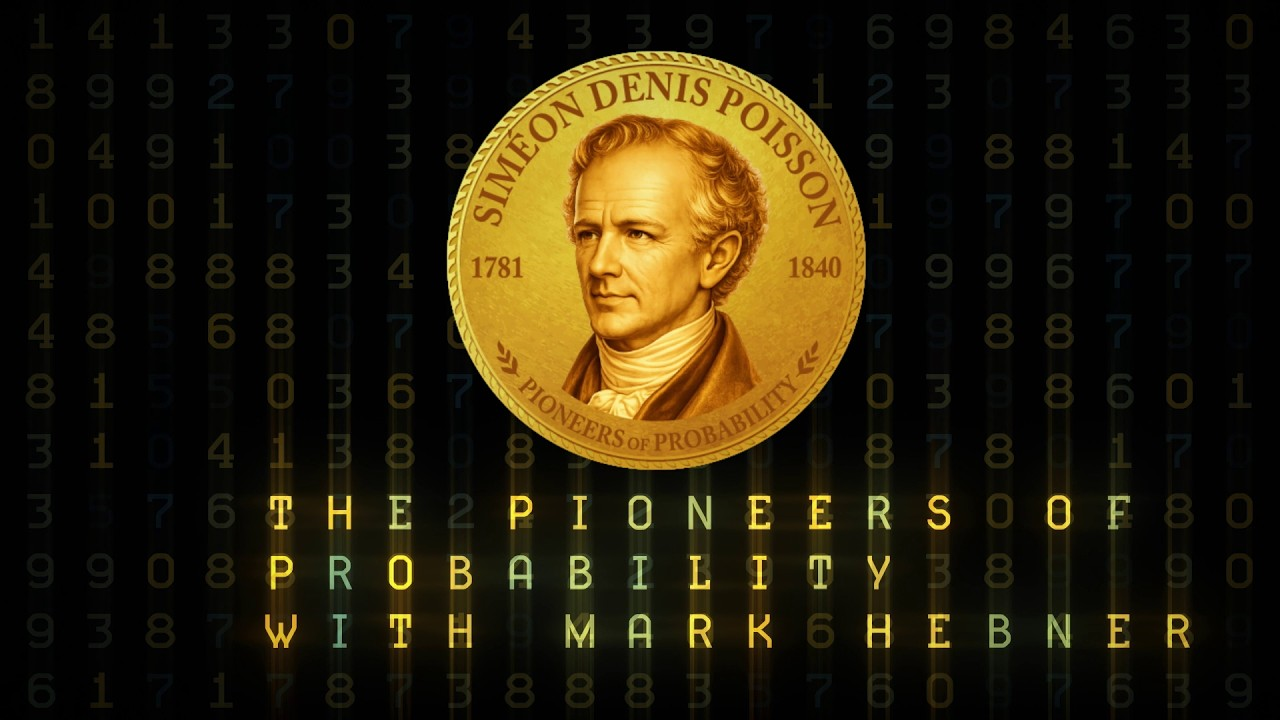
Pioneers of Probability: Simeon Denis Poisson

Disclosure:
This video is for informational and educational purposes only and does not constitute a solicitation or recommendation to buy or sell any security. The historical and mathematical concepts discussed are intended to illustrate the development of probability theory and its relevance to investing. Past performance is not indicative of future results. All investing involves risk, including the possible loss of principal. Content is AI-assisted. Index Fund Advisors, Inc. is a registered investment adviser. For additional information, please visit adviserinfo.sec.gov or www.ifa.com.
In the Prussian army in the late nineteenth century, soldiers were occasionally killed by horse kicks — rare, but across a large army over many years, it happened with a certain regularity.
A statistician named Ladislaus Bortkiewicz collected the data. Over twenty years, across fourteen cavalry corps, he recorded every death by horse kick.
The numbers were sparse — many units recorded zero deaths in a given year, some one, a few two, very rarely three or more.
He fit the data to a mathematical model developed sixty years earlier by a French mathematician named Siméon Denis Poisson. The fit was remarkably close.
That dataset became one of the most famous in the history of statistics — not because horse kicks matter, but because it demonstrated something profound: Rare, random, independent events follow a precise and predictable mathematical pattern. And that pattern governs far more of the world than anyone had imagined.
Welcome to Pioneers of Probability with me, Mark Hebner
Siméon Denis Poisson was born in 1781 in Pithiviers, France, and spent nearly his entire career at the École Polytechnique in Paris — publishing over 300 works across four decades, contributing to mathematical physics, celestial mechanics, electrostatics, and elasticity. He was one of the most productive mathematicians of his generation.
Yet his most enduring contribution appeared almost as an aside — a mathematical footnote in an 1837 book on probability applied to judicial decisions.
The book's main subject was the reliability of jury verdicts,
The question: what happens when you have a very large number of opportunities for an event to occur, but the probability on any single opportunity is very small?
Deaths from rare diseases. Industrial accidents. Misprints on a page. Phone calls arriving at an exchange. Radioactive decay events.
The binomial distribution can handle these in principle, but becomes unwieldy when n, the number, is very large and p, the probability, is very small.
Poisson found the elegant limiting form that describes them well.
The formula on the coin is compact and powerful: P(X equals k) equals λᵏ times e to the power of negative λ, divided by k factorial.
One parameter — λ, lambda — is the average rate of occurrence.
k is the number of events you want to calculate the probability of. e is Euler's number, approximately 2.718.
If you know the average rate, you can calculate the probability of any specific count. The entire distribution is determined by a single number.
As λ changes, the shape changes: when λ is small, the distribution is highly skewed toward zero events; as λ grows larger, it becomes more symmetric, approaching the normal distribution as a limiting case.
The Poisson model arises naturally under three conditions:
events occur independently, the average rate λ is constant over time or space, and events occur singly rather than in clusters.
Statisticians call this the Law of Small Numbers — a deliberate echo of Bernoulli's Law of Large Numbers; the two are, in a sense, mirror images.
Returning to the horse kicks: Bortkiewicz calculated the average rate at approximately 0.61 deaths per corps per year.
Plugging λ equals 0.61 into the formula produced predictions that matched the observed data closely. The mathematics described reality.
The Poisson distribution was largely ignored for the half century following its publication.
It was Bortkiewicz's much later 1898 horse kick study that demonstrated its power — a reminder that mathematical tools often wait decades for the datasets that reveal their importance.
Once recognized, it proved to be one of the most versatile distributions in statistics — describing customer arrivals, radioactive particle emission, DNA mutations, credit portfolio defaults, insurance claims, and extreme weather events.
Any process where discrete, independent events occur at a roughly constant average rate finds a natural first model here.
It also filled a crucial gap in the probability toolkit: the normal distribution describes continuous measurements, the binomial describes repeated binary trials,
and the Poisson covers discrete counts of rare events. Together, the three cover an enormous range of the phenomena that science and finance need to quantify.
For investors, the Poisson distribution provides a framework for modeling the frequency of rare events — precisely the class of events the normal distribution handles least well. [finger click to present day]
Consider credit defaults.
In a large portfolio of bonds or loans, each borrower has a small, roughly independent probability of default in a given year, at a relatively stable average rate.
This is precisely the Poisson regime, and Poisson-based models are standard tools in credit risk management.
Consider operational risk. Major operational failures — fraud, systems failures, rogue trading events — are rare, discrete, and roughly independent.
Modeling their frequency with Poisson distributions lets risk managers estimate the probability of experiencing zero, one, or two such events in a given year, and size capital reserves accordingly.
Consider market crises. Severe market dislocations can be approximated as Poisson-like events in simplified models, with a historically estimated rate of occurrence.
Under such a model, you can estimate how often such events might be expected to occur over a twenty or thirty year investment horizon.
The result, in simplified models, may appear more frequent than simple normal models suggest — and more often than most investors intuitively expect.
For the index investor, the lesson is not to avoid risk but to understand it clearly. Rare events are not as rare as they feel:
If something happens on average once every ten years, there is a meaningful probability of it happening twice in a decade, and a non-trivial probability of it not happening for twenty years.
Patience and diversification are not just philosophical commitments — they represent a rational response to a world where rare events can follow Poisson-like statistics.
We are fifteen steps into an 800-year story. Three more to go.














 Home
Home 888-643-3133
 Contact Us
 Newsletter Subscribe
 eMoney
 IFA Apps
 Index Funds Book on Kindle
 Index Funds Audiobook
 Careers
 Facebook
 X
X LinkedIn
 Instagram
 Youtube
 Terms
Terms Index Descriptions