
 Risk Capacity
 Wealth Management
 Outsourced CIO
 Retirement Plans
 Institutional
 Financial
  Open an Account
 IFA App

 Articles
 Charts
 Investor Education ▾
 Fund
Fund
 Store
Store

 Taxes
Taxes Back-testing Disclosures
 Glossary
 Form CRS
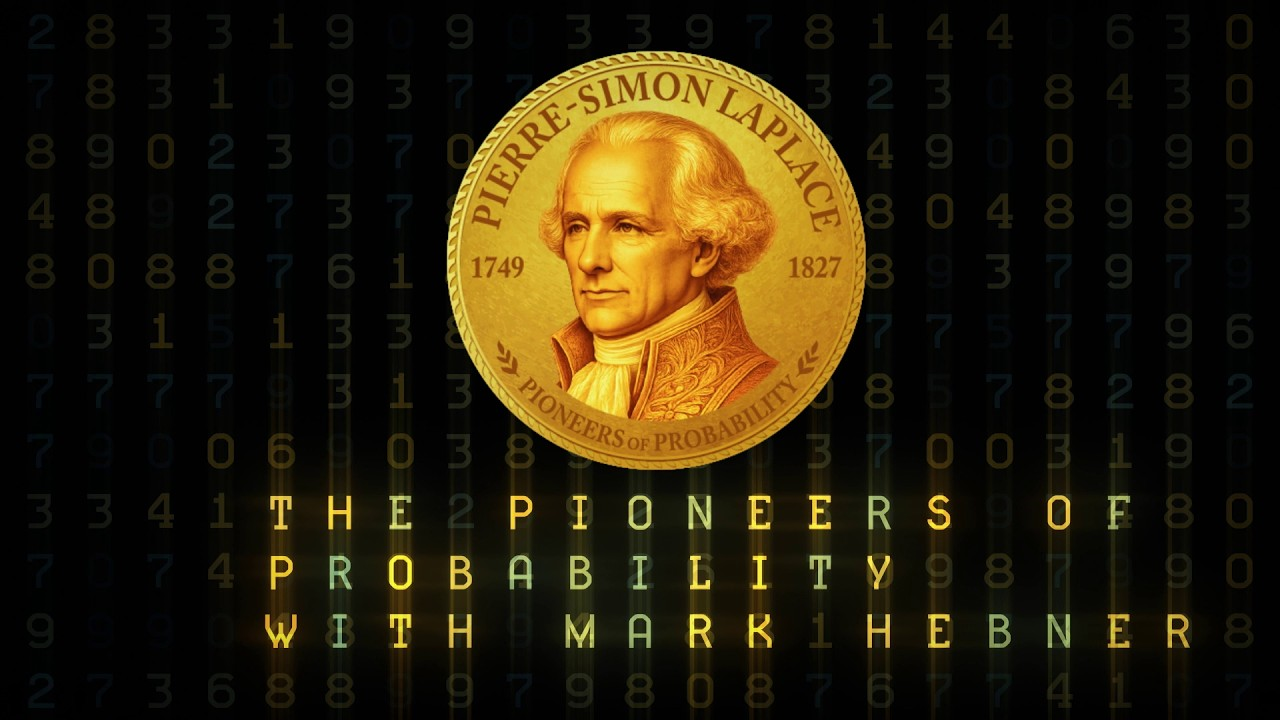
Pioneers of Probability: Pierre-Simon Laplace

Disclosure:
This presentation is provided for educational and informational purposes only and should not be construed as investment, legal, or tax advice. The views expressed are those of the presenter as of the date of recording and are subject to change without notice. References to investment principles, market behavior, or investment strategies are illustrative in nature and are not recommendations to buy, sell, or hold any security. All investing involves risk, including the possible loss of principal. Past performance is not indicative of future results. Content is AI-assisted. Index Fund Advisors, Inc. is a registered investment adviser. For additional information, please visit adviserinfo.sec.gov or www.ifa.com.
By the end of the eighteenth century, probability theory had accumulated a remarkable collection of results.
Cardano had counted outcomes.
Galileo had enumerated arrangements.
Pascal and Fermat had solved the Problem of Points.
Huygens had formalized expected value.
Leibniz had argued for degrees of belief.
Jacob Bernoulli had proved the Law of Large Numbers.
De Moivre had discovered the normal curve.
Bayes had given us the machinery for updating beliefs with evidence.
Each breakthrough was a solution to a specific problem — brilliant, precise, and largely isolated.
What the field did not yet have was a unified foundation. A single coherent framework from which all these results could be derived, extended, and applied.
One man from Paris spent fifty years building it.
Welcome to Pioneers of Probability with me, Mark Hebner.
Pierre-Simon Laplace was born in 1749 in Normandy, the son of a peasant farmer.
He arrived in Paris as a young man with a letter of introduction to the mathematician Jean le Rond d'Alembert
Clip of Jean Le R saying "I was so impressed by him that I immediately arranged a teaching position for him"
« J'fus si impressionné par ses talents que je lui procurai sur-le-champ une chaire d'enseignement. »
Over the next half century, Laplace became the dominant figure in French science — surviving the Revolution,
advising Napoleon, serving as a minister of state, and outlasting every political regime that came and went while his mathematics stood unchanged. Napoleon was even a student of his.
When Napoleon complained that his monumental Mécanique Céleste — Celestial Mechanics, five volumes proving the stability of the solar system — contained no mention of God, Laplace replied:
Laplace clip "I had no need of that hypothesis"
« Je n'avais pas besoin de cette hypothèse. »
He brought the same cool, systematic confidence to probability that he brought to astronomy.
The question he set out to answer was not a specific gambling problem or a legal puzzle. It was the deepest possible question about the field itself.
Laplace clip "What is probability? Not in a specific case. In general. Precisely. Formally. Completely."
« Qu'est-ce que la probabilité ? Non pas dans un cas particulier. En général. Avec précision. Formellement. En totalité. »
The formula on our coin is Laplace's classical definition.
P(k) equals k divided by n. The probability of an event is the number of favorable outcomes divided by the total number of equally likely possible outcomes.
That sounds simple — almost obvious. It isn't. Before Laplace, probability had been defined differently by different mathematicians for different problems. Laplace brought them into a unified and systematic framework
He showed that this single definition, applied rigorously, could unify and systematize much of the existing body of probability theory that had accumulated over the previous two centuries.
The key phrase is equally likely. Laplace was precise about the assumptions underlying his definition — a precision that would matter enormously later.
If outcomes are not equally likely, the formula requires adjustment. Laplace recognized this limitation and helped develop methods for handling it.
Consider nineteenth-century maritime insurance. On paper, a ship crossing the Atlantic faces a binary outcome: it either arrives safely or sinks.
But reality isn't a fair coin toss.
Laplace analyzed decades of shipping logs to adjust the math—weighting the odds against seasonal hurricanes, treacherous routes, and captain experience.
By factoring in past evidence, Laplace transformed raw uncertainty into a practical framework for assessing real-world risk. At the heart of this breakthrough was Laplace's expansion of Thomas Bayes's theorem into what we now call Bayesian-Laplacian inference.
By constantly updating probabilities with fresh data, he applied one unified framework to astonishingly diverse problems—from gauging the reliability of courtroom witnesses to calculating the precise movements of the stars.
He also applied it to something grander. Using his Rule of Succession — a direct application of Bayesian reasoning — he calculated the probability that the sun would rise tomorrow, given that it had risen every day in recorded history. His answer: 1,826,214 to 1. Not certainty. A very large probability, derived from evidence alone, with no appeal to physical law. It was probability reasoning applied not to a dice game but to the cosmos itself.
His Théorie Analytique des Probabilités, published in 1812, was the first comprehensive mathematical treatise on probability.
And his Philosophical Essay on Probabilities — written as a non-mathematical introduction to the same ideas — remains one of the most lucid expositions of probabilistic thinking ever written.
In that essay, Laplace introduced what became known as Laplace's demon — a thought experiment about determinism.
If an intellect could know the position and momentum of every particle in the universe, he wrote, nothing would be uncertain.
Probability, in Laplace's view, was not a property of the world. It was a measure of our ignorance about the world. A rational tool for making decisions when knowledge is incomplete.
That philosophical position — probability as a measure of ignorance rather than a feature of reality — is one of the deepest ideas in the history of science. It is still debated today.
Laplace extended de Moivre's normal approximation, pushing this work toward what would later become the Central Limit Theorem.
He applied probability to astronomy, showing how to estimate the true position of a celestial body from a series of imperfect measurements.
He developed generating functions — an important tool later used widely in probability and statistics.
He also made probability respectable. Before Laplace, probability was associated with gambling, legal disputes, and philosophical puzzles. After Laplace, it was a branch of mathematics as rigorous as calculus — with formal definitions, proved theorems, and systematic methods of application.
Every field that uses statistics today — medicine, economics, physics, engineering, social science — builds on foundations that Laplace helped establish.
The analytical foundations of probability: that is what the rim of our coin says. It is a fair characterization.
For investors, Laplace's classical definition carries a direct and important implication today.
P(k) equals k over n — favorable outcomes over possible outcomes — only works when all outcomes are equally likely.
The moment outcomes have different probabilities, or the moment you don't know the probabilities in advance, you need more than the classical definition.
You need estimation, updating, and inference —
the tools Laplace himself developed to go beyond the simple formula.
Markets are not dice. The possible outcomes of a portfolio over ten years are not equally likely. The probability that a given stock will outperform is not simply one in two.
Anyone who reasons about investment decisions as though markets were a simple k-over-n problem — as though all scenarios were equally probable — is using a tool that Laplace himself recognized was limited.
What Laplace actually advocated was something more demanding:
combine everything you know, estimate probabilities as carefully as the evidence allows, update those estimates as new data arrives, and maintain rigorous humility about the limits of your knowledge. Rassemblez toutes vos connaissances, estimez les probabilités au plus près des faits, ajustez-les avec chaque nouvelle donnée et restez rigoureusement humble face aux limites de votre savoir.
His demon knew everything. We know very little. Probability is the tool we use to reason carefully in the gap between the two.
An investor who applies that general discipline— who quantifies uncertainty rather than ignores it, who updates beliefs with evidence rather than defending them against it,
We are twelve steps into an 800-year story. Six more to go!













 Home
Home 888-643-3133
 Contact Us
 Newsletter Subscribe
 eMoney
 IFA Apps
 Index Funds Book on Kindle
 Index Funds Audiobook
 Careers
 Facebook
 X
X LinkedIn
 Instagram
 Youtube
 Terms
Terms Index Descriptions