 Risk Capacity
 Wealth Management
 Outsourced CIO
 Retirement Plans
 Institutional
 Financial
  Open an Account
 IFA App

 Articles
 Charts
 Investor Education ▾
 Fund
Fund
 Store
Store

 Taxes
Taxes Back-testing Disclosures
 Glossary
 Form CRS
Pioneers of Probability: Pierre de Fermat
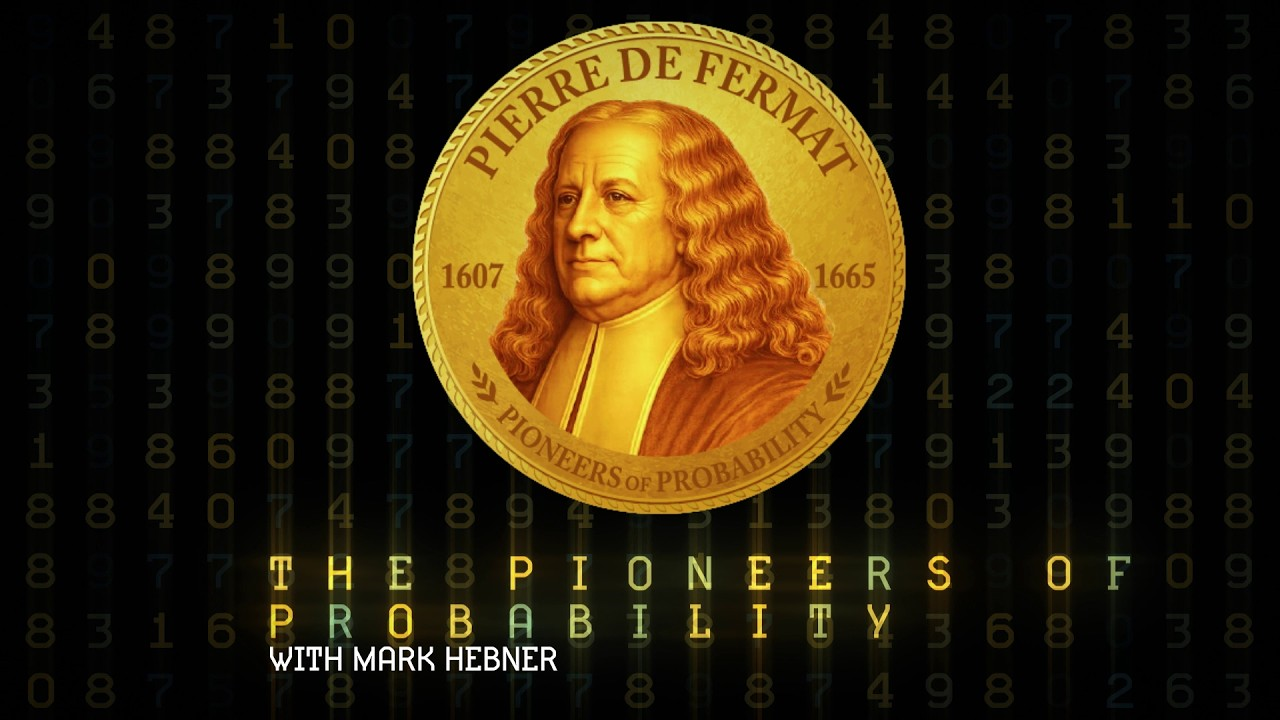

It's the summer of 1654. Two mathematicians in France are exchanging letters about a gambling problem.
One is Blaise Pascal — young, brilliant, already famous. The other is Pierre de Fermat — a magistrate in Toulouse, a lawyer by profession, a mathematician by pure obsession. He holds no university position. He publishes almost nothing. Mathematics is, technically, his hobby.
Together, over a handful of letters written that summer, they will lay the foundations for a new branch of science.
You may know Fermat's name from a different story — the margin note he left in a copy of Arithmetica, claiming a proof he never wrote down, that kept mathematicians searching for 350 years. That story is real. But it isn't this one.
This one is about a question that had frustrated gamblers, merchants, and mathematicians for centuries before Fermat sat down to answer it.
Welcome to Pioneers of Probability.
The problem is called the Problem of Points — and it is deceptively simple.
Two players are gambling. The game is fair — each has an equal chance of winning each round. They agree to play until one of them wins a set number of points. Then, for whatever reason, they have to stop early. Let's imagine the score is 9-1 and the winning score is 10.
How do you divide the pot?
It sounds like an accounting question. It isn't. It's a question about the future — about how to put a number on something that hasn't happened yet. And for centuries, no satisfactory solution existed.
The standard attempts divided the pot based on what had already happened — points scored so far, rounds played, lead at the time of stopping. Luca Pacioli, an influential Renaissance mathematician, proposed exactly this in 1494. It seems fair. It is wrong. At a score of 9-1, that would give the leading player 90% of the pot. But what if the winning score was 50? That would seem very unfair with so many points left to play. So, Cardano, who we met in part 2 of this series, devised a ‘remaining points ratio' in 1539 that would give the leading player about 59% of the pot.
However, Cardano's method does not account for all future possibilities.
Fermat saw this clearly. And he found a way to calculate it.
He asked: of all the games that could still be played from this point — every possible sequence of future rounds — how many does each player win?
Fermat's method was exhaustive enumeration. If the game continues for at most N more rounds — where N equals the total wins still needed by both players combined, minus one — then there are exactly 2^N possible sequences of outcomes, each equally likely. Think of each round as a coin flip: heads means player A wins the round; tails means player B does. Every possible future is one path through those N coin flips.
The formula on the coin states this precisely: P of A equals one divided by 2 to the N, multiplied by the sum of the binomial coefficients (N,k) for k running from a to N — where a is the number of wins player A still needs.
This modern version of the formula looks silent — no plus signs, no multiplication crosses. That's because the symbols themselves are the engines. The Sigma is a hidden plus sign that runs as many times as needed, and a shorthand way of counting every possible path through the future.
In plain language: count every sequence of N coin flips where player A wins at least a of them. That count, divided by the total number of possible sequences 2^N, is the probability that A wins from this point forward. That probability is their fair share of the pot.
Now, if you remember, Luca Pacioli's method would approach a 9-1 score with a simple backward glance, proposing that the stakes be divided in a direct proportion based on the points already won, and would award a 90% share. Cardano's would give 97.8%. Fermat's combinatorial logic, though, reveals a much harsher reality: the leader's true
mathematical probability of winning is a staggering 99.8%, effectively transforming the underdog's "fair share" into a statistical ghost.
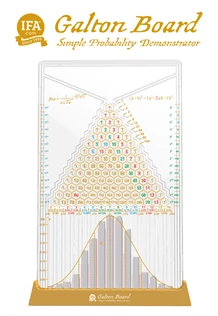
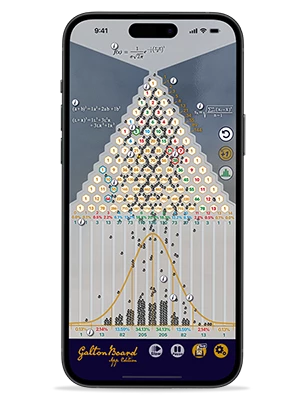
Notice what connects this to the rest of the series. The binomial coefficients in the formula are the same numbers in Pascal's Triangle. The 2^N denominator is the total number of coin flip sequences — the same logic that fills the bins of the Galton Board. Fermat's formula for dividing a gambling pot is built from the same mathematical DNA as every other idea in this series.
It isn't an estimate. It isn't a guess. It is the mathematically exact fair share of an uncertain future, under the model of a fair game.
The pot should be divided not by what has happened, but by what the future probabilistically holds.
That idea — that you can estimate a fair value for an uncertain future outcome — runs through the heart of modern finance.
Many modern pricing models, portfolio frameworks, and risk systems build on the same underlying idea introduced in those letters: that uncertain futures have calculable structure. This is why on our coin we call it the Big Bang of probability theory. Not because Fermat invented mathematics. But because this was the moment someone first showed systematically how to put a precise, defensible number on what hasn't happened yet.
Fermat never published his solution. The letters to Pascal circulated privately. They were printed only after both men had died. But the ideas didn't wait. Within a generation, the framework Fermat and Pascal built in that correspondence had spread across Europe — into insurance, into astronomy, into the first serious attempts to understand mortality and risk. Each thinker who followed them took the same basic question — how do you reason about an uncertain future? — and pushed it one step further.
For investors, the practical lesson is uncomfortable — much like Galileo's insight in the third part of this series.
We instinctively divide our financial futures based on the past — recent returns, recent performance, what the market did last year. We overweight what has already happened and underweight what is probabilistically likely to happen next. Fermat's framework suggests that may be backward. The past is context. The future is what you're buying.
A diversified index strategy is, at its core, a claim about the future — that owning the whole market is intended to capture the broad share of possible economic outcomes, without making a bet on which specific path gets us there. That echoes the logic of the Problem of Points, applied at the portfolio level.
We're four steps into an 800-year story. There are fourteen more to go.
https://www.ifa.com/coins#pioneers
Connect with an Advisor now!
Sources
David, F. N. (1962). Games, gods and gambling: The origins and history of probability and statistical ideas. Charles Griffin.
Devlin, K. (2008). The unfinished game: Pascal, Fermat, and the seventeenth-century letter that made the world modern. Basic Books.
DISCLOSURES:
This video is for informational and educational purposes only and does not constitute a solicitation or recommendation to buy or sell any security.
The historical and mathematical concepts discussed are intended to illustrate the development of probability theory and its relevance to investing. Past performance is not indicative of future results. All investing involves risk, including the possible loss of principal. Indices and fund performance figures referenced are for illustrative purposes only and do not reflect the performance of any actual client account.
The Morningstar Mind the Gap data cited reflects the estimated gap between dollar-weighted investor returns and time-weighted fund returns for US mutual funds and ETFs over the 10-year period ending December 31, 2024.
Content is AI-assisted.
Index Fund Advisors, Inc. is a registered investment adviser. For additional information, please visit adviserinfo.sec.gov or www.ifa.com.








 Home
Home 888-643-3133
 Contact Us
 Newsletter Subscribe
 eMoney
 IFA Apps
 Index Funds Book on Kindle
 Index Funds Audiobook
 Careers
 Facebook
 X
X LinkedIn
 Instagram
 Youtube
 Terms
Terms Index Descriptions