
 Risk Capacity
 Wealth Management
 Outsourced CIO
 Retirement Plans
 Institutional
 Financial
  Open an Account
 IFA App

 Articles
 Charts
 Investor Education ▾
 Fund
Fund
 Store
Store

 Taxes
Taxes Back-testing Disclosures
 Glossary
 Form CRS
Pioneers of Probability: Jacob Bernoulli
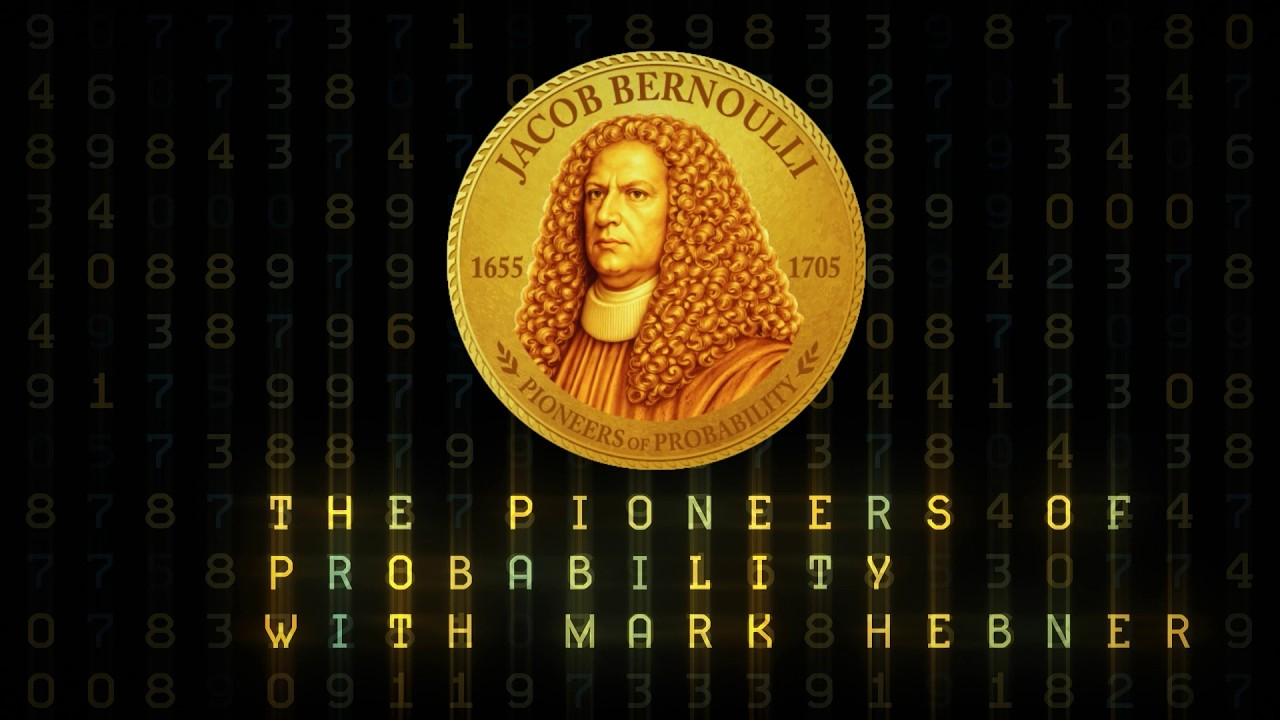

Flip a coin. Heads or tails? You know going in that the odds of heads is one and two. In episode two, Cardano would have told you that. In three, Galileo would have counted it. In four and five, Pascal and Fermat would have used it to divide a gambling pot. In six, Huygens would have calculated your expected winnings. But here's a different question, one nobody had thought to ask formally until a Swiss mathematician did.
Welcome to the pioneers of probability with me, Mark Hebner.
The Bernoulli family is one of the most remarkable dynasties in the history of mathematics. Jacob was the eldest of the brothers who made the family famous. His brother Johann was equally brilliant. The two of them feuded bitterly for much of their lives, competing over priority, prestige, and problems. and Jacob's nephew Daniel will appear later in this series extending the family's contributions into economics and utility theory. But Jacob was first and the question he spent his career answering was in some ways the most important one in the whole story we are telling.
Everything built before Bernoulli started from a known probability, a fair die, a fair coin, a fair game. The mathematics was about calculating what follows from that starting point. But the real world almost never gives you the starting point. You don't know whether a coin is fair until you flip it many times. You don't know the true return of the stock market until you observe it across many years. You don't know whether a medical treatment works until you run many trials. Let the virtue of the stone cleanse the poison.
In the real world, probability is not given. It is estimated from data with uncertainty. In 1689, using a metaphorical urn filled with an unknown amount of black and white pebbles, Jacob Bernoulli was the first to rigorously prove a law showing that this estimation can be reliable. He showed repetition really does reveal truth.
He called it the golden theorem. We call it the law of large numbers.
The foundation is what we now call the Bernoulli distribution shown on our coin.
The simplest probability model imaginable. A single trial, two outcomes. Success with probability P, failure with probability 1 minus P. A coin flip, a market day, any binary event anywhere in the world can often be modeled as a Bernoulli trial. Stack enough of them together and something profound happens. The law of large numbers says the fraction of successes will converge toward P. It may fluctuate in the short run, but over time those deviations become smaller and less frequent with the probability of a large deviation shrinking toward zero as the number of trials grows. Bernoulli proved this not as an approximation, as a theorem.
Mathematically, provably with increasing reliability and in proving it he established something deeper than a formula. He showed that probability is not just something we assume. It is something we can measure. Frequency becomes a powerful source of knowledge.
He worked on the proof for 20 years. His master work Ars Conjectandi, The Art of Conjecturing, was unfinished when he died in 1705. It sat in manuscript for eight more years before his nephew Nicolaus finally published it in 1713.
By this point in the series, postumous publication has almost become a tradition.
The law of large numbers once published changed everything. It provided the rigorous mathematical bridge between the theoretical world of known probabilities and the practical world of observed data. It told scientists, physicians, insurers, and eventually investors something they desperately needed to hear. You can trust the pattern that emerges from enough repetitions. The noise is real, but it is temporary. The signal is also real, and given enough time, it becomes clearer. Bernoulli's theorem also quietly resolved a tension that had run through this series since Leibniz.
Bernoulli showed that belief and frequency are connected. That if you observe enough trials, your rational degree of belief converges to the true probability. The philosophical and the mathematical were in the end pointing at the same thing.
Bernoulli's work didn't just stay in the history books. It's one of the principles that informs how we approach building wealth today.
For investors, the law of large numbers is more than a metaphor. It's a framework that helps inform why long-term passive investing has tended to work over time — though past patterns are no guarantee of future results. Think of each trading day as a trial. Not perfectly binary, not perfectly independent, but close enough that the underlying logic holds. In the short run, the noise overwhelms the signal.
Returns in any given year are nearly impossible to predict. Active managers who beat the market one year may do so by luck alone, but the long run is different across decades across thousands of trading days.
Bernoulli's logic offers one way to think about why staying invested may matter over time. The noise begins to average out and the underlying signal becomes clearer.
The longer you hold, the more trials you accumulate and the more likely long run outcomes are to move closer to underlying expectations, though individual results will still vary.
This is why the time horizon may be as much a mathematical consideration for investors as a practical one.
The investor who panics and sells in a downturn is in Bernoulli's terms stopping the experiment before the law of large numbers has had time to operate. Concluding from too few trials that the coin is unfair and walking away just as the pattern was about to reveal itself. Repetition reveals truth.
That is the rim of our coin. And it is the lesson of this episode. Not patience as a virtue. Patience as a mathematical strategy. one with a proof behind it written by a man in Basel who spent 20 years making sure it was airtight. We're eight steps into an 800year story. There are 10 more to go.
https://www.ifa.com/coins#pioneers
Connect with an Advisor now!
Disclosure:
This video is for informational and educational purposes only and does not constitute a solicitation or recommendation to buy or sell any security. The historical and mathematical concepts discussed are intended to illustrate the development of probability theory and its relevance to investing. Past performance is not indicative of future results. All investing involves risk, including the possible loss of principal. Content is AI-assisted. Index Fund Advisors, Inc. is a registered investment adviser. For additional information, please visit adviserinfo.sec.gov or www.ifa.com.












 Home
Home 888-643-3133
 Contact Us
 Newsletter Subscribe
 eMoney
 IFA Apps
 Index Funds Book on Kindle
 Index Funds Audiobook
 Careers
 Facebook
 X
X LinkedIn
 Instagram
 Youtube
 Terms
Terms Index Descriptions