
 Risk Capacity
 Wealth Management
 Outsourced CIO
 Retirement Plans
 Institutional
 Financial
  Open an Account
 IFA App

 Articles
 Charts
 Investor Education ▾
 Fund
Fund
 Store
Store

 Taxes
Taxes Back-testing Disclosures
 Glossary
 Form CRS
Pioneers of Probability: Galileo Galilei
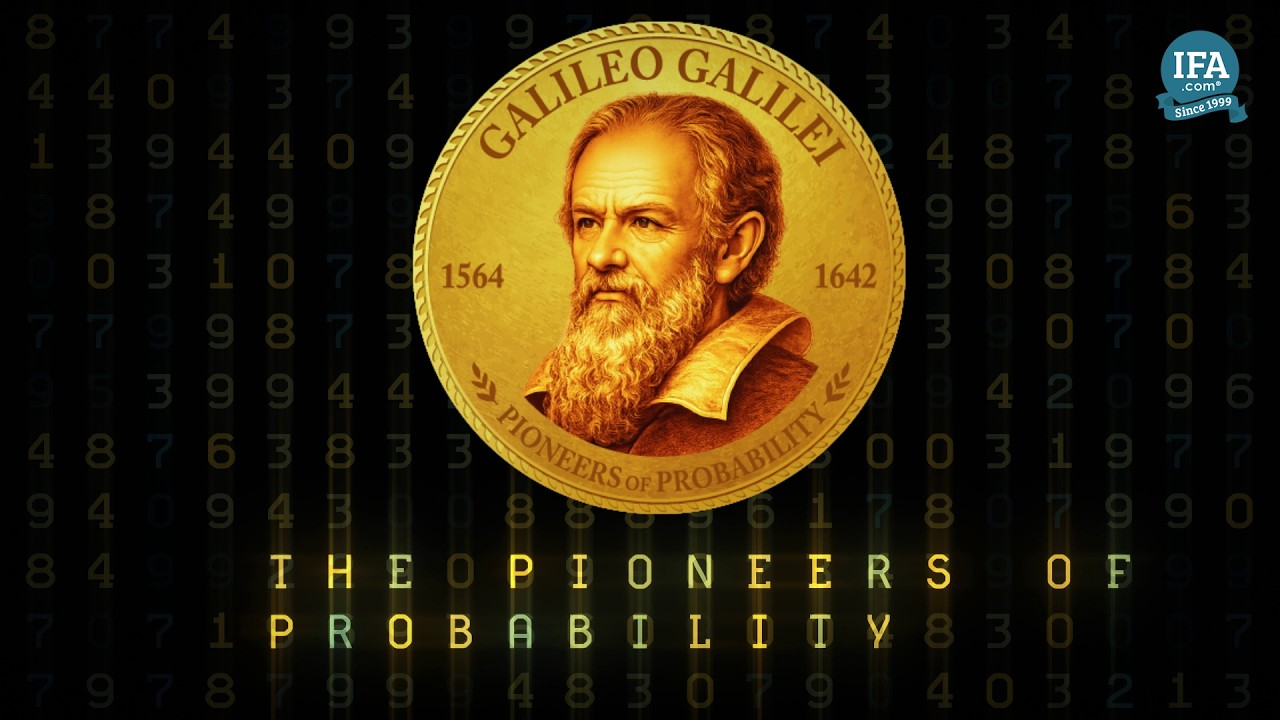

It's Florence, around 1620. The grand duke's courtiers are arguing — again — about dice.
Specifically, why a total of ten seems to come up more often than a total of nine.
It makes no sense to them. Both totals can be made from exactly six combinations of three numbers. Six and six. Equal. So why does ten keep winning?
They bring the question to the one of the most renowned thinkers in all of Italy — Galileo Galilei. Yes, that Galileo. The one with the telescope. But today he's not looking at the stars. He's looking at dice. And what he finds will reveal something uncomfortable about the way all of us think about chance.
Welcome to Pioneers of Probability.
Before Galileo, people judged odds by instinct. They played, they watched, they developed hunches. Experienced gamblers noticed patterns — ten beats nine over thousands of throws — but they couldn't explain why. The numbers looked equal. Their experience said otherwise. And without a method to settle the question, argument was all they had.
The problem wasn't the dice. It was the assumption that equal combinations mean equal chances. Nobody had thought to count every single way three dice can actually land.
Galileo did.
Three dice, six faces each. That gives you 216 possible outcomes — six times six times six. Every single one equally likely.
Now, both nine and ten can be assembled from six groups of three numbers. Take nine: you can make it with 1-2-6, 1-3-5, 1-4-4, 2-2-5, 2-3-4, and 3-3-3. Six groups. Ten has six groups too. Looks perfectly equal.
But here's where intuition breaks down. A group like 1-2-6, where all three numbers differ, can be arranged six different ways across the three dice. A group like 1-4-4, with a repeated number, only three ways. And 3-3-3? Just one.
When you count every arrangement, nine has 25 ways to land. Ten has 27. That tiny gap — two chances in 216 — is invisible in ten throws. But over a thousand? The gamblers were right. Ten really does come up more often. Not by much. But reliably.
Galileo recorded every one of those 216 outcomes — among the earliest complete enumerations of a three-dice probability space. The logic was airtight. No theory, no approximation. Just exhaustive, careful counting.
His short paper, known today as Sopra le Scoperte dei Dadi, was never published in his lifetime. It circulated quietly among the Medici court and was only printed decades after his death. But the method endured — because the method was the message. Don't trust your gut. Count.
Galileo showed that intuition fails — that you need a system to replace it. Forty years later, in Paris, Pascal and Fermat would build: a rigorous, formal mathematics of chance that could calculate what instinct could only guess at.
But Galileo's lesson wasn't really about dice. It was about the gap between what we feel is happening and what's actually happening — and that gap continues to affect investor outcomes today.
Morningstar's annual Mind the Gap study reported
that over the decade ending in 2024, the average dollar invested in US funds earned 1.2 percentage points less per year than the funds themselves returned. Not because of bad funds. Not primarily because of fees. Because of timing — buying after rallies, selling after drops, trusting gut over evidence.
Over ten years, that 1.2 percent annual drag compounds into something significant. Investors captured roughly 85 percent of what a simple buy-and-hold strategy would have delivered. The funds did the work. The investors got in their own way — making the same intuitive errors Galileo identified four centuries ago.
Galileo would have recognized the problem instantly. The gamblers of Florence thought they understood the odds. They didn't. Many investors today exhibit similar behavior — overriding evidence with instinct, chasing what feels right instead of what the numbers show.
Three dice, 216 outcomes, and a truth that hasn't changed in four hundred years: if you want to know the odds, don't guess. Count.
Galileo proved that the gap between intuition and reality is real, measurable, and consequential. The next question was whether mathematics could do more than count — whether it could predict. That question fell to two men exchanging letters in the summer of 1654.
We're three steps into an 800-year story. There are fifteen more to go.
https://www.ifa.com/coins#pioneers
DISCLOSURES:
This video is for informational and educational purposes only and does not constitute a solicitation or recommendation to buy or sell any security.
The historical and mathematical concepts discussed are intended to illustrate the development of probability theory and its relevance to investing. Past performance is not indicative of future results. All investing involves risk, including the possible loss of principal. Indices and fund performance figures referenced are for illustrative purposes only and do not reflect the performance of any actual client account.
The Morningstar Mind the Gap data cited reflects the estimated gap between dollar-weighted investor returns and time-weighted fund returns for US mutual funds and ETFs over the 10-year period ending December 31, 2024.
Content is AI-assisted.
Index Fund Advisors, Inc. is a registered investment adviser. For additional information, please visit adviserinfo.sec.gov or www.ifa.com.












 Home
Home 888-643-3133
 Contact Us
 Newsletter Subscribe
 eMoney
 IFA Apps
 Index Funds Book on Kindle
 Index Funds Audiobook
 Careers
 Facebook
 X
X LinkedIn
 Instagram
 Youtube
 Terms
Terms Index Descriptions