
 Risk Capacity
 Wealth Management
 Outsourced CIO
 Retirement Plans
 Institutional
 Financial
  Open an Account
 IFA App

 Articles
 Charts
 Investor Education ▾
 Fund
Fund
 Store
Store

 Taxes
Taxes Back-testing Disclosures
 Glossary
 Form CRS
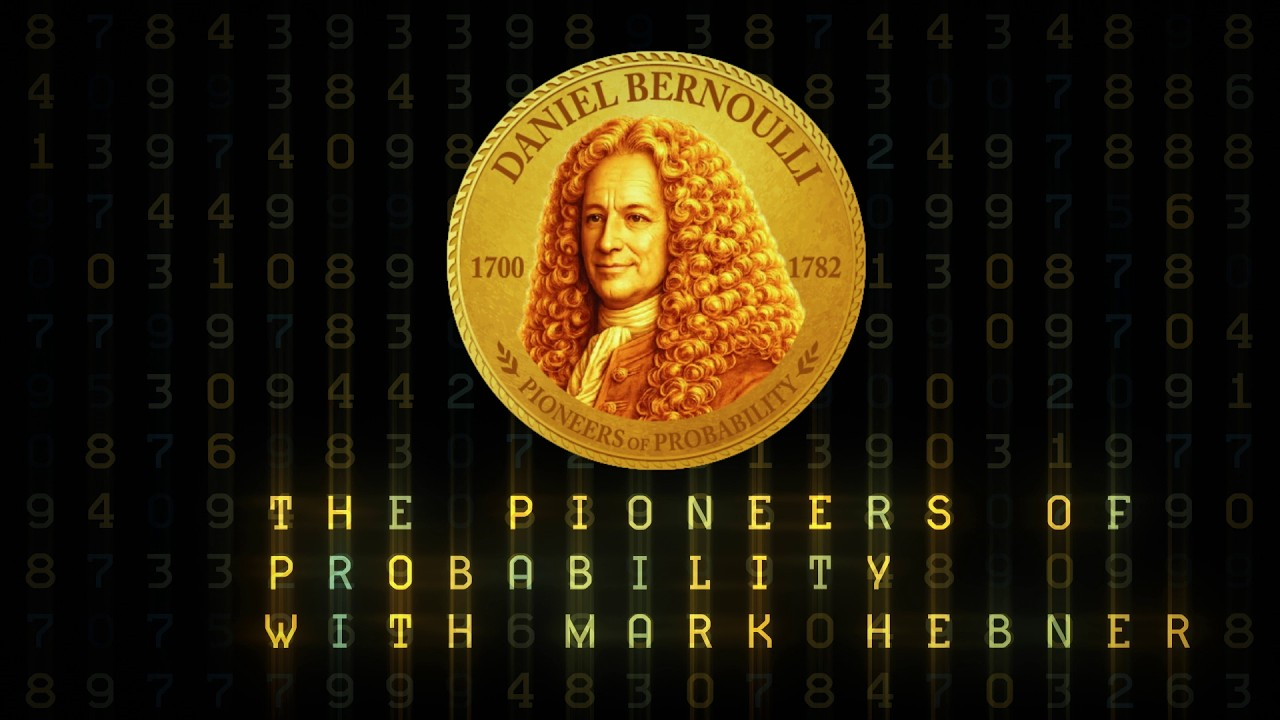
Pioneers of Probability: Daniel Bernoulli

Here is a game. We flip a fair coin, repeatedly, until it lands tails.
If tails appears on the first flip, you win two dollars. If it first appears on the second flip, four dollars. The third, eight dollars. Each additional flip doubles the prize
To play this game, you have to pay a fee upfront: Your stake.
How much would you pay to play?
Take a moment. Think about it.
The expected value of this game — the probability-weighted average of all possible payouts — is infinite. Literally infinite. By the logic of every probability theorist from Huygens to de Moivre, you should be willing to pay any finite sum to play a game with an infinite expected return.
Would you pay a thousand dollars? Ten thousand? Everything you own?
Almost nobody would. And that gap — between what the mathematics said you should do and what every rational person actually does —
was one of the most important puzzles in probability theory for the first half of the eighteenth century, until Daniel Bernoulli found the answer.
Welcome to Pioneers of Probability with me, Mark Hebner.
Daniel Bernoulli worked here as a chair in mathematics at the Imperial Academy of Sciences in St Petersburg from 1725 to 1733.
The puzzle was originally posed in 1713 by Nicolaus Bernoulli — Daniel's cousin — in a letter to the French mathematician Pierre Rémond de Montmort.
It became known as the St. Petersburg Paradox because Daniel's famous solution appeared in the proceedings of the Academy in 1738, 7 years after submitting a paper whose title announced exactly what he intended to do: Specimen Theoriae Novae de Mensura Sortis — an exposition of a new theory on the measurement of risk.
Daniel was the nephew of Jacob Bernoulli, whose Law of Large Numbers we explored two episodes ago. Jacob had proved that probability could be measured from observed data. Daniel asked:
"What should a rational person do with those probabilities once they had them."
His answer upended everything.
The problem with the St. Petersburg game, is not the mathematics. The mathematics of expected value are correct.
The problem is the assumption that people value money linearly — that a hundred dollars is always worth exactly twice as much as fifty dollars, regardless of how much you already have.
That assumption, he showed, is simply false.
Imagine you have nothing. Someone gives you a thousand dollars. That thousand dollars is transformative — it changes your life, your security, your options.
Now imagine you already have a million dollars.
Someone gives you another thousand. It is welcome. But it does not change your life. The same amount of money has a completely different value depending on your starting point.
This is diminishing marginal utility. The more wealth you have, the less each additional unit of it matters to you.
If utility diminishes as wealth grows, then a natural and mathematically convenient function to describe it is logarithmic.
u(w) equals the natural logarithm of w.
That is the formula on our coin. When you replace the dollar amounts in the St. Petersburg game with their logarithmic utilities and recalculate, the infinite expected value collapses into a finite number. The game is worth something — but not an infinite amount. The mathematics now matches what people actually do.
The implications reached further still. A gamble that offers a fifty percent chance of doubling your wealth and a fifty percent chance of losing it all has an expected net gain of zero — but an expected utility that is deeply negative.
Losing everything destroys far more utility than doubling your wealth creates. The same arithmetic that resolves the paradox also explains why ruin is categorically different from merely bad outcomes. You cannot average your way through bankruptcy.
Logarithmic utility captures that asymmetry clearly. And with it, Daniel Bernoulli gave risk a formal role in decision-making — making variability matter mathematically, through the curvature of utility itself. Not just the average outcome. The shape of the outcomes around that average.
Bernoulli was among the first to clearly separate two things that had been conflated since Cardano, who we met in episode 2:
The probability of an outcome and the value of that outcome to a specific person.
Those are different quantities. They interact — but they are not the same. And once you separate them, you open an entirely new field: the economics of decision-making under uncertainty.
The Kelly criterion — used by professional gamblers and quantitative traders to determine optimal bet sizing — is a direct application of expected log utility maximization.
Mean-variance optimization,
The framework Harry Markowitz built in 1952, can be understood through a modern lens as an approximation of expected log utility for small risks.
The mathematical kinship is real, and a long literature has explored it. In 2002, two hundred and sixty four years after Bernoulli, psychologist Daniel Kahneman would win the Nobel Prize in Economics for mapping exactly how and where human utility judgments deviate from the logarithmic model.
Behavioral economics has roots in a question Bernoulli asked in St. Petersburg in 1738.
So, how does this affect your money today?
In modern portfolio terms, Bernoulli's logic is direct and demanding.
A rational investor maximizing expected log utility will generally prefer broader diversification when it reduces uncompensated risk — because diversification can reduce variance without necessarily reducing the expected log return.
Concentrated bets in individual stocks can introduce the kind of variance that may erode expected utility without improving expected return.
The investor who holds the whole market can reduce most uncompensated, idiosyncratic risk — keeping the market exposure that has historically earned a return while shedding the stock-specific exposure that has not.
That is not a slogan. It is consistent with the logic Bernoulli introduced in 1738 — a logic that modern finance has continued to develop.
The Kelly criterion says: size your bets to maximize the long-run growth rate of your wealth. Modern portfolio theory says: minimize variance for a given expected return. Index investing suggests: own broadly, cost-efficiently, and hold. All three are closely related ideas expressed in different languages —
The language Daniel Bernoulli first spoke when he replaced a linear ruler with a logarithmic one and showed that how much you have always shapes how much more you need.
We are ten steps into an 800-year story. Eight more to go.
https://www.ifa.com/coins#pioneers
Connect with an Advisor now!
Sources
Bernoulli, D. (1954). Exposition of a new theory on the measurement of risk. Econometrica, 22(1), 23–36. (Original work published 1738 as Specimen theoriae novae de mensura sortis) Stigler, S. M. (1986). The history of statistics: The measurement of uncertainty before 1900. Harvard University Press.
Disclosure:
This video is for informational and educational purposes only and does not constitute a solicitation or recommendation to buy or sell any security. References to diversification and index investing reflect IFA's general investment philosophy and are not a personalized recommendation for any individual investor. The historical and mathematical concepts discussed are intended to illustrate the development of probability theory and its relevance to investing. Past performance is not indicative of future results. All investing involves risk, including the possible loss of principal. Content is AI-assisted. Index Fund Advisors, Inc. is a registered investment adviser. For additional information, please visit adviserinfo.sec.gov or www.ifa.com.
















 Home
Home 888-643-3133
 Contact Us
 Newsletter Subscribe
 eMoney
 IFA Apps
 Index Funds Book on Kindle
 Index Funds Audiobook
 Careers
 Facebook
 X
X LinkedIn
 Instagram
 Youtube
 Terms
Terms Index Descriptions