
 Risk Capacity
 Wealth Management
 Outsourced CIO
 Retirement Plans
 Institutional
 Financial
  Open an Account
 IFA App

 Articles
 Charts
 Investor Education ▾
 Fund
Fund
 Store
Store

 Taxes
Taxes Back-testing Disclosures
 Glossary
 Form CRS
Pioneers of Probability: Carl Friedrich Gauss

Disclosure:
This video is for informational and educational purposes only and does not constitute a solicitation or recommendation to buy or sell any security. The historical and mathematical concepts discussed are intended to illustrate the development of probability theory and its relevance to investing. Past performance is not indicative of future results. All investing involves risk, including the possible loss of principal. Content is AI-assisted. Index Fund Advisors, Inc. is a registered investment adviser. For additional information, please visit adviserinfo.sec.gov or www.ifa.com.
In the last episode, Legendre gave science its most powerful practical tool for fitting models to noisy data. He showed how to find the line — the function — that minimizes the sum of squared errors. He proved it worked. But he did not fully explain why it was the right method rather than simply a convenient one.
Why squares? Why not absolute values? Why not cubes? Why is minimizing the sum of squared errors the optimal strategy rather than just the simplest?
The answer required understanding something deeper about the nature of measurement error itself. It required asking: if you measure the same quantity many times and get slightly different results each time, what does that pattern of errors actually look like? What is its shape?
A young German mathematician named Carl Friedrich Gauss had been thinking about exactly this problem since his early twenties. And the answer he found connected two of the most important ideas in the history of statistics into a single, elegant theorem.
Welcome to Pioneers of Probability.
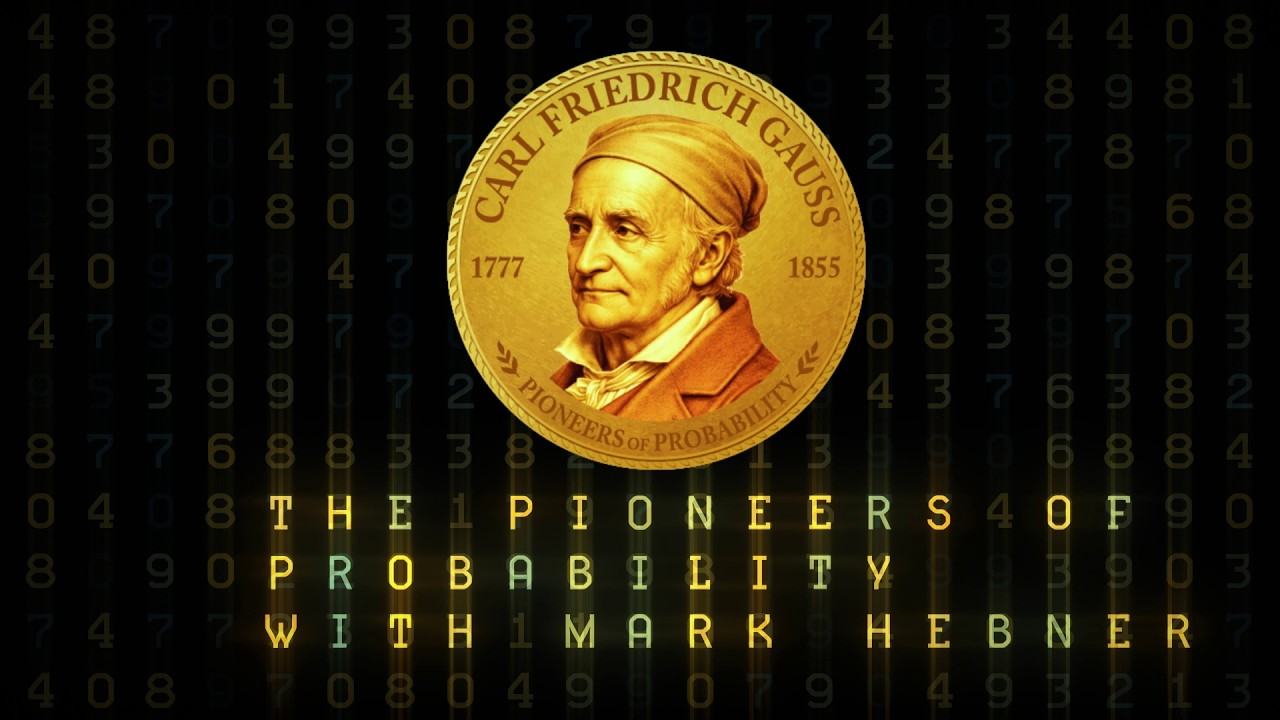
Carl Friedrich Gauss was born in 1777 in Brunswick, Germany, the son of a bricklayer. His mathematical gifts were apparent almost from infancy. The stories are famous: as a young schoolboy, asked by his teacher to sum all the integers from 1 to 100, he produced the answer almost instantly — recognizing that the numbers form 50 pairs each summing to 101, giving 5,050.
By his early twenties he had made fundamental contributions to number theory, proved the fundamental theorem of algebra, and constructed a regular 17-sided polygon using only compass and straightedge. He was, by any measure, the greatest mathematician of his era.
And yet one of his most consequential contributions came not from pure mathematics but from a practical problem in astronomy — the same problem that was preoccupying Legendre at almost exactly the same time. Given a series of imperfect measurements, what is the best estimate of the true value?
Gauss had been working on these questions since at least 1795 and had developed the method of least squares without publishing it. When Legendre published in 1805, Gauss claimed priority — a claim that was almost certainly true and that destroyed his relationship with Legendre permanently.
But Gauss's deeper contribution was not the method itself. It was the justification of why the method was optimal — a justification that required him to derive, from carefully chosen assumptions, the mathematical form that measurement errors naturally follow.
Gauss asked a deceptively simple question: what is the probability distribution of measurement errors?
He approached it axiomatically. He assumed that errors are independent of each other, that small errors are more probable than large ones, that positive and negative errors are equally likely, and — crucially — that the arithmetic mean of a set of measurements is the most probable estimate of the true value.
Under these assumptions, he showed that the normal distribution is the natural model for measurement error — the distribution that makes the arithmetic mean the maximum likelihood estimate of the true value.
The formula on the coin is the result:
- $\mu$ (mean): the center of the distribution, the most probable value.
- $\sigma$ (standard deviation): the spread of the distribution, the typical size of an error.
Together they completely characterize the distribution. Every bell curve in the world is described by exactly these two numbers.
And once Gauss had shown that measurement errors are often well-approximated by the normal distribution, the connection to least squares was immediate. If errors follow a normal distribution, least squares corresponds to the maximum likelihood estimate — the method that makes the observed data most probable.
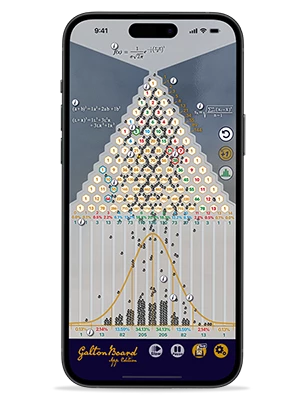
The bell curve with its standard deviation markers tells the whole story: 68 percent of observations fall within one standard deviation of the mean. 95 percent within two. 99.7 percent within three. These are exact results for a normal distribution — and a useful benchmark for understanding real-world data.
Gauss's work did something that no previous contribution had fully accomplished: it gave the normal distribution a theoretical justification. While de Moivre had noticed that the binomial distribution approximated a bell curve as $n$ grew large, Gauss showed that under reasonable assumptions about measurement error, the normal distribution is the natural model across scientific domains.
The implication spread through astronomy, physics, chemistry, biology, and eventually the social sciences. The normal distribution became the default assumption of empirical science, laying groundwork for what would later become the modern Central Limit Theorem.
He continued working until his death in 1855, making contributions to electromagnetism, geodesy, and differential geometry that shaped physics for generations. He published reluctantly and selectively — his private notebooks revealed he had anticipated several major mathematical discoveries years or decades before others published them.
The normal distribution bears his name. It is, in some ways, the most fitting memorial in the history of science: a curve that describes the distribution of error, named for a man who refused to publish until he was sure he had made none.
For investors, the Gaussian normal distribution is simultaneously the most useful and most dangerous concept in quantitative finance.
Useful because it is tractable. A normally distributed return is completely described by two numbers — its mean and its standard deviation. Much of the classical framework of quantitative finance — modern portfolio theory, the capital asset pricing model, Black-Scholes options pricing, value at risk models — is built on the assumption that returns are approximately normal.
Dangerous because financial returns are not perfectly normal. The tails of the actual distribution are fatter than the Gaussian model predicts. Extreme events — crashes, crises, sudden dislocations — happen more often than a normal distribution would suggest. The daily losses observed during the 2008 financial crisis were extremely unlikely under a normal model, yet they occurred on multiple consecutive days.
Every serious risk manager knows this. The normal distribution is a model — a powerful, useful, mathematically tractable approximation to reality. It is right often enough to be indispensable. It is wrong in the tails in ways that can be catastrophic.
Gauss himself understood the limits of models derived from assumptions. For the index investor, the practical implication is clear. Use the normal distribution as a working framework — understand standard deviation, understand the 68-95-99.7 rule, understand what volatility means in Gaussian terms. But never mistake the model for reality. The tails are fatter. The rare events are less rare than the bell curve suggests. Build portfolios that can survive what the normal distribution says should almost never happen.
The bell curve is the shape of uncertainty. Gauss gave it its exact mathematical form. And he was among the first to understand, precisely, what that form could and could not tell you.
We are fourteen steps into an 800-year story. Four more to go.














 Home
Home 888-643-3133
 Contact Us
 Newsletter Subscribe
 eMoney
 IFA Apps
 Index Funds Book on Kindle
 Index Funds Audiobook
 Careers
 Facebook
 X
X LinkedIn
 Instagram
 Youtube
 Terms
Terms Index Descriptions