
 Risk Capacity
 Wealth Management
 Outsourced CIO
 Retirement Plans
 Institutional
 Financial
  Open an Account
 IFA App

 Articles
 Charts
 Investor Education ▾
 Fund
Fund
 Store
Store

 Taxes
Taxes Back-testing Disclosures
 Glossary
 Form CRS
US equity markets delivered strong results in 2025 despite significant volatility and economic uncertainty. The S&P 500 gained about 18%, marking its third consecutive year of double-digit returns, although the path was uneven. Markets experienced sharp swings driven by tariff announcements, interest rate changes, concerns over artificial intelligence valuations, and the longest US government shutdown in history. Even so, US stocks finished the year near record highs, and bonds also posted solid gains.
International markets outperformed the US by a wide margin. Developed international stocks rose nearly 32%, their largest outperformance versus the S&P 500 since 1993, while emerging markets climbed about 34%. Global equities overall gained more than 22%, illustrating how international diversification has historically contributed to returns.
Technology stocks remained influential, with the Nasdaq up roughly 21%, even though some high-profile AI-related companies pulled back from earlier peaks. Investors may not need to concentrate in a handful of mega-cap tech stocks to benefit from AI, as the technology is broadly embedded across many industries. Diversification remains a key way to seek exposure to innovation without excessive concentration risk.
Monetary policy played an important role in market dynamics. The Federal Reserve cut interest rates three times in 2025, totaling 0.75 percentage points, citing labor-market concerns despite persistent inflation pressures. Changes in the Fed's policy rate do not always translate directly to movements in longer-term market rates, such as the 10-year Treasury yield, which ended the year just above 4%. US Treasuries returned over 6%, and the broader US bond market posted its best annual performance since 2020.
Factor performance varied by region. In the US, growth stocks outperformed value, and large caps beat small caps. Outside the US, however, value stocks—especially international small value—were among the strongest performers. While US large-cap stocks have delivered unusually high returns over the past decade, small-cap returns have been closer to their long-term historical averages, supporting the rationale for considering diversification across company sizes and styles.
Gold prices surged more than 50%, surpassing $4,000 per ounce, but we caution that historically, gold has not been a consistent hedge against inflation or economic downturns. Historically, gold prices have shown little consistent relationship with inflation or economic growth.
While 2025 included some of the most volatile periods in recent history, a long-term perspective shows that markets have steadily rewarded patient investors over decades. Focusing too closely on short-term fluctuations can amplify anxiety and lead to poor decisions. Investors who stayed invested through the turbulence of 2025 were well positioned to benefit from the year's strong overall returns.
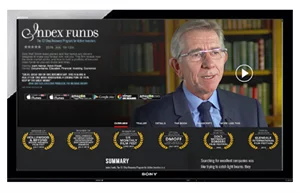
(For a more thorough breakdown, see IFA Founder and CEO Mark Hebner's video below.)
Domestic Equities
All six of IFA's domestic equity indexes posted positive returns for the quarter. Large Value (LV) and Small Value (SV) had the best performance in the fourth quarter with a 4.42%(LV) and a 3.66%(SV) return. Coming in with the third highest return for the quarter was U.S. Large Company with a 2.53% return followed by U.S. Small Company with a return of 2.14%. Rounding out the bottom two were U.S. Large Growth which finished the quarter up 1.77% and U.S. Small Growth which finished with a 1.51% return.
International Equities
International Indexes continued their outperformance as all finished the quarter in positive territory. The IFA International Value Index which ended quarters 1-3 positive posted another positive return of 8.86% for Q4. For the year ending 12/31/25 IFA International Value Index finished up 45.17%. The IFA International Small Cap Value Index returned 7.14% for the quarter and 47.28% for the year followed by the IFA International Small Company Index at 4.53% for the quarter and 37.52% for the year. International Indexes led the way as the best performing asset class. This underscores our commitment to the princple of diversification. While diversification is prudent, it cannot guarantee profits or eliminate losses in markets that have declined, nor does it ensure the best performance of a specific asset class. For more on what a diversified portfolio may include click here.
Emerging Markets Equities
Stocks issued by companies based in developing countries had positive results for the quarter with the majority of IFA's Emerging Market Indexes posting positive returns for Q3. The IFA Emerging Markets Value Index led the way coming in with a 6.75% return followed by the IFA Emerging Markets Index returning 4.46%. The IFA Emerging Markets Small Cap Index came in third wit a -0.93% return for the quarter. Year-to-date as of 12/31/25 all Emerging Market Indexes are up with both the IFA Emerging Markets Index and the IFA Emerging Markets Value Index crossing 30% and the IFA Emerging Markets Small Cap Index returning roughly 20%.
Real Estate Equities
IFA's Global REIT Index ended the quarter down posting a negative return of -1.14%. Year-to-date as of 12/31/25 IFA's Global REIT Index was up 7.65%.
Fixed-Income
For Q4, three of IFA's fixed-income benchmarks all produced returns topping 1%. The IFA Short Term Government Index finished the quarter with a postive 1.04% return. The IFA One-Year Fixed Income Index and the IFA Two-Year Global Fixed Income Index finished up 1.07% and 1.01% respectively. The IFA Five-Year Global Fixed Income Index came in with a return of 0.87%. Year-to-date as of 12/31/25 IFA's Fixed Income Benchmarks are all up over 4%.
IFA Index Portfolios
Fourth quarter 2025 was a strong quarter for all IFA portfolios. For the quarter, our all equity Portfolio 100 returned 3.47% while our portfolio 10 made up of 90% bonds and 10% equity posted a postive 1.07% return. Below is an overview of how several IFA Index Portfolios performed in Q4 as well as during the previous quarter. Full year 2025 returns for all IFA Index portfolios were strong. All of these returns are shown net of IFA's maximum annual 0.90% advisory fee through December 31, 2025.
Each quarter, we monitor our recommended funds for clients. As part of that process, we've developed a rating system. For a summary of those results, please feel free to check IFA's latest Performance Monitoring Report (PMR).
IFA encourages both novice and experienced investors to discuss their financial situation and investment goals with an IFA wealth advisor, tailoring strategies to their personal risk capacity and long-term objectives. Besides offering an online Risk Capacity Survey, we provide to each client a complimentary and holistic financial plan.
The wealth of IFA's educational materials are available for Apple iOS and Android devices via the IFA App. This free App is available to download from both the Apple App Store and the Google Play Store for Android.
Prior performance is not indicative of future results. Investors should review complete performance data over time before making investment decisions.
Footnotes
- Dimensional, Market Review 2025: US Stocks Ride Rocky Road to a Third Straight Year of Gains, Jan, 2026
Disclosure:
Performance results for actual clients investing in accordance with the IFA Index Portfolio Models may differ from backtested data due to factors such as fund implementation, market conditions, cash flows, mutual fund allocations, index changes, rebalancing, deviation from advice, retained securities, tax strategies, fees, and timing of fee deductions.
Diversification is a prudent investment approach, but it does not assure a profit or protect against loss in declining markets, nor does it eliminate all investment risks. Performance data presented is for illustrative purposes, and readers are encouraged to consider longer-term performance horizons, such as one-year, five-year, and ten-year periods, when making investment decisions. Comprehensive performance data, including net-of-fee results for these periods and additional disclosures, is available upon request.
This information is not an offer, solicitation, or recommendation for any security, product, or service. No investment strategy guarantees success, and all investing carries risks, including the potential loss of principal. Performance results may include both live and hypothetical data, which do not represent actual client portfolios and should not be interpreted as indicative of future results.
Hypothetical performance relies on assumptions, including fixed market conditions, periodic rebalancing, and historical data, and does not account for real-world factors such as transaction costs, tax implications, behavioral tendencies, or cash flows, which can affect results. References to diversification, portfolio construction, or market trends are intended for educational purposes and should not be considered prescriptive or guaranteed strategies for success.
The data provided is based on information believed to be accurate as of the date of publication but may change as market conditions evolve. Investors are encouraged to consult with a qualified advisor to assess personal financial goals and risk capacity. Additional information is available by reviewing IFA's ADV Brochure at https://www.adviserinfo.sec.gov/ or visiting www.ifa.com."














 Home
Home 888-643-3133
 Contact Us
 Newsletter Subscribe
 eMoney
 IFA Apps
 Index Funds Book on Kindle
 Index Funds Audiobook
 Careers
 Facebook
 X
X LinkedIn
 Instagram
 Youtube
 Terms
Terms Index Descriptions